
‹ All movies
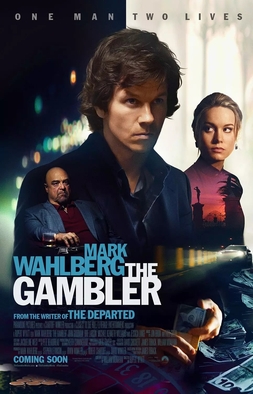
The Gambler poster

The Gambler

111 minutes

Cast

Selected cast credits ·

Mark Wahlberg Jim Bennett
Jessica Lange Roberta
John Goodman Frank
Brie Larson Amy Phillips
Michael Kenneth Williams Neville Baraka

The Gambler | The Rewatchables

Explore episodeClose episode

Producer credits not yet identified.

In the discussion (7)
Approx. transcript time · 00:07:48Read transcript
  • Jon Bernthal is the ideal replacement proposed for the lead.
  • Oscar Isaac, Ethan Hawke and Mark Ruffalo are further possibilities, especially for believable teaching scenes.
  • Jake Gyllenhaal is another appealing replacement, imagined reacting with greater anguish at the roulette loss.
  • Jon Bernthal is reaffirmed as the desired Wahlberg replacement.
  • Oscar Isaac and Ethan Hawke are proposed for a more bookish lead; Isaac is challenged for lacking the unintentional comedy the film needs.
  • Jake Gyllenhaal could supply comic excess, although his intensity and potential weight loss might go too far.
  • Bernthal and Ruffalo are reaffirmed as performers who could deliver the classroom speech more convincingly.

Casting What-Ifs

DiCaprio and Scorsese initially; Todd Phillips briefly

In the discussion (2)
Approx. transcript time · 00:07:48Read transcript
  • Leonardo DiCaprio was reportedly initially attached.
  • The project initially involved Scorsese, DiCaprio and Monahan; Scorsese departed, Todd Phillips briefly followed, and Wyatt and Wahlberg eventually took over.

It’s a Weird One for You

Mark Wahlberg

The panel proposes a new category here.

In the discussion (1)
Approx. transcript time · 00:17:14Read transcript
  • A proposed award would recognize an unusually sideways career choice; Wahlberg’s strange performance here is the example.

Roger Ebert's review

In the discussion (2)
Approx. transcript time · 00:26:13Read transcript
  • RogerEbert.com awarded two stars; Roger Ebert himself had died and did not review this film.
  • An AI-generated prediction suggests two-and-a-half to three stars and imagined praise and objections; it is not an actual Ebert review or rating.

Most Rewatchable Scene

Frank’s financial-independence speech (two choices)

In the discussion (21)
Approx. transcript time · 00:28:21Read transcript
  • The opening launches directly into gambling without lifestyle setup, introducing the underground room and Bennett’s all-or-nothing behavior.
  • The opening blackjack streak builds from ten thousand through repeated doubled bets; refusing to pocket winnings exposes his self-destructive approach.
  • Neville’s high-interest loan and Bennett calling life a losing proposition intensify the sense that he wants to destroy himself.
  • Mr.Lee’s demand for repayment meets Bennett’s literal insistence that this is a gambling establishment.
  • Bennett rejects the dealer’s protection because the point is to escape protection from himself; the new-dealer sequence is particularly enjoyable.
  • Taking the blackjack winnings to roulette and losing on black completes an opening stretch worth repeated viewing, despite the contradictory running money totals.
  • The casino’s ocean view prompts uncertain Venice/Palisades geography before settling tentatively on hillside Palisades.
  • Bennett’s lecture compares literary genius with elite athletic ability and rejects respectable mediocrity, including mutually flattering novelist reviews.
  • The pretentious student trying to impress him is sharply dismissed.
  • Having a future NBA player, national tennis prospect and genius writer in one class is comically remarkable.
  • The tennis player’s shift from winning to understanding the game is praised through Bennett’s IQ-breakpoint remark.
  • Calling the talkative student an NPR host while identifying quiet Amy as the genuine writer makes another strong classroom passage.
  • Frank’s shaved-head introduction diagnoses Bennett’s contradictions and asks whether privilege has really burdened him.
  • Frank demands humiliating self-admission before lending; Bennett refuses to say he is not a man, preserving his insistence that gambling is only a means to an end.
  • Lamar’s knee problem and Bennett’s complaint about teaching indifferent students make their exchange another candidate.
  • The casino trip with Amy begins with an absurd successful double-down on18 and quickly becomes a race to lose everything.
  • Frank’s financial-independence speech argues that a paid home, reliable car and savings create freedom to refuse demands; it is the first explicit favorite.
  • The final confirmation gives Frank’s speech both scene votes.
  • The basketball is considered convincing despite an overly dark arena; Lamar’s game is compared with several NBA players without a single settled analogue.
  • The final roulette bet in another hidden gambling room, with all parties watching, is a strong setup even if a climactic blackjack scene would be preferred.
  • Both final choices agree on Frank’s financial-independence speech.

Picking Nits

Casino scrutiny; craps alternative; athlete timeline; injuries; opponent mismatch; Amy’s writing; Frank’s work; payoff bag; basketball finish and gym

In the discussion (11)
Approx. transcript time · 00:40:50Read transcript
  • Huge casual-table bets should bring multiple pit bosses, spectators and surveillance, rather than being treated like routine play; a defiant camera gesture is missed.
  • Craps is proposed as a more cinematic alternative to blackjack, offering dice, crowds and visual variety.
  • A major basketball prospect needing his senior year to improve draft stock feels outdated.
  • Bennett’s visible injuries understate the severity of his repeated beatings.
  • The announced Michigan opponent becomes the Bulldogs, and a 2014 conference semifinal does not fit USC versus Michigan.
  • The film does not establish what writing Jim has read to conclude Amy is a generational genius.
  • Frank’s continued loan-sharking seems inconsistent with his financial-independence philosophy.
  • Leaving a huge bag of payoff cash in Lamar’s locker is conspicuous and implausible.
  • The basketball finish has neither intentional fouls nor clock management; Lamar’s late shot makes little strategic sense.
  • A final free throw with the spread unresolved would produce a more credible dramatic ending.
  • Lamar’s practice gym looks too small for USC.

The most "year the movie came out" thing

Young Brie Larson; deep supporting casts in crime films

In the discussion (2)
Approx. transcript time · 00:50:23Read transcript
  • Early-career Brie Larson is the most obvious2014 marker.
  • Crime films packed with accomplished actors in brief supporting roles define the period, though examples trace the pattern back through The Departed to True Romance.

What’s Aged the Best?

Gambling reaction; casting; King of Spades; Michael K. Williams; Monahan lines; Koreatown; soundtrack; BMW; literary adaptation; third-person Lamar

In the discussion (11)
Approx. transcript time · 00:52:21Read transcript
  • An attractive woman reacting with dismay to renewed gambling is a reliable movie pleasure, although Amy entered the relationship knowing Bennett was already spiraling.
  • The casting director’s credit signals strong taste and confidence in the ensemble.
  • King of Spades as a phone-contact entry is enjoyed, prompting discussion of insulting real-life contact labels.
  • MichaelK.Williams’s substantial role and scene work are celebrated.
  • Ideas connect across scenes, such as suicidal gambling leading into Camus; Monahan’s observation about a sixth bullet reportedly came from his own literary reading.
  • The electricians line playfully recycles a comparable politicians line from The Departed.
  • Koreatown at night provides instant cinematic atmosphere.
  • The unusual soundtrack and two M83 tracks work even for a listener who is not generally a fan.
  • Questioning how a BMW owner can be unhappy and whether a book was written sincerely are memorable lines.
  • Neville’s dismissive assessment of the novel’s adaptation as an indie is funny.
  • Lamar speaking in the third person and Neville’s crew reacting to the point-shaving game resemble a modern gambling watch-along.

The most GIFable moment

Goodman shaving his head

In the discussion (1)
Approx. transcript time · 00:56:37Read transcript
  • Goodman shaving his head is the main GIF choice; a blackjack-loss reaction is considered but Wahlberg deliberately shows little pain.

The Butch’s Girlfriend Award for the Weakest Link in the Film

Amy’s attraction and casino job; rushed romance; simple gambling

In the discussion (4)
Approx. transcript time · 01:03:10Read transcript
  • JessicaLange is explicitly defended; Amy’s attraction to a self-destructive, discouraging professor is the real weak link.
  • Amy’s work as an underground-casino waitress is unexplained, particularly for a reserved student with no expressed gambling views.
  • The romance seems likely to last only two weeks before Amy tires of his self-pity.
  • The gambling lacks sophisticated strategy or skill: Bennett repeatedly stacks bets toward destruction, although this remains entertaining.

Half-Assed Internet Research

Cut academic rival; expanded Amy role; Kennedy’s final film; shirt colors; weight loss; classroom research; roulette echo; script fidelity

In the discussion (8)
Approx. transcript time · 01:04:01Read transcript
  • A cut academic-adversary character reportedly played by LelandOrser described Bennett as a brilliant professor, which would have explained his appeal.
  • The filmmakers reportedly expanded Amy’s part because they liked the character and sought more places to use her.
  • This was George Kennedy’s last movie.
  • Jim’s shirts become lighter each day, moving from black toward white as he becomes free.
  • Wahlberg reportedly lost 61 pounds, from 198 to 137, to be one pound lighter than for Boogie Nights; he said he would never repeat it.
  • Wahlberg attended college classes to observe professors and their mannerisms.
  • The final roulette result, 22 black, matches The Sting; deliberate reference is suspected but not established.
  • The filmed script reportedly largely preserves Monahan’s writing apart from removed scenes.

What’s Aged the Worst?

Professor–student romance; Wahlberg’s hair; Dexter disputed; Lange’s tennis; pre-NIL athlete; knee and draft timing

In the discussion (6)
Approx. transcript time · 01:06:10Read transcript
  • The romance between a fortyish professor and his twenty- or twenty-one-year-old student has aged poorly, including the ending run to her dorm.
  • Wahlberg’s long, wrapping hairstyle looks like a 1974 hockey player’s and distracts.
  • Emory Cohen’s Dexter divides opinion: the eccentric performance is criticized through a David Arquette comparison, but its oddness is also enjoyed.
  • Jessica Lange’s tennis serve, clothing and conspicuous editing are unconvincing; doubles might have hidden the problem.
  • The broke college athlete belongs to the pre-NIL era; a modern prospect could receive collective money.
  • Lamar’s concealed knee problem seems implausible with modern sports medicine, and a major prospect would likely leave college earlier.

The Stephen A. Smith Hottest Take Award

Center Jim and Lamar; Wahlberg’s actress collaborators; Larson or Theron chemistry

In the discussion (3)
Approx. transcript time · 01:12:23Read transcript
  • Remove the Amy romance and center Jim’s relationship with Lamar, including the ethical conflict of point shaving and the athlete’s exceptional talent.
  • Wahlberg is credited with repeatedly working opposite attractive actresses at notable career moments: Heather Graham, Diane Lane, Charlize Theron, Elizabeth Banks, Kate Mara, Amy Adams, Mila Kunis and Brie Larson.
  • Brie Larson is proposed as Wahlberg’s best chemistry despite the argument for cutting her subplot; Charlize Theron competes.

Apex Mountain

Indoor basketball spectators wearing sunglasses; podcast cereal conversations (joke)

In the discussion (5)
Approx. transcript time · 01:23:11Read transcript
  • Wahlberg, Lange, Larson, blackjack, gambling and Michael K. Williams are rejected.
  • The podcast itself is jokingly deemed Apex Mountain for cereal conversations.
  • Watching basketball indoors in sunglasses is affirmed.
  • Point shaving faces Blue Chips; Omega watches are floated without a settled answer.
  • Cocktail waitresses are tentatively proposed through Larson and the racetrack waitress, then challenged by Swingers.
In the discussion (1)
Approx. transcript time · 01:25:33Read transcript
  • Cruise is the emphatic consensus, ideally around Jerry Maguire or Vanilla Sky.

Probably Unanswerable Questions

Jim’s book; $2.5 million; final run; debt arithmetic; Dexter’s refusal; fix payout

In the discussion (7)
Approx. transcript time · 01:32:36Read transcript
  • What is Jim’s novel Uphill Both Ways about? A working-class story or adult Catcher in the Rye are speculative possibilities.
  • Is $2.5 million really enough for permanent financial independence? Goodman’s unusually specific figure is accepted.
  • How far does Jim run? The apparent long journey may only be about a mile to the Los Altos apartments, with confusing downtown geography.
  • A detailed debt calculation reaches $656,000 owed before the basketball bet, then $350,000 available for roulette after Neville is repaid; winning leaves $700,000 to settle the remaining debts.
  • Dexter declines the offered $50,000; his assumption that tennis will readily supply comparable money is criticized.
  • The roulette win exceeds the debt: Bennett leaves the surplus rather than keeping it, reinforcing his wish to be free.
  • The basketball fix’s overall payout is uncertain; estimates of the participants’ cuts and larger winnings remain speculation.

What Piece of Memorabilia Would You Want From This Movie?

Uphill Both Ways; Jim’s house; sunglasses; duffel; tennis racket

In the discussion (3)
Approx. transcript time · 01:38:02Read transcript
  • The sunglasses, cash duffel and Lange’s tennis racket are offered.
  • Jim’s house is desired, with its exact neighborhood uncertain.
  • The actual Uphill Both Ways novel becomes the favored collectible.

Who Won the Movie?

William Monahan; John Goodman

In the discussion (2)
Approx. transcript time · 01:38:42Read transcript
  • William Monahan is selected because the film is an unusually unfiltered vehicle for his ideas and social riffs.
  • John Goodman receives the other final choice: the movie would fall apart without the quality of his performance.
Podcast choices
Speaker not identified
William Monahan
Speaker not identified
John Goodman

Producer review

Uneven but memorable; committed cast; unintentionally funny lecture

In the discussion (3)
Approx. transcript time · 01:39:16Read transcript
  • The film improves after hearing the discussion; a complimentary Jordan Poole comparison describes inefficient execution with memorable highlights.
  • The talented cast’s wholehearted commitment to an overwritten gambling movie is appreciated.
  • Wahlberg’s lecture becomes unintentionally funny rather than achieving the intended authority, changing how the film plays.

More from the conversation

Carry-On and the Ringer’s television channel form the opening tangent before the film trailer.
Approx. transcript time · 00:02:00Read transcript
The film divided Grantland critics, gained little initial traction and became a cable rediscovery that rewards repeated viewing.
Approx. transcript time · 00:03:44Read transcript
Its gambling, writing and college-basketball interests appeal strongly; it is considered an ideas film built around arguments about how to live.
Approx. transcript time · 00:04:15Read transcript
Dense, mumbled dialogue sometimes benefits from subtitles.
Approx. transcript time · 00:05:30Read transcript
Wahlberg may be ideally strange casting or a limitation; this is viewed as a road not taken before later family and action films.
Approx. transcript time · 00:06:22Read transcript
His earnest literary lectures and unfamiliar haircut create an otherworldly quality, unlike James Caan’s effortless swagger in the original.
Approx. transcript time · 00:08:31Read transcript
Jim Bennett mostly tells the truth even to the people threatening him; selective disclosure about Lamar does not invalidate that pattern.
Approx. transcript time · 00:10:15Read transcript
The central interpretation is self-destruction as a way to rebuild: without an obvious trauma, Bennett rejects ordinary secure happiness in pursuit of an exceptional life.
Approx. transcript time · 00:11:03Read transcript
All-or-nothing blackjack stacking is interpreted as a death wish rather than ordinary gambling; Amy gives Bennett a possible reason to survive.
Approx. transcript time · 00:12:17Read transcript
The classroom speech states the film’s question: if greatness is inaccessible, is it worth trying at all?
Approx. transcript time · 00:13:56Read transcript
William Monahan’s dialogue gives every character a philosophical riff, including loan sharks and the basketball player, creating an appealing alternative reality.
Approx. transcript time · 00:15:18Read transcript
The gambling itself can feel flat, but repeated viewing reveals the value in what Bennett says at the tables.
Approx. transcript time · 00:16:21Read transcript
The film resembles a lesser Thief or Collateral in its Los Angeles atmosphere and synthesizer mood, with Rounders another comparison.
Approx. transcript time · 00:17:34Read transcript
Hidden back rooms and elite criminal spaces create a city within the familiar city, compared with John Wick, Heat, Rounders and Michael Clayton.
Approx. transcript time · 00:18:07Read transcript
Wahlberg’s earlier searching filmography contrasts with the later family-film/action pattern; Boogie Nights remains the favorite, while Ted complicates whether he has a sense of humor.
Approx. transcript time · 00:19:48Read transcript
Remaking the1970s original initially inspired suspicion, but this version is substantially different.
Approx. transcript time · 00:21:35Read transcript
Brie Larson, Michael K. Williams, Goodman, Lange and supporting players repeatedly outshine the star in individual scenes.
Approx. transcript time · 00:22:19Read transcript
Goodman’s brief but forceful supporting turns may now define his legacy more than Roseanne; his lack of an Oscar nomination is checked and lamented.
Approx. transcript time · 00:22:44Read transcript
The Dostoevsky connection is considered loose, while The Stranger and existentialism are clearer thematic influences.
Approx. transcript time · 00:23:43Read transcript
Rupert Wyatt is praised; an alleged Kristen Stewart scandal is explicitly corrected as confusion with Rupert Sanders.
Approx. transcript time · 00:24:10Read transcript
Greig Fraser’s photography makes Los Angeles striking but difficult to map, including the final run’s geography.
Approx. transcript time · 00:24:45Read transcript
Wesley Morris’s harsh review attacks Wahlberg’s inability to convey interiority and the climactic run; whether his opinion changed later is unknown.
Approx. transcript time · 00:25:25Read transcript
The hosts disagree about asking an AI to imitate the deceased Ebert; the generated opinion remains hypothetical.
Approx. transcript time · 00:26:13Read transcript
Seventies remakes and the Condor television adaptation prompt a brief tangent before the sponsored scene segment.
Approx. transcript time · 00:27:14Read transcript
Brie Larson’s earlier supporting stage is contrasted with the fame that followed; the conversation recalls Short Term12 and later films.
Approx. transcript time · 00:35:06Read transcript
The professor resembles a charismatic, disheveled college intellectual who captivates students despite pretension and questionable boundaries.
Approx. transcript time · 00:36:50Read transcript
A remembered overnight casino trip with House and Chang illustrates the thrill and self-sabotage of chasing action after winning.
Approx. transcript time · 00:41:50Read transcript
The loan sharks operate like spiritual tests, offering servitude or a different way to live; Frank’s attachment is unexplained except for possible family history.
Approx. transcript time · 00:45:29Read transcript
Gambling is a vehicle for self-destruction rather than the film’s real subject, closer in that respect to Leaving Las Vegas.
Approx. transcript time · 00:47:43Read transcript
Gerard Butler’s filmography would be sufficient entertainment for a long flight.
Approx. transcript time · 00:48:39Read transcript
Cereal nostalgia contrasts pleasure with health warnings; Cheerios, RiceKrispies, frosted mini-wheats and GoldenGrahams are personal favorites.
Approx. transcript time · 00:58:21Read transcript
Cereal is praised as a quick bridge between snack and meal, with banana and flakes or whole milk preferred in different routines.
Approx. transcript time · 00:59:35Read transcript
College meals, deep bowls and soggy cereal lead to a joking cereal podcast and all-cereal experiment proposal, not health advice.
Approx. transcript time · 01:00:53Read transcript
The discussion distinguishes sugary cereals, childhood mixing and dessert use; a first-name Jack response says his generation still eats cereal.
Approx. transcript time · 01:02:22Read transcript
An anecdote about a classmate involved with a professor prompts skepticism about how such relationships would be viewed now.
Approx. transcript time · 01:05:29Read transcript
Padel and pickleball produce a brief sports tangent, with strong dislike for pickleball.
Approx. transcript time · 01:10:01Read transcript
A Ben Affleck version is floated as an interesting age-appropriate possibility, without claiming he was actually considered.
Approx. transcript time · 01:17:12Read transcript
Dominick Lombardozzi’s career prompts discussion of Entourage, The Wire, Miami Vice and other film appearances.
Approx. transcript time · 01:17:52Read transcript
The best blackjack scene remains unresolved: Rain Man leads, The Hangover imitates it, Casino Royale and California Split involve poker, and 21 is remembered without enthusiasm.
Approx. transcript time · 01:24:04Read transcript
Poker’s strategic hands are considered more naturally dramatic than blackjack, followed by a late-night casino anecdote.
Approx. transcript time · 01:25:19Read transcript
Cruise’s teaching roles prompt a correction: he is an instructor in Top Gun: Maverick.
Approx. transcript time · 01:26:15Read transcript
The recurring better-with roster is audited: Raymond/Ramon, J.T. Walsh and Sid Goldberg are dropped, while Danny Hurley is added for sports films.
Approx. transcript time · 01:30:46Read transcript
The movie is recommended as repeatable Sunday-afternoon cable viewing despite initial reservations.
Approx. transcript time · 01:41:54Read transcript
Focus provides another example of a flawed crime film finding a later audience; sports, gambling and the criminal underworld are especially appealing subjects.
Approx. transcript time · 01:42:22Read transcript
Craig and Jack receive production thanks, without spoken surnames.
Approx. transcript time · 01:42:38Read transcript
The closing plugs the video channels, extends the cereal-podcast joke and previews a Christmas movie.
Approx. transcript time · 01:42:54Read transcript