‹ All movies
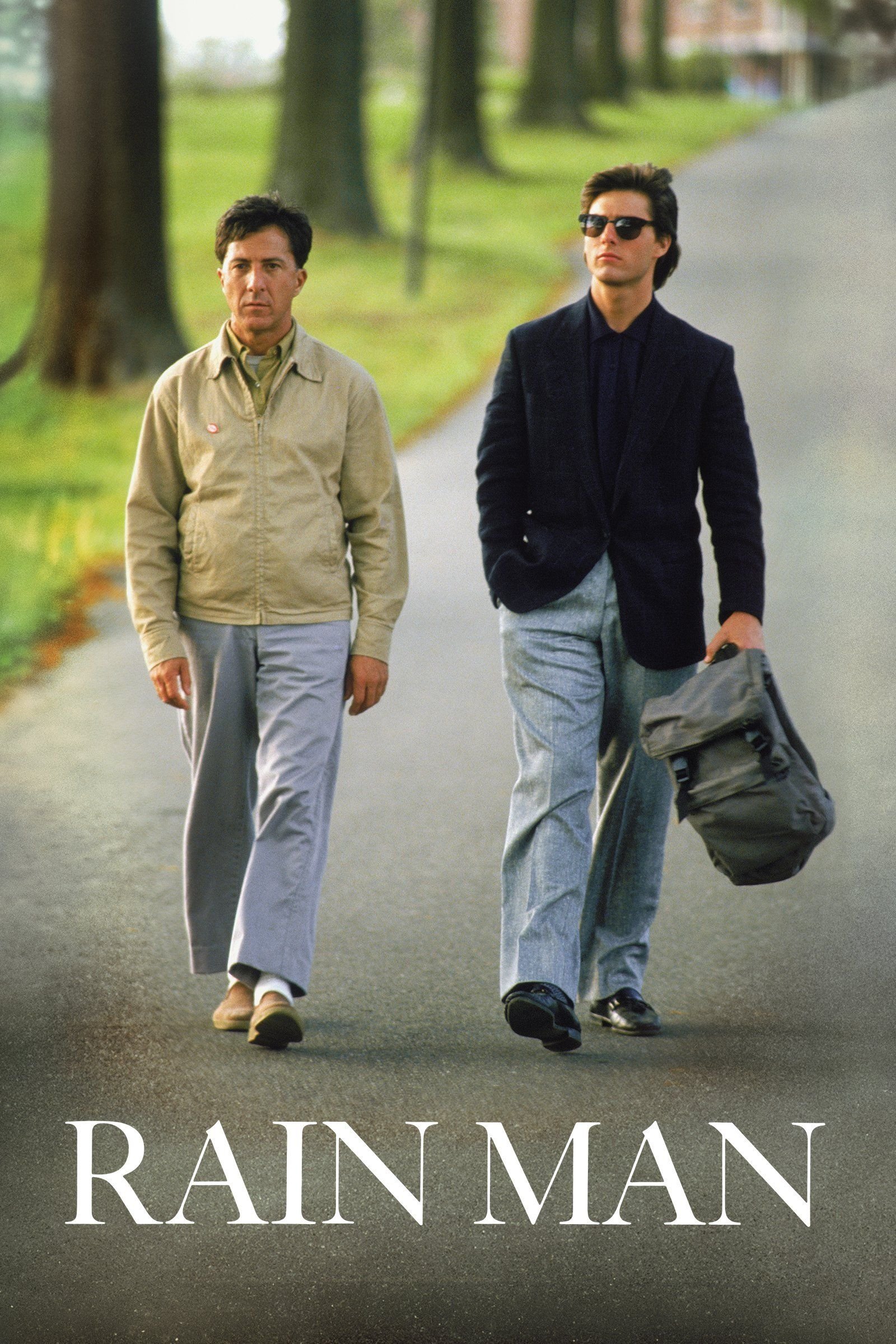
Rain Man poster

Rain Man

134 minutes

Cast

Selected cast credits · Film reference

Dustin Hoffman Raymond Babbitt
Tom Cruise Charlie Babbitt
Valeria Golino Susanna
Jerry Molen Dr. Gerald Bruner
Bonnie Hunt Sally Dibbs
Beth Grant Farmhouse Mother
Barry Levinson Dr. Marston (uncredited)
Nick Mazzola Blackjack Dealer

Rain Man | The Rewatchables

Explore episodeClose episode

Casting What-Ifs

Dustin Hoffman as Charlie with Bill Murray as Raymond; Martin Brest, Steven Spielberg or Sydney Pollack as director; J.T. Walsh as the psychiatrist

In the discussion (6)
Approx. transcript time · 00:17:38Read transcript
  • Michael Ovitz sent Hoffman the script thinking Hoffman would play the Cruise part; Hoffman preferred the other role.
  • CAA wanted Dustin Hoffman and Bill Murray, with Hoffman as Charlie; Murray went on to make What About Bob, called a similar but different-toned lane that suited him better.
  • CAA agent Paula Wagner, later Cruise's producing partner, suggested making Charlie the younger brother to get Tom Cruise in, raising objections that the two could never be brothers given the age gap.
  • Martin Bress, Spielberg and Sydney Pollack all circled the film; Pollack and Hoffman legendarily despised each other on Tootsie, but Pollack got Levinson to read it.
  • Levinson acts in the film because J.T. Walsh was supposed to play the psychiatrist but had a conflict.
  • Jokes follow about Walsh playing the part as Markinson or as Happy Kikindale from Blue Chips.

Roger Ebert's review

In the discussion (3)
Approx. transcript time · 00:37:22Read transcript
  • Ebert is jokingly called "Raj" because the hosts feel closer to him after doing a Siskel and Ebert podcast; his score is three and a half stars.
  • The quoted review says the film refuses to supply sentimental but unrealistic answers and is not a movie with a miracle cure; he also liked what Cruise did in the film.
  • The first line of a second critic's review, read aloud next, calls the film Dustin Hoffman humping one note on a piano for two hours and 11 minutes.

Most Rewatchable Scene

Vegas blackjack sequence

In the discussion (11)
Approx. transcript time · 00:38:52Read transcript
  • The will reading, where Charlie learns he got the rose bushes and a used car while the beneficiary got $3 million, ending with "If there is a hell, sir, my father's in it" and laughing his ass off.
  • A combined pick: Charlie meeting Raymond at the car, then Charlie touching Raymond's things in his room ("definitely not a weekend visit, Vern"), including the uncut sheet; called a really well-written scene.
  • The breakfast toothpick scene: Raymond counts 246 with four left in the box.
  • The doctor's explanatory scene is very 80s and they would never do it that way now, but it still earns sentiment; it leads into the phone-booth fart scene.
  • The bathtub scene is a little forced but really well acted; in the Premiere piece Hoffman is quoted saying the key scene where Tom finds out he is the Rain Man was the first take, which Levinson kept.
  • Reading the Tootsie material shows Hoffman was a big rehearsal guy, while Levinson worked on an if-we-got-it-we-got-it basis, and they somehow navigated that.
  • The breakfast where the card-counting scheme is hatched begins the last 45 minutes, called a favorite part of the movie, running through the Vegas blackjack section.
  • It is asked whether Vegas was the number one reason to do this movie; wanting to finally talk about Hoffman is given as a reason too.
  • Charlie letting Ray go back to Wallbrook, with the head touching and Barry Levinson being weirdly good, and the Amtrak ending with "one for bad, two for good" are also nominated.
  • The pick is Vegas: the seven minutes of blackjack are called unassailable, and it is affirmed as definitely Vegas.
  • The Vegas sequence is instantly iconic and may have sent more teens and twentysomethings to Vegas than any movie stretch; Swingers references it. It is Hollywood Vegas rather than the real chain-smoking grind.

What’s Aged the Best?

The music and Hans Zimmer score; Charlie's Ferrari; the Rain Man would save me line; asshole Cruise; the Bonnie Hunt cameo; the old Vegas view from Caesars; the traffic, bathtub and smoke-alarm sequences; the autistic-savant premise; Raymond crashing the sex scene; Valeria Golino; The Hangover's parody; the Rain Man Suite; Cruise's 1988; Qantas

In the discussion (16)
Approx. transcript time · 00:44:16Read transcript
  • The music holds up: a great 80s score, the Iko Iko use, and the two Hans Zimmer pieces.
  • Asked for Hans rankings, the answer is Zimmer number one, Gruber being pretty problematic. — Chris Ryan
  • Charlie Babbitt's 1983 Ferrari ("400 I") and the line "when I was a kid, I always thought the Rain Man would save me," framed as foreshadowing.
  • Asshole Cruise ages best: telling Raymond to shut up, and ordering large pepperoni after being told pepperoni is not wanted; this is straight asshole rather than the cocky version in The Color of Money, Top Gun or Days of Thunder.
  • A question is raised whether hotel room service ever let guests freestyle an order like beer for two and the closest thing to tapioca pudding.
  • A weird, very young Bonnie Hunt cameo.
  • Freezing on the view from the Caesars suite shows old Vegas: a "holiday in" across the street, none of today's casinos, and the Barbary Coast, thought to be the Cromwell now.
  • The smoke-alarm scene was left out of the rewatchable-scene picks because it is disturbing; the traffic, bathtub and smoke-alarm moments are praised as tension-building sequences.
  • The autistic-savant concept in movies and TV has aged well because it keeps being revisited.
  • Raymond crashing the sex scene is weird but works, a 9.9 degree of difficulty; he just wanted to see what was on TV.
  • Valerie Galena (as transcribed) is great in this; she became the queen of Hot Shots, made a couple of American thrillers, went back to Italy and appeared in Portrait of a Lady on Fire. — Sean Fennessey
  • The Hangover's parody of Rain Man is an addendum that plays all the same notes.
  • The Rain Man Suite lives on as a Vegas idea; the hosts recall being given a suite during a Summer League trip, with high ceilings and multiple rooms.
  • Cruise's 1988, with Cocktail and Rain Man making him the biggest under-35 star in the world.
  • Qantas is called the biggest pick: still no crashes, apart from early propeller crashes.
  • Asked how often he has flown Qantas, the answer is never; only Air New Zealand. — Chris Ryan

What’s Aged the Worst?

Oscar-bait disability movies; Raymond crashing the sex scene; the car-import business scenes; the card-counting stigma and casino reaction; Tom Cruise's cigarette smoking

In the discussion (12)
Approx. transcript time · 00:50:27Read transcript
  • The Oscar-bait run of movies like Regarding Henry looks bad in totality.
  • Raymond crashing the sex scene also goes here: weird, though it somehow works.
  • The car-import business scenes with Lenny are one and a half too many and five minutes too much, like someone gave Oliver Stone an eight ball to write two Lamborghini-importing scenes.
  • The economics of Charlie's business is flagged and deferred to a later spot.
  • The stigma of card counting starts with this movie, yet they don't seem to win enough for the casino to turn on them; up 80 grand in 1988 is guessed at about 400K now.
  • Crowds in Vegas do not gather behind random winners at a table unless it is someone like Tiger Woods or Charles Barkley.
  • Card counting is not illegal, and being called into the manager's office for that amount seems ridiculous; trouble usually starts in the millions. — Sean Fennessey
  • There is no law against counting cards unless using a device; casinos push out players who crush them over months, not for one night.
  • Tom Cruise trying to smoke cigarettes ages worst and is suggested to have cost him an Oscar nomination; fans are invited to make a montage of Cruise smoking in movies.
  • Cruise learned to fly a plane, flip pool cues and drive a race car, yet smokes like an idiot, holding the cigarette like a tree stump, usually at a diner.
  • Hoffman smoked through the Bernstein role and could have given him advice; Cruise also learned a back handspring for The Firm.
  • Bad smoking on screen is called a passion; Cruise clearly never had a cigarette, holds it sideways and never smokes it, because his body is a temple.

Probably Unanswerable Questions

The high-end car delivery business; Charlie's profit on the deal

In the discussion (3)
Approx. transcript time · 00:50:48Read transcript
  • Economics of Charlie's business were first raised during What's Aged the Worst and saved for this segment.
  • Asked whether the high-end car delivery service was a 1980s idea or one that worked, the answer is a 1980s idea. — Chris Ryan
  • What is Charlie clearing after paying Lenny, giving $5,000 discounts and paying about 13 people while bribing EPA agents?

Picking Nits

Buick travel time; stopping near L.A.; burned waffles; Raymond's routine in Vegas; the brothers' age gap; the hotel bath; the route through old Vegas; casino overreaction; too little cocaine; anti-EPA attitude

In the discussion (11)
Approx. transcript time · 00:56:32Read transcript
  • It is ridiculous that the two are supposed to be brothers, joked about as the nitpick done early.
  • A 1949 Buick Roadmaster at 35 mph from Cincinnati to L.A. in three days doesn't work, especially losing a day in Missouri; the distance is looked up as 2,173 miles.
  • Passing through Vegas they are about 240 miles from L.A., so why stop at a hotel; the reply is that Raymond needs to sleep in a bed.
  • How does Ray burn toaster waffles so badly that the kitchen fills with smoke like the Malibu fires?
  • In Vegas Raymond's routine, Wapner, Wheel of Fortune and bedtime, stops mattering; the counter is that time vanishes in Vegas.
  • The age gap looks more like 10 or 12 years in the photo, and there should have been a middle sister.
  • Why does Charlie run an instantly hot bath in a crappy hotel with Ray in the room; it is also defended as the skeleton-key scene where he learns he is the Rain Man.
  • Why drive through old Vegas on the way to L.A.; many shots are at dusk or dawn on roads chosen to look cool.
  • No way the casino gets that angry about 89K.
  • Cocaine should have been more involved; Charlie seems high in the first Lenny scene.
  • The movie is dismissive of the EPA.
In the discussion (5)
Approx. transcript time · 01:01:10Read transcript
  • Iris the hooker could have been a great one-scene part; Marky Post, described as having just passed away, is suggested with an 80s hairdo and a cocktail dress.
  • It was a lost scene, seemingly to save money, needing a hot 80s actress who could click with Cruise.
  • Laura San Giacomo is offered for Iris, and another voice calls it even better.
  • A joke category about which part a co-host wishes he could have played points to Lenny, who is close to Pantoliano's Midnight Run character.
  • Joey Pants as Lenny is called a much better recasting-couch answer than the earlier Iris pick, with a Guido the Killer Pimp reunion with Cruise; a voice then says "I changed my answer."

Half-Assed Internet Research

Two schmucks in a car; the strike-era ending; airline edits; Hoffman's early crisis; the Kim Peek origin; the Hoffman, Hackman and Duvall roommates

In the discussion (16)
Approx. transcript time · 01:02:49Read transcript
  • During filming Hoffman and Cruise called the movie two schmucks in a car and constantly worried it would not work.
  • Principal photography happened during the 1988 Writers Guild strike, so the final scene was apparently winged without writers.
  • The ending is questioned as unsatisfying for a Best Picture winner, since it lacks a sappy payoff where Raymond stays with Charlie.
  • A sentimental Amtrak scene always lands for someone who spent the 80s riding Amtrak between a mom's house and a dad's house.
  • Card counting is meant to be the climax that brings the brothers close and saves Charlie's business; the ending is neither victory nor defeat, and its ambiguity is liked.
  • Jokes imagine a modern version with Raymond as a Marvel superhero, a Wallbrook driveway epilogue, or Lenny killing Charlie.
  • Airline versions deleted the airline-accident scene, except on Qantas.
  • Choosing a flight at the airport and hopping on last minute was possible through the late 90s.
  • Three weeks in, Hoffman thought the movie was a disaster and told Levinson to get Richard Dreyfuss; Dreyfuss is described as Hoffman on steroids in the asshole department.
  • The film was written by Barry Morrow and Ronald Bass; Morrow created Raymond after meeting real-life savant Kim Peek.
  • Hoffman beat Gene Hackman for Best Actor and hugged him; they were playhouse classmates who shared Hackman's apartment on 2nd Avenue and 26th Street, where Hoffman slept on the kitchen floor before moving in with Robert Duvall on West 109th Street.
  • The three as roommates is pitched as a documentary or original series, compared to LeBron, Wade and Carmelo on one AAU team.
  • Asked whose career they would rather have, one voice picks Duvall and Hackman is picked as well; Hackman was the most liked by other actors; Denzel and Will Smith took movies to work with him.
  • Hackman won a second Oscar for a supporting part in Unforgiven, something Hoffman never did.
  • Duvall is picked as the best storyteller of the three, with Godfather and Apocalypse Now stories.
  • The Replacements is called a top-five Hackman performance, with scenes apparently done in one take.

Apex Mountain

People's Court; Barry Levinson; the 1949 Buick Roadmaster; Qantas; Caesars Palace; road trips caused by fear of flying; 97X

In the discussion (21)
Approx. transcript time · 01:11:08Read transcript
  • Tom Cruise: no for this movie, though a case is made for 1988; another view puts his peak at 1996 with Mission: Impossible, his first production, and McGuire.
  • Asked directly, the reply is "No, I think I'm going to go with" what a co-host is saying. — Chris Ryan
  • Hoffman's Apex is Kramer vs. Kramer, as decided on an earlier episode; Outbreak and Sphere are mentioned jokingly.
  • People's Court never got better: crushing it in the late 80s and prominently featured in the number one movie, part of the 4:30-6 p.m. TV block with Jeopardy and Wheel of Fortune.
  • Asked if he had heard of People's Court, the answer is vaguely; Judge Judy took it over. — Craig Horlbeck
  • Barry Levinson is a yes for this period: best director and the number one movie at the box office.
  • Levinson was also key to 30 for 30; once he committed, other directors followed.
  • Levinson pretty much invented modern TV with Homicide a couple of years later and has perhaps the most underrated behind-the-scenes career, though his filmography is called hit and miss.
  • Diner created a template everyone ripped off, and Levinson was already an Oscar-nominated screenwriter before that, having written ...And Justice for All in the 70s.
  • Kasdan is proposed as the winner of a most-underrated tournament; Grand Canyon is mocked.
  • Valeria Galena's Apex is Hot Shots.
  • Road-trip movies: no, though this is a great road-trip movie shot sequentially; a list follows: Easy Rider, Thelma & Louise, Almost Famous, Blues Brothers, Midnight Run, Planes, Trains and Automobiles, Smokey and the Bandit, Dumb and Dumber and Tommy Boy, with Road Trip, Vacation and Due Date added.
  • Handheld TVs, the Sony Watchman, were a thing for about three years.
  • Who's on First: not its Apex overall, but perhaps for the last 40 years.
  • The 1949 Buick Roadmaster and Qantas Airlines are yeses; Qantas is still throwing the no-hitter.
  • Wheel of Fortune: no.
  • Caesars Palace: yes, still the greatest casino gimmick in Vegas, versus New York-New York being grim inside.
  • Blackjack: no, with personal blackjack peaks recalled instead.
  • A case is made for Cincinnati: this film, the Reds, the Bengals making the Super Bowl, and WKRP reruns.
  • The Apex of road trips caused by a main character afraid to fly: this and Midnight Run, right next to each other.
  • One last Apex: 97X, bam, the future of rock and roll, which has never been topped.

What Piece of Memorabilia Would You Want From This Movie?

Uncut 1984 or 1985 card sheet from Raymond's room; Cruise's sunglasses

In the discussion (3)
Approx. transcript time · 01:30:31Read transcript
  • The 1949 Buick Roadmaster is disallowed as too easy.
  • The pick is the 1984 uncut "top sheet" in Raymond's room, possibly 85; guesses at the cards include Ted Kluszewski, Reds, Sandberg, Clemens and Gooden.
  • Cruise's sunglasses: a great run that reinvented sunglasses in movies, the King of Raybans.
In the discussion (8)
Approx. transcript time · 01:31:36Read transcript
  • Hoffman would have been the pick years ago, but Cruise wins the movie, and not as a contrarian zag.
  • Another voice agrees and adds that the movie is Cruise's story of transformation, his first real adult part, pointing toward the rest of his career.
  • Barry Levinson is floated: Best Picture, Best Director and the number one movie, though nothing he made after is as good; he is rejected because people see it as a Hoffman-Cruise movie.
  • Removing the film would barely change how Hoffman and Cruise are viewed, but Cruise is said to need it more.
  • Asked who from the last 20 years could pull off Charlie, Leo, Damon, Affleck, Chris Evans, Brad Pitt, E. McGregor, Michael Keaton and others are floated; Hanks would not be believable as a chain-smoking dick.
  • A spoken tally lists two Cruise votes and one Levinson vote.
  • Pressed, the answer is Hoffman: Raymond became an iconic figure, won Best Actor and launched a wave of imitators; Hoffman is the not-overthinking-it answer, Levinson the overthinking one, and Cruise the smart answer. — Sean Fennessey
  • A voice says it really wants Cruise to win and feels bad; a reply says he'll be okay and jokes that he can't win the Oscar or Who Won the Movie. The count is not restated.
Podcast choices
Speaker not identified
Tom Cruise

More from the conversation

A Ringer network plug points to the hosts' other shows (The Big Picture, The Watch, the Ringer NBA show) before a trailer-style cold open.
Approx. transcript time · 00:01:24Read transcript
After recent episodes on Superbad and Argo, the show goes backwards to Rain Man, then on Netflix, called the definition of a rewatchable movie.
Approx. transcript time · 00:02:16Read transcript
In the mid-80s the four most important actors were Nicholson, De Niro, Pacino and Hoffman, with Newman, Redford and Eastwood as elder statesmen and Brando hovering over everyone.
Approx. transcript time · 00:02:31Read transcript
Hoffman is described as the only actor with top billing in three Best Picture winners (Midnight Cowboy, Kramer vs. Kramer, Rain Man), about 10 years apart, yet he has slipped the most historically.
Approx. transcript time · 00:03:22Read transcript
Hoffman has seven Academy Award nominations, all for Best Actor, and never made the usual late-career move to supporting character parts.
Approx. transcript time · 00:03:22Read transcript
Hoffman is described as exacting and difficult to work with, which makes him less worth casting in small roles.
Approx. transcript time · 00:04:01Read transcript
Hoffman had roughly 30 years of cultural relevance, from The Graduate through Dick Tracy, Hook and Billy Bathgate, and was a big leading-man star in the 80s.
Approx. transcript time · 00:04:45Read transcript
A February Premiere profile of Hoffman asked whether he was too big an asshole; it lists projects he nearly made in six years, including Dead Poets Society.
Approx. transcript time · 00:06:01Read transcript
Hoffman is compared to his character in Tootsie and called a product of the post-Brando generation: meticulous, abrasive, picky and powerful.
Approx. transcript time · 00:07:57Read transcript
Hoffman lends any film credibility; Daniel Day-Lewis is his modern analogue, and Downey in Zodiac is cited as a Hoffman-type part.
Approx. transcript time · 00:09:11Read transcript
Only a few stars carry a stamp of approval like Nicholson, De Niro, Pacino and Hoffman once did; Newman is said to have the best track record, and Leo almost never misses.
Approx. transcript time · 00:10:53Read transcript
Quoted passages from the Premiere profile by Peter Biskind (ASR "Biscan") have Hoffman upset about press claims that he forgets collaborators and about a GQ profile.
Approx. transcript time · 00:13:14Read transcript
Old-school magazine profiles let writers spend days with stars, access that publicists would not allow now.
Approx. transcript time · 00:14:19Read transcript
Per the Premiere piece, Hoffman performed characters from his mental-institution days during a three-hour meeting and said he would be remembered for Ratso Rizzo and Rain Man.
Approx. transcript time · 00:15:18Read transcript
Rain Man is one of the first times Hoffman plays a character the audience can fully empathize with, after decades of unsympathetic parts.
Approx. transcript time · 00:16:17Read transcript
Hoffman might have been a great Fredo in The Godfather.
Approx. transcript time · 00:18:30Read transcript
For years Rain Man was the last number one box-office movie to win Best Picture, until Titanic.
Approx. transcript time · 00:18:30Read transcript
Pairing two giant stars became a studio strategy in the mid-80s; Cruise, fresh from The Color of Money with Newman (an upcoming anniversary episode), wanted to work with great actors, and Cocktail's summer success elevated him before Rain Man.
Approx. transcript time · 00:19:10Read transcript
Seeing it in theaters, the head-touching ending had audiences sobbing; it's a rare case where two big stars, a great director and a good story all delivered.
Approx. transcript time · 00:20:24Read transcript
Cruise plays an irredeemable character until the last minutes; the film avoids the sentimentality of later movies like Forrest Gump.
Approx. transcript time · 00:21:08Read transcript
One of the best Cruise performances: the film falls apart without his desperation in the final evaluation scene, a take linked to Goldman's view that Cruise had the harder part.
Approx. transcript time · 00:22:04Read transcript
Rain Man was a word-of-mouth hit released in a loaded 1988, becoming the year's top earner, and would likely be a Netflix movie now.
Approx. transcript time · 00:23:00Read transcript
Disability-showcase Oscar movies (Regarding Henry, Nell, Scent of a Woman, I Am Sam, At First Sight, Awakenings) became a running joke; some, like The Fisher King, Gilbert Grape and My Left Foot, hold up.
Approx. transcript time · 00:24:30Read transcript
Box office surged after the Best Picture win, a December-release pattern that happens less now; such showcase roles are also seen as culturally insensitive today.
Approx. transcript time · 00:26:26Read transcript
Pauline Kael (ASR "Kale") panned the film, asking why an autistic actor didn't play the role and calling it wet kitsch; it still affects audiences emotionally.
Approx. transcript time · 00:27:19Read transcript
The film is described as a notes-meeting triumph after multiple writers and directors; Hoffman reportedly unlocked the tension that Charlie can never reach Raymond.
Approx. transcript time · 00:28:35Read transcript
Rain Man won Best Picture, Original Screenplay, Director and Actor out of eight nominations; its Best Picture field (Accidental Tourist, Dangerous Liaisons, Mississippi Burning, Working Girl) is mocked.
Approx. transcript time · 00:31:29Read transcript
Levinson beat Scorsese, Nichols and others; Hoffman beat Hackman, Hanks, Olmos and Max von Sydow; Cruise wasn't eligible for supporting actor and arguably is better in the film.
Approx. transcript time · 00:32:41Read transcript
Cruise's closest Oscar chances are debated: Magnolia, Born on the Fourth of July (criticized for overacting by one voice, praised by another) and above all Jerry Maguire; the early Jerry Maguire episode predated the categories.
Approx. transcript time · 00:33:53Read transcript
Levinson's 1982-88 run (Diner, The Natural, Young Sherlock, Tin Men, Good Morning, Vietnam, Rain Man) is praised, along with the film's music and pacing.
Approx. transcript time · 00:35:25Read transcript
Hans Zimmer's first solo big Hollywood score; a $25 million budget made $355 million, and Cruise had the number one and number nine movies of 1988.
Approx. transcript time · 00:36:47Read transcript
William Goldman often cited Rain Man as a film where the other guy was the real star; Michael Caine said Cruise had the harder part.
Approx. transcript time · 00:38:13Read transcript
A question asks why Dr. Bruner is so intent on getting Raymond back; the hosts side with Charlie taking his brother.
Approx. transcript time · 01:00:23Read transcript
Tangent about Sex, Lies, and Videotape and trying to get a host's mother on a Big Chill episode.
Approx. transcript time · 01:01:51Read transcript
Aside on 80s white-privilege movies like Bonfire of the Vanities and Grand Canyon, and Mississippi Burning aging poorly.
Approx. transcript time · 01:16:58Read transcript
The episode is taped at 11:27 a.m. on a Monday; a co-host is teased for yawning after having a baby within the last five weeks, and the film is compared to watching over a newborn.
Approx. transcript time · 01:28:18Read transcript
The hosts note no Tom Cruise movie in three years because of COVID, want him to pass the torch like Newman did, and conclude there will never be another Tom Cruise.
Approx. transcript time · 01:36:04Read transcript
Closing credit: produced by Craig Horlebeck (ASR); next week's film not yet decided; the film is on Netflix.
Approx. transcript time · 01:38:12Read transcript