
‹ All movies

The Langley heist

Nominees run through the Prague sequence as a whole (a 32-minute opening act that even fades to black after Tom Cruise jumps through the Aquarium and escapes from Kittredge), Ethan and Max's negotiation, the Langley heist, and the Phelps versus Hunt coffee scene where Hunt sees what Phelps has done while Phelps lies to him, the scene that confused a generation of filmgoers.

One host admits not understanding the coffee scene until rewatching it yesterday after roughly 20 viewings; the Langley break-in is called the most iconic, incredibly staged, ripped off numerous times, and the precedent for Tom Cruise attempting something that seems impossible, even though Wu takes it to another level.

"You've never seen me very upset"

Nominees: 'do you read me, the list is in the open', already flagged; Kittredge's line that dying slowly in America can be a very expensive proposition, guessed to be Robert Towne or David Koepp; 'you've never seen me very upset'; 'relax Luther, it's much worse than you think'; and Kittredge wanting Don Lowe (as transcribed) manning a radar tower in Alaska by the end of the day, just mail him his clothes.

The film

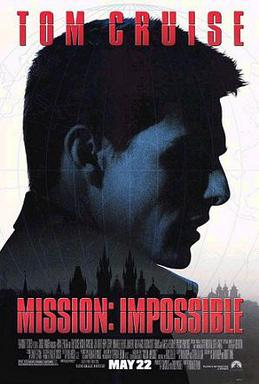
Mission: Impossible (1996)

Directed by Brian De Palma · Drama

110 minutes

Cast

Selected cast credits · Film reference

Tom Cruise Ethan Hunt : A young IMF agent
Jon Voight Jim Phelps : The leader of Ethan's IMF team and his mentor
Emmanuelle Béart Claire Phelps: Jim's wife and a member of his IMF team, specializing in getaway transportation
Henry Czerny Eugene Kittridge: The director of the IMF
Jean Reno Franz Krieger: A disavowed IMF agent and skilled pilot recruited by Ethan to assist him
Ving Rhames Luther Stickell : A disavowed IMF agent and skilled computer hacker recruited by Ethan to assist him
Vanessa Redgrave Max: An illegal arms dealer
Kristin Scott Thomas Sarah Davies: An IMF agent and undercover infiltration expert on Phelps's IMF team
Ingeborga Dapkūnaitė Hannah Williams: An IMF agent and surveillance expert on Phelps's IMF team
Emilio Estevez (uncredited) Jack Harmon: An IMF agent and security system specialist on Phelps's IMF team
Rolf Saxon William Donloe: A CIA analyst at Langley
Marcel Iureș Alexander Golitsyn: An IMF agent posing as a rogue agent to lure out a mole in Prague

Everything from the episode

In the order the hosts got to it. Open a row for the discussion.

21:16

Most Rewatchable Scene

The Langley heist

The Langley heist

In the discussion (6)
Approx. transcript time · 00:21:16Read transcript
  • Nominees run through the Prague sequence as a whole (a 32-minute opening act that even fades to black after Tom Cruise jumps through the Aquarium and escapes from Kittredge), Ethan and Max's negotiation, the Langley heist, and the Phelps versus Hunt coffee scene where Hunt sees what Phelps has done while Phelps lies to him, the scene that confused a generation of filmgoers.
  • One host admits not understanding the coffee scene until rewatching it yesterday after roughly 20 viewings; the Langley break-in is called the most iconic, incredibly staged, ripped off numerous times, and the precedent for Tom Cruise attempting something that seems impossible, even though Wu takes it to another level.
  • The scene one host rewound four times is Ethan on the horn with Kittredge after the team is killed, shouting that his team is dead, that they knew we were coming, that the disc is gone and the list is in the open; the clip is played, and Cruise is said to go Ruffalo before Ruffalo and to resemble Bill Paxton in Aliens.
  • The Kittredge call is a bookend to the Aquarium restaurant scene: before it Cruise is loud and brash, cracking jokes while Jon Voight's Phelps lays out the plan, and in the restaurant he turns cerebral, seeing the other team, the waiters and the lovers on the river bank; the Langley heist is then named the pick, iconic and almost all in silence, with the tension of Don Lowe (as transcribed) about to come back, and compared to the silent drilling heist in Rafifi (as transcribed), the host's favorite heist movie.
  • Further Langley favorites: the digital sound meter, the rat in the air duct likened to the final shot of The Departed, the Top Copy (as transcribed) reference to the same filmmaker Jules Dassen (as transcribed), the trope of explaining the heist on the train before doing it with Jean Reno, Ving Rhames and Emmanuel Bayard (as transcribed), Cruise's Cheshire Cat grin saying it is even worse than you think, and the first encounter with the idea of an air-gapped computer; Langley is confirmed as the most rewatchable scene.
  • Asked for memories earlier, the Langley drop of Cruise hanging is named the iconic image inside the movie, one the later Mission Impossible films call back to every time, and the film is called De Palma's last great movie. — Sean Fennessey
26:15

What’s Aged the Best?

De Palma's visual style

De Palma's visual style

In the discussion (5)
Approx. transcript time · 00:26:15Read transcript
  • The movie is in a race against time as digital life changes; it was weirdly prescient about wireless streaming video, while things like Netscape no longer make sense; the first nominees are the Hitchcockian vibe of drawing on 1950s and 1960s Hitchcock for an espionage movie, especially in the Prague sequence, the cat-and-mouse format of the set pieces built on ducking into rooms, masks, disguises and hanging from places rather than buildings falling, and Cruise's performance.
  • Casting great actors in supporting roles is argued to hold up: Voight at the right stage of his career to be Phelps, a character from the television series; Manuel Bear (as transcribed), an actress few American filmgoers had seen; Jean Reno coming off Leon the Professional with his dickishness; Ving Rhames, who becomes the only other connecting figure in the series along with Monaghan; Kristen Scott Thomas, Vanessa Redgrave, Emilio Estevez and Henry Zerny (as transcribed), later of Sharp Objects, all lived in and knowing what movie they are in.
  • The Prague sequence is bittersweet because two or three movies of the Estevez, Kristen Scott Thomas and Cruise team would be welcome; it is set up like Alien with people who know each other, down to the wife's coffee and the barn in Kiev, and the scene where Cruise and Kristen Scott Thomas make out while tracking the arms dealer shows legitimately good chemistry, if less than Cruise's with Vanessa Redgrave; killing off those movie stars 35 minutes in is called a Hitchcockian twist like Janet Leigh in Psycho.
  • Estevez's line about lasagna while showing Cruise the chewing gum explosive is a favorite; red light green light and 'you've never seen me very upset' show Robert Towne style dialogue sprinkled throughout, and the hosts assign roles: Koepp the genius of action plotting, Zalian (as transcribed) the dramatic storyteller, Towne the king of memorable lines, with Tom Cruise movie starring on top.
  • De Palma's visual flair under control is the final nominee: the deep-focus shot where Don Lowe (as transcribed) is dressed down by Henry Zirny's (as transcribed) CIA character before being sent to Siberia, a charismatic look unlike same-looking modern blockbusters, stylish and fun where a Villeneuve film never makes you laugh; De Palma's playful visual style is named the pick.
35:14

The Dion Waiters Award for Best Heat Check Performance

Vanessa Redgrave

Vanessa Redgrave

In the discussion (7)
Approx. transcript time · 00:35:14Read transcript
  • The award is defined as supporting character actors who make the most of their time; Vanessa Redgrave, born in 1937 and about 59 or 60, one of the great actresses of the 20th century, plays an arms dealer named Max who communicates via Usenet group, and is argued to have more sexual chemistry with Cruise than anyone in his movies except Kelly McGillis.
  • Redgrave looks at him like he is a steak, chews over every line, calls him dear boy, seems to have been taking nitrous hits, and smiles like a shark when he comes in; the shroud scene is recalled, with Ethan hooded in a knit hat and warned he will wear the shroud indefinitely if Max does not like what he has to say, and the clip of her asking who he is and his demand for $150,000 is played.
  • Whether it is a flaw or a nitpick, the villains' goals in the whole series are elusive: this film has Phelps and Max, and what they have going on, beyond shifting money around, is unclear; the explanation offered is Phelps's bitterness, voiced to Ethan as a tool for a war that is no longer going on, farmed out on $60,000 a year, the same line Ed Harris has at the end of The Rock the same year, read as the post-Desert Storm, Fukuyama end-of-history mood.
  • Other nominees: Henry Zerny (as transcribed), who did not pop off after this, whose performance once seemed over the top and is now excellent, including his interplay with Barnes played by Dale Dye, bullying him throughout, and dressing like a G man from the 1930s in overcoat and fedora once the pursuit of Hunt begins; he built a career on the dick bureaucrat after Clear and Present Danger, called his iconic performance.
  • Emilio Estevez, coming off Young Guns, seemed to be doing a fun cameo and never showed up in a blockbuster ensemble again, with The Outsiders and The Mighty Ducks debated; Kristen Scott Thomas was remarkable; Jon Voight has too many minutes played for the award but is unrecognizable from the iconic 1970s actor of Coming Home and Midnight Cowboy.
  • Ving Rhames gets respect: Luther becomes Ethan's conscience across the series, and casting the burly Marcellus Wallace figure as the smartest hacker in the room was a smart choice that holds, even after Simon Pegg is introduced; one host then goes with Redgrave.
  • Jean Reno is shouted out for a volcanic hot streak from The Professional through this to Ronin, where he plays nearly the same role more gregariously, with Sean Bean as the Jean Reno of Ronin; French Kiss with Kevin Kline and Meg Ryan is cited as his erased earlier appearance, and Redgrave is confirmed.
42:36

What’s Aged the Worst?

The masks

The masks

In the discussion (5)
Approx. transcript time · 00:42:36Read transcript
  • Nominees: Ethan typing internet access into a computer, the Netscape browser the IMF uses to watch news clips, floppy disks, the attention-drawing surveillance eyewear worn by Hannah and Sarah in the Prague scene, the masks, and the whole Claire plotline.
  • The masks are disputed: one side finds them unbelievable with no rules, while the other says these movies need something preposterous, and the masks, inherited from the TV show, are that thing, even as later films add voice strips; the objection is that with good mask use half the movie need not happen, since Ethan could just walk in as Don Lowe (as transcribed) and take the knock list, prompting the joke about Andy Greenwald in a mask.
  • The senator mask Ethan wears is the worst offender: he has ostensibly been impersonating a sitting U.S. senator for an untold time, doing interviews; the hosts argue whether the senator exists, with the theory that he is a real adversary of the IMF taken on fishing trips to County Kildare while the IMF uses his face, versus an entirely invented man elected to high office and only ever played by Tom Cruise.
  • In 1996 the political landscape was different: a teenager would have accepted old Senator Walter without question, since nobody knew their senators or how to contact them, and a political category is jokingly suggested after the Quint campaign bit from the Jaws episode.
  • Pressed for a final answer, the masks are chosen over the computer tech, which should be graded on a curve, though the forward-looking movie suffers when a floppy disk appears, the Langley screen just reads download complete, and Luther hacking Max's computer on the train amounts to typing plain instructions; the masks are confirmed with a fist bump.
59:49

The Ruffalo / Hanna / Rubinek / Partridge Overacting Award

Henry Zerny (as transcribed) or Tom Cruise

Henry Zerny (as transcribed) or Tom Cruise

In the discussion (1)
Approx. transcript time · 00:59:49Read transcript
  • Zerny (as transcribed) is proposed, with the Ruffalo-voiced 'they knew' already covered, and seconded as a sure thing; the counter is that Cruise is really going for it, with unbelievable blinking work and the 'Job, Job, Job' face at the computer, which only his face keeps from looking ridiculous; nothing is settled before moving on.
1:00:44

Is This Movie Better With…?

Steve Buscemi in Emilio Estevez's role

Steve Buscemi in Emilio Estevez's role

In the discussion (1)
Approx. transcript time · 01:00:44Read transcript
  • The evolution of the Danny Trejo category is said to be one of the six or seven things that matter most to Bill; Steve Buscemi is one of the added names and could definitely be in this movie, in the Estevez role rather than Krieger's, with a joke that he should be Claire; Trejo himself is never placed.
1:00:59

Apex Mountain

No affirmative selection

No affirmative selection

In the discussion (4)
Approx. transcript time · 01:00:59Read transcript
  • Apex Mountain and who won the movie are bundled because they are complicated; Tom Cruise, Brian De Palma and Ving Rhames all get no, with Baby Boy preferred to Pulp Fiction for Rhames.
  • Jon Voight is not close, with Anaconda as the joke; Kristen Scott Thomas is a no, joked to be Only God Forgives; Jean Reno is a no, so this is Apex Mountain for nobody.
  • Henry Zerny (as transcribed) is floated hesitantly as the one possible apex, immediately answered that he is better in Clear and Present Danger, with the two self-described only Henry Zerny experts in the world saluting each other.
  • Danny Elfman is a no, with Beetlejuice and Batman as his peak and a plug for the Midnight Run soundtrack; cinematographer Stephen Burham (as transcribed) has The Outsiders, Rumblefish, St. Elmo's Fire, Eight Million Ways to Die, The Untouchables and Hoffa, and The Untouchables is chosen as his peak instead.
1:02:42

Who Won the Movie?

Tom Cruise or the chaotic collaborative Hollywood process that made the film

Tom Cruise or the chaotic collaborative Hollywood process that made the film

In the discussion (3)
Approx. transcript time · 01:02:42Read transcript
  • Cruise and De Palma are named first, then a wrinkle: Hollywood, the studio system putting people at the top of their craft in position to succeed, with the money to build an aquarium that did not exist and blow it up, the tanks being Tom Cruise's idea; the chaotic, almost old Hollywood way the film came together is now heard of only as a cautionary tale, like the fired Star Wars director or Fantastic Four, so the victor may be that improvisatory collaborative filmmaking.
  • The case cuts both ways: the manic nature of Hollywood creation showed this can work, but the film is also end times for movies, signaling a new path for the greatest movie star of the last 30 years who realizes he must keep falling off things to stay relevant into his 50s, the end of Brian De Palma, the least celebrated yet maybe most talented movie brat, the start of the powerful Wagner-Cruise partnership that ended badly at United Artists, and the end of Jon Voight's good movies after Heat; it feels like a win for nobody but Mission Impossible.
  • The counter-pick is Cruise, the engine of the whole thing, since nobody else could play Ethan Hunt and the attempt to try failed; the what-ifs of a different director or Cruise continuing to make films like A Few Good Men are unknowable, and the recent films have leveled out and gotten better.
Podcast choices
Speaker not identified
Tom Cruise