
‹ All movies

Ray meeting Terrence Mann in Boston

First nominee: Ray meets Shoeless Joe, is this heaven, no it's Iowa; a quick Liotta imitation; this was a year before Goodfellas, when he was a critic's darling after Something Wild; he still has never seen the movie and thought the script was dumb.

Liotta plays Joe Jackson like a sensitive, dew-eyed guy from 1989 rather than a period Black Sox type, which is perfect because he seems like a ghost who doesn't know he is one; a Chantix commercial with him in the cornfield and a second-half-of-Goodfellas Henry Hill emerging from the corn are joked about.

"You see, that's the sort of crap people are always trying to lay on me"

A lot of candidates: Ray never having done a crazy thing until he heard the voice, you build it, he will come, that's the sort of crap people are always trying to lay on me, it's not my fault you wouldn't play catch with your father, hey, Dad, you want to have a catch, and the this is Terrence Mann, Easter Bunny exchange, which is really funny.

The film

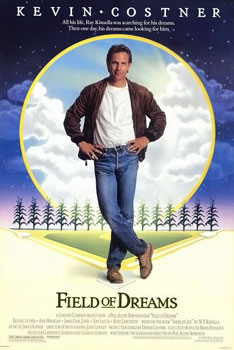
Field of Dreams (1989)

Directed by Phil Alden Robinson · Drama

106 minutes

Cast

Selected cast credits · Film reference

Kevin Costner Ray Kinsella
Amy Madigan Annie Kinsella
James Earl Jones Terence Mann
Ray Liotta Shoeless Joe Jackson
Burt Lancaster Dr. Archibald "Moonlight" Graham Frank Whaley as young Archibald Graham

Everything from the episode

In the order the hosts got to it. Open a row for the discussion.

27:58

Most Rewatchable Scene

Ray meeting Terrence Mann in Boston; Moonlight Graham crossing the line to save Karen; the James Earl Jones speech

Ray meeting Terrence Mann in Boston; Moonlight Graham crossing the line to save Karen; the James Earl Jones speech

In the discussion (17)
Approx. transcript time · 00:27:58Read transcript
  • First nominee: Ray meets Shoeless Joe, is this heaven, no it's Iowa; a quick Liotta imitation; this was a year before Goodfellas, when he was a critic's darling after Something Wild; he still has never seen the movie and thought the script was dumb.
  • Liotta plays Joe Jackson like a sensitive, dew-eyed guy from 1989 rather than a period Black Sox type, which is perfect because he seems like a ghost who doesn't know he is one; a Chantix commercial with him in the cornfield and a second-half-of-Goodfellas Henry Hill emerging from the corn are joked about.
  • Second nominee: Ray goes to Cambridge in his Volkswagen van and meets Terrence Mann; the finger-or-gun exchange is played, the door slamming is really funny, and Mann flips fast once Ray brings up John Kinsella (transcribed 'John Consala'); great suspenders and belt.
  • The two hosts who have spent time in Boston are asked whether there really are that many Jewish people there, since the street looks like half of Brooklyn with Hebrew letters on windows; the Boston exteriors were apparently filmed in Dubuque with after-the-fact wide shots, though they obviously shot at Fenway.
  • Third nominee: after Fenway, Mann pretends he didn't see the scoreboard, drops Ray off, then is standing in the street; the Moonlight Graham, you saw it exchange is recited, New York Giants 1922, one game, never batted, Chisholm, Minnesota; that part is amazing.
  • Fourth nominee: the nighttime scrimmage with Archie, the first time Frank Whaley walks out, ghosts playing at 9:30 with Amy Madigan turning the lights on, the most baseball in the movie, a four-minute sequence.
  • A host doubts they could hit fly balls to a ghost who showed up in the backyard; the counter is that Ray had been prepping, taking BP every day; the one caveat is that Costner wears Timberlands the entire movie rather than Chucks or running shoes.
  • The James Earl Jones speech and the actual ending round out six nominees; the Beulah and Annie scene is rejected as padding rewatchable stats; Moonlight's sacrifice, Karen falling and being saved, is counted as its own scene separate from the catch with dad.
  • The opening catch-up montage is really good where it goes wrong in so many movies, and a secretly great choice is that the voice comes in the first scene with no thirty-minute build-up of farm life; Amy Madigan is quirky enough to buy it, unlike one host's wife, and she asks whether it's acid.
  • Ray meeting Moonlight for the first time and walking back to his office is poetry, resonant though removed from the climax; the rack focus to The Godfather on the marquee; the magic realism works seamlessly and the story is about life rather than baseball or fantasy.
  • Burt Lancaster's last movie, and the part was supposed to be, or at least offered to, Jimmy Stewart, blurted early and rebuked for stepping on half-assed internet research. — Chris Ryan
  • Ray simply accepting that it's 1972 is not ridiculous at all, which is why it is more a fantasy movie than a baseball movie.
  • One pick is when Ray goes to Boston: great chemistry, the reclusive countercultural icon surrounded by tapes and books who wants to be left alone, the locks on his doors; the last thirty minutes can only be watched once a decade, like dialing it up on YouTube to cry it out.
  • Seeing Terrence Mann for the first time has become a favorite, a well-written, well-acted five minutes, with a wish for four hours of deleted van small talk; the 1989-era library research for the old interview mentioning Ebbets Field is loved, as is Mann's heartbreak at not remembering and the you're from the 60s line.
  • Another pick is Moonlight crossing the line to save Karen and Ray's oh my God, you can't go back, the first thing that comes to mind about the movie, more than the catch; it is the emotional gut punch where every theme and tension, hope, purpose, sacrifice, is realized in one second.
  • A sneaky good scene is picking up Frank Whaley hitchhiking, the I need good karma line and his day-job baseball towns, looking like he's in Stand By Me; a host promises to ruin that scene later.
  • A further pick is when he sees Terrence Mann for the first time, and then really the pick is the James Earl Jones speech, with all the ghosts stopping to watch; baseball's a part of us, Ray.
41:19

What’s Aged the Best?

James Horner's score; Shoeless Joe's 'I would have played for nothing'; late-80s Fenway Park; the Kinsella house; Ray...

James Horner's score; Shoeless Joe's 'I would have played for nothing'; late-80s Fenway Park; the Kinsella house; Ray's chemistry with the White Sox ghosts; Gabby Hoffman as Karen; the Terrence Mann character; the Annie and Ray relationship; the van scenes; Busfield walking across the field; Costner's hair and jeans; the disgruntled writer as plot point; the themes of hope and purpose

In the discussion (16)
Approx. transcript time · 00:41:19Read transcript
  • James Horner's score, unequivocally, arguably who won the movie: stolen over and over by sporting events, documentaries and trailers across thirty years, it plays five seconds and you need to excuse yourself; heard in surround sound for the first time it feels like a stadium; it has to double and triple the emotional climax in the last twenty minutes, like Shawshank's iconic score.
  • Shoeless Joe's I would have played for nothing, against today's spoiled players like Bryce Harper getting cash and checks.
  • Late-80s Fenway Park, a personal thing: the caterer, two dogs and two beers for seven bucks, few movies filmed there, the Morgan Magic 88 team with Ellis Burks and Mike Greenwell before the A's kicked their ass.
  • The Kinsella house is a top seven or eight movie house, still standing as it was, worth a fortune if moved to LA; the White Sox ghosts busting Ray's balls during the call to dinner show his chemistry with them, and it would be amazing if he plowed the field and told the cheaters to go back to hell.
  • Gabby Hoffman as the daughter is all-time adorable, in a cutest-daughters final with the Remember the Titans girl, with Macaulay Culkin's bee movie ruled out as a non-sports film; a host's own daughter at six was their favorite human ever and their own field of dreams would be going back to that age; Karen's precociousness is winning.
  • Terrence Mann is James Baldwin meets J.D. Salinger; the book used Salinger and the film changed it for fear of a lawsuit; the recited bio, voice of the 60s, marched with MLK, cover of Newsweek, coined make love not war; asked whether we ever had a writer like this, the answer is no, though Baldwin and Norman Mailer were around back then doing that kind of writing; the whole movie could have been Costner and James Earl Jones in the van.
  • The Annie and Ray relationship: a great, supportive, believable marriage with real history, down to her sleeping in one of his old t-shirts.
  • The son of a bitch died before I could take it back scene is gut-wrenching, Joe Jackson's a criminal being the meanest thing you could say to your dad; the van exchange about the falling out and it's not my fault you wouldn't play catch with your father; all their scenes are high level, high PER.
  • Busfield walking across the field and interrupting without knowing the ghosts are there, the pitch just missing him and the batter swinging through, timed with no visible special effects.
  • Costner's hair and everything about him, worth bottling; the tightness of the jeans, which they don't make like that anymore.
  • Disgruntled writer as plot point has aged well: the recluse found at a pivot point between influencing everyone and being influenced, the aura pulsating over every conversation about him, a stand-in for baseball and tradition in American life; more broadly the themes of the movie.
  • The retort that the themes could equally have aged the worst is greeted as a holy shit take and parked for the next category, with a promise to explain why fathers and sons aren't as interesting as you think.
  • Asked for a pick, the answer is Annie and Ray, first misspoken as Amy and Ray. — Chris Ryan
  • Another pick is the blend of magic realism with hope and purpose as a driving force in a life, which Bill is expected to try to dissuade.
  • Late 80s Fenway Park, a selfish pick for just one person. — Bill Simmons
  • The show missed its chance to get a Ray Liotta walking off the field yelling Karen.
50:28

What’s Aged the Worst?

Baseball as the one constant in the James Earl Jones speech; the slow first twenty minutes; the Christmas-sweater tim...

Baseball as the one constant in the James Earl Jones speech; the slow first twenty minutes; the Christmas-sweater time jump; Costner drinking from a coffee mug while driving; no concussion protocol for Karen; the cover of Newsweek as proof of relevance

In the discussion (7)
Approx. transcript time · 00:50:28Read transcript
  • Baseball itself: the speech's premise that the country ebbs and flows while baseball is the one constant no longer holds, with an apology to Mal; the picker clarifies they are not saying baseball aged badly, only that the 1989 point, once totally true, has been undone by everything that has happened in baseball.
  • Counter: the country is in turmoil now as in the late 60s, sports are a rhetorical minefield yet still elementally loved and shared, what the Red Sox did for one host the Cubs, Eagles and Ravens did for others; a shout out to 'maize' (as transcribed), who would have been on if he hadn't quit four years ago.
  • Most time with baseball now is spent on what's wrong with it and how to fix it, with a counter-struggle of still liking it; in 1989 there was no struggle; the Field of Dreams way of thinking peaked with Sosa and Maguire (as transcribed) and was destroyed when that proved horseshit; Lupica's Summer of 98 book is now a comedy; the conversation is largely numbers.
  • Reply: the message is not the purity of the game but how the game unlocks something in your life; it's a part of our past is still true; investing in something as a portal to something else is eternal; both sides agree they are both right.
  • The 80s already had gross Astrodome stadiums, Pete Rose and cocaine, and Terrence Mann wouldn't have been allowed to play in the majors, a stain the film doesn't acknowledge; yet baseball's space, a rural game held in cities, never changes, which is why the Iowa cornfield setting is so inspired; the cinematography, the smell of a glove and the feel of grass have aged well.
  • The first twenty minutes are a little slow and could lose three minutes; the Christmas sweater time jump always gets a laugh, and what about field maintenance after winter; Costner driving while drinking from a coffee mug seems old, though a thermos is classic.
  • Two small ones: no concussion protocol when Karen falls from the top of the bleachers, nobody checks her head and neck, and a six-year-old would cry for ten minutes rather than recover instantly; and citing the cover of Newsweek as definitive proof of relevance makes members of the media a little sad.
59:15

The Dion Waiters Award for Best Heat Check Performance

Gabby Hoffman (Karen)

Gabby Hoffman (Karen)

In the discussion (4)
Approx. transcript time · 00:59:15Read transcript
  • The field is tight: James Earl Jones is not eligible, Frank Whaley is liked but not a heat-check performance, Busfield is doing the most with the same Ray, you gotta sell the farm, why didn't you tell me routine.
  • Art LaFleur as Chick Gandil (transcribed 'Chick Gandal'), the first baseman, is liked, with his you get a cigarette lines; all the White Sox guys are great.
  • The Busfield character prompts a memory of parents paying the bills at the kitchen table and then fighting; Busfield is initially given the Waiters Award.
  • Gabby Hoffman is raised, every moment a heat check, she's great; a host's daughter at six was as great as her and yelled at goalies at Kings games, so Karen would have been a heckler; the award switches to Karen with an apology to Busfield (transcribed 'Westfield').
1:00:55

The Joey Pants “That Guy” Award

Art LaFleur

Art LaFleur

In the discussion (2)
Approx. transcript time · 01:00:55Read transcript
  • The Joey Pants Award goes to Art LaFleur because nobody knows who that guy is.
  • Earlier, LaFleur's Chick Gandil (transcribed 'Chick Gandal'), the first baseman, was picked out as a favorite among the White Sox.
1:07:56

Apex Mountain

Kevin Costner; Timothy Busfield; Amy Madigan; Iowa

Kevin Costner; Timothy Busfield; Amy Madigan; Iowa

In the discussion (7)
Approx. transcript time · 01:07:56Read transcript
  • Costner is a yes for this movie rather than Dances with Wolves, since this sets up Dances with Wolves and made him the biggest star; a case for the Apex Mountain Supreme Court; he is cooler in Bull Durham, and 88 and 89 are treated as a pair, plus No Way Out, which deserves its own episode; he was able to direct Dances with Wolves only because of the roll he was on as the most bankable actor, and Robin Hood is placed after Dances with Wolves.
  • He was never more likable across America, everybody was in on Kevin Costner, whereas Dances with Wolves drew a fuck that guy backlash and Goodfellas-should-have-won complaints; this movie has no backlash.
  • James Earl Jones: not enough is known of his career, Darth Vader or Othello, but this feels like his longest-lasting performance, so no answer is given; Timothy Busfield was in thirtysomething and directed a lot of Sorkin, but no question this is his.
  • Amy Madigan, yes, for sure; Gabby Hoffman, no.
  • Iowa: late-80s Iowa, Kirk Ferentz, Steve Alford, its role in the presidential process, but it's hard to top literally standing in for heaven; 100 percent yes.
  • Baseball might have been at its apex: the end of the great baseball movie decade cresting with this, the 86 World Series, the Twins, before the earthquake series, steroids not yet involved though Consico and McGuire (as transcribed) looked like Pacific Rim, cocaine cleaned up, integration achieved; the thought trails off into I don't know.
  • Shoeless Joe as a sympathetic figure: Eight Men Out and this came back to back, and most people's knowledge of the Black Sox comes from these two movies; the Eight Men Out book is a staple that lays out how unfair some of it was; he's a tragic figure; Craig is asked whether his generation reads books.
1:13:14

The Ruffalo / Hanna / Rubinek / Partridge Overacting Award

Beulah, the woman at the PTA meeting

Beulah, the woman at the PTA meeting

In the discussion (1)
Approx. transcript time · 01:13:14Read transcript
  • The overacting award goes to the woman at the PTA meeting, dubbed Eva Braun, Beulah, who is over the top, punching the air and sliding into lockers, though it works; it is explicitly not Amy Madigan, whose notes are held for nitpicks; Meg Ryan is floated as the only other possible casting for Amy Madigan's part, and Chris is teased for being sweet on Amy Madigan.
1:38:33

Sequel, Prequel, Limited Series, or All-Black Remake

No

No

In the discussion (3)
Approx. transcript time · 01:38:33Read transcript
  • Could this be remade as a ten-episode Netflix show: absolutely not, nobody would touch it, though it would be an interesting show.
  • Field of Dreams 2 in the post-steroids era writes itself: Bonds and McGuire (as transcribed) return 48 years from now with normal-sized necks and 7.5 hats; or Ray pursues bringing the Negro Leaguers back to play; maybe it's a cartoon.
  • A joke remake: a son who left at 17 calling Larry Bird a loser builds his father a basketball court in the cornfield; you'd make it a basketball movie set in a city.
1:44:37

Who Won the Movie?

Kevin Costner

Kevin Costner

In the discussion (2)
Approx. transcript time · 01:44:37Read transcript
  • Costner is named at once, with Iowa floated as an alternative; only Costner could have done this, not Tom Hanks, since the wet eyes and the way he looks over a twilight cornfield are not replicable and you believe he is from there.
  • The key Ray scene is his interaction with the old farmers, which makes the premise believable and shows him absorbed into that community; great hair, and he knows how to wear the Berkeley t-shirt.
Podcast choices
Speaker not identified
Kevin Costner
Speaker not identified
Kevin Costner