‹ All movies
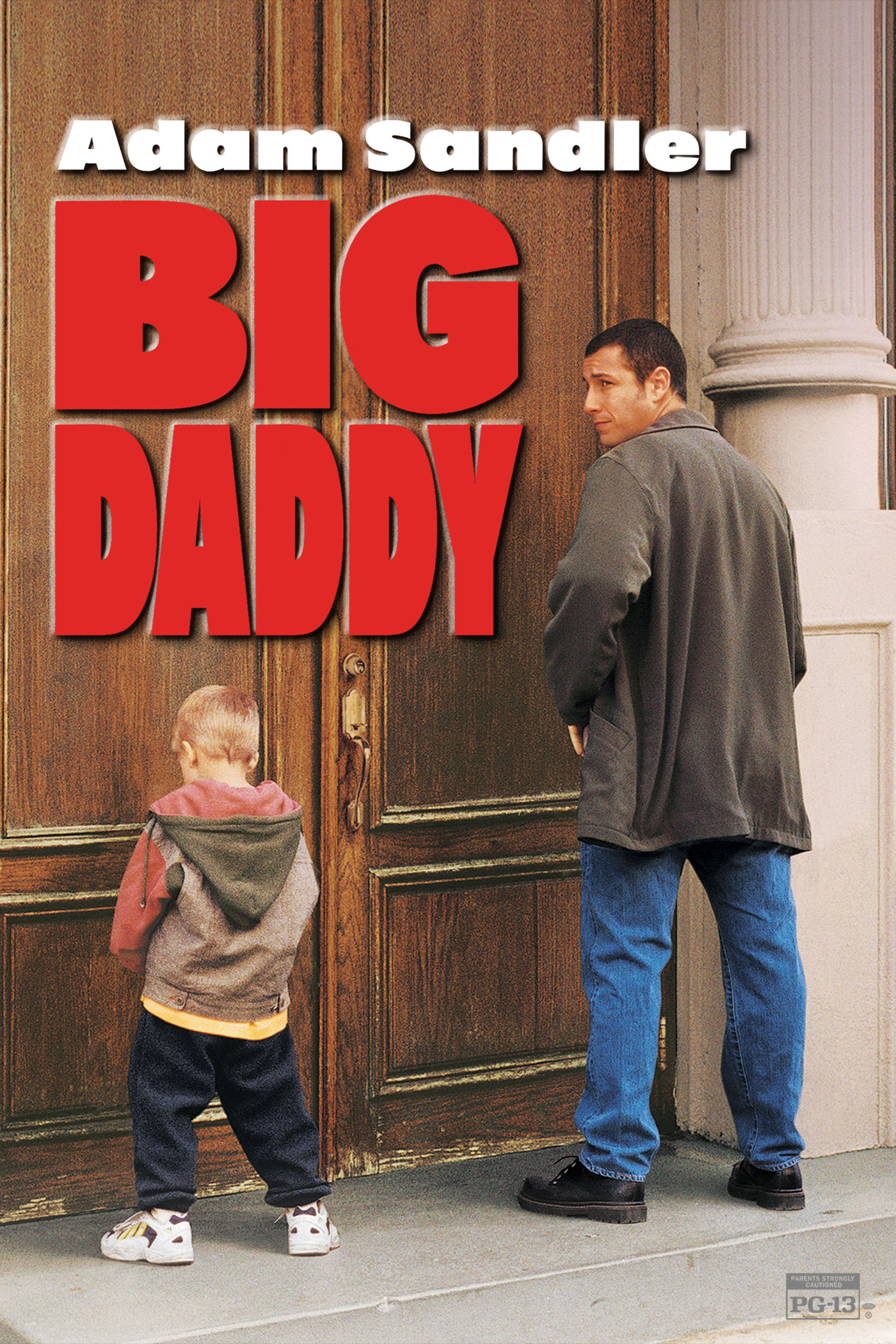
Big Daddy poster

Big Daddy

93 minutes

Cast

Selected cast credits ·

Adam Sandler Sonny Koufax
Joey Lauren Adams Layla Maloney
Jon Stewart Kevin Gerrity
Allen Covert Phil D’Amato
Josh Mostel Arthur Brooks
Dylan Sprouse Julian McGrath
Cole Sprouse Julian McGrath
Leslie Mann Corinne Maloney
Peter Dante Tommy Grayton
Kristy Swanson Vanessa
Joseph Bologna Lenny Koufax
Steve Buscemi Homeless Guy
Edmund Lyndeck Mr. Herlihy
Steven Brill Ted Castellucci
Jackie Sandler Waitress
Dennis Dugan Trick-or-Treat Giver

Big Daddy | The Rewatchables

Explore episodeClose episode

Half-Assed Internet Research

Production anecdotes, Sandler’s collaborators and box-office success

In the discussion (9)
Approx. transcript time · 00:19:38Read transcript
  • The stated opening weekend is $41.5 million and domestic total $163 million, making it his biggest 1990s film.
  • The cited reception scores are 40% Rotten Tomatoes and 41/100 Metacritic.
  • Sandler met his future wife Jackie on the film; her waitress role began a pattern of cameos.
  • Scuba Steve was invented for the film.
  • Allen Covert is described as Sandler’s NYU friend and a recurring collaborator in twenty-five films.
  • This was the last Sandler comedy before Happy Madison Productions was founded.
  • Dylan and Cole Sprouse played the child; their Friends and Disney careers are recalled.
  • Hand pumps simulated the urination scenes.
  • Syracuse references include a familiar local bar, prompting comparison with Holy Cross haunts.

Most Rewatchable Scene

The surprise birthday party / the kangaroo-show argument

In the discussion (5)
Approx. transcript time · 00:29:15Read transcript
  • Sonny spoiling the surprise birthday party and engagement is the first final choice.
  • The McDonald’s breakfast confrontation is funny but shockingly hostile, with Buscemi’s missed sausage sandwich adding to the scene.
  • Sonny sabotaging rollerbladers is an amusing but antisocial slapstick sequence.
  • The argument over playoff hockey versus the kangaroo show is nominated and becomes the other final choice.
  • Sonny sending the child to approach Layla works because she immediately recognizes his tactic.
In the discussion (3)
Approx. transcript time · 00:34:58Read transcript
  • The constant Hooters jokes and shaming of Leslie Mann’s character are the strongest 1999 marker.
  • The child’s cartoon is another dated element.
  • The gay couple’s presentation was both deliberately edgy and comparatively progressive for its moment.
In the discussion (6)
Approx. transcript time · 00:36:51Read transcript
  • Acceptance of Sonny’s gay friends holds up better than expected, including the child being taught to accept them.
  • Young Jon Stewart works as Sonny’s friend in a relatively small supporting part; an initial claim that he plays the brother is corrected.
  • Kristy Swanson and Leslie Mann are praised, with Mann the final preferred answer.
  • Mr. Herlihy continues Sandler’s funny pattern of confrontations with combative older men.
  • Sonny’s misguided parenting discovery—options rather than orders—is amusing.
  • The soundtrack captures its era through Sheryl Crow, Garbage, Limp Bizkit, Everlast, Big Audio Dynamite, Styx, Eurythmics, Springsteen, New Radicals and Harvey Danger.

Probably Unanswerable Questions

Why no Everclear “Father of Mine” on the soundtrack?; formal segment canceled

In the discussion (2)
Approx. transcript time · 00:43:28Read transcript
  • Why was Everclear’s Father of Mine absent from such a suitable soundtrack?
  • The formal unanswerable-questions category is canceled for lack of depth.

What’s Aged the Worst?

Hooters jokes about Leslie Mann’s character

In the discussion (6)
Approx. transcript time · 00:44:39Read transcript
  • The gay friends remain comparatively progressive, but their portrayal would benefit from greater nuance today.
  • The repeated Hooters jokes at Leslie Mann’s expense are the strongest choice.
  • The child’s television shows divide opinion.
  • The trick-or-treating break-in and taking a man’s watch are excessive.
  • The trial is considered long and boring, though the father’s criticism supplies welcome realism for another view.
  • Sonny’s reassuring courtroom speech to his father is unconvincing.
In the discussion (2)
Approx. transcript time · 00:51:39Read transcript
  • The Sprouse twins are proposed as benefiting from the film and their subsequent Disney success.
  • Sandler receives agreement: a major hit caps his comedy streak and positions him to launch his own production company.

Picking Nits

Age-inappropriate TV; delivery man’s illiteracy; absent father; changed attitude toward child; unaffordable lifestyle

In the discussion (5)
Approx. transcript time · 00:54:59Read transcript
  • The five-year-old watches programs aimed at substantially younger children.
  • Rob Schneider’s character’s inability to read is questioned as a comic premise.
  • Stewart’s character remains in China after learning a child has been left at his home.
  • Leslie Mann’s character’s eventual acceptance of the child seems inconsistent with her earlier opposition.
  • A $200,000 settlement and minimal tollbooth work cannot plausibly sustain Sonny’s New York apartment and lifestyle.

Who Won the Movie?

Sonny’s father and the judge / Adam Sandler

In the discussion (2)
Approx. transcript time · 00:57:38Read transcript
  • Sonny’s father is chosen for delivering a realistic judgment of his irresponsibility; the judge is added to that answer.
  • Adam Sandler is chosen for the career and production-company benefits and his unusual ability to sustain audience sympathy.
Podcast choices
Speaker not identified
Sonny’s father and the judge

More from the conversation

The 2024 introduction explains that the 2019 Luminary series is returning to the public feed; this conversation includes Bill Simmons, Joe House and Sean Fennessey, who leaves early.
Approx. transcript time · 00:02:46Read transcript
The rewatch coincides with Sandler’s first SNL hosting appearance after his departure, prompting a reassessment of his 1995–1999 film run.
Approx. transcript time · 00:04:36Read transcript
Billy Madison, Happy Gilmore, The Wedding Singer, The Waterboy and Big Daddy define the initial run; Bulletproof is initially excluded, then restored to the discussion.
Approx. transcript time · 00:05:22Read transcript
Sandler’s adolescent persona fits high-concept comedy despite modest-looking production, alongside the rise of Myers and Carrey.
Approx. transcript time · 00:06:07Read transcript
Big Daddy is regarded as a more mature transition and the run’s largest success, despite being a least-favorite entry for two participants.
Approx. transcript time · 00:06:52Read transcript
Showing the film to an eight-year-old leads to questions about Hooters and imitation of the film’s profanity, undermining its apparent family suitability.
Approx. transcript time · 00:07:34Read transcript
The Wedding Singer and Big Daddy broaden Sandler’s audience beyond young fans toward adults in their thirties and forties.
Approx. transcript time · 00:08:32Read transcript
Sandler’s reported four-billion-dollar career box office is considered impressive for comedies built around one performer rather than superheroes.
Approx. transcript time · 00:09:02Read transcript
SNL’s late-1980s ensemble of actors and writers gives way to movie-star personalities after Wayne’s World, weakening the show’s identity.
Approx. transcript time · 00:09:40Read transcript
Sandler’s Weekend Update songs and comedy albums create a distinctive kind of stardom, alongside stand-up performers such as Spade and Rock.
Approx. transcript time · 00:11:05Read transcript
Big Daddy is read as a reflection on and transition beyond Sandler’s man-child persona.
Approx. transcript time · 00:12:11Read transcript
His musical comedy recalls Steve Martin and earlier sketch traditions; the Hanukkah Song, Canteen Boy and Opera Man endure.
Approx. transcript time · 00:12:11Read transcript
Sandler’s movie-star potential was less obvious than Farley’s, but his personal comic instincts found an audience alongside other absurdist 1990s comedies.
Approx. transcript time · 00:13:12Read transcript
Grown Ups is defended as transparent entertainment that lets Sandler work with friends and make films for his children.
Approx. transcript time · 00:14:20Read transcript
Billy Madison and Happy Gilmore share a comic structure and became especially rewatchable through cable and the rise of DVDs.
Approx. transcript time · 00:14:37Read transcript
House’s first Rewatchables appearance prompts reflection on growing from Sonny’s age into married parenthood.
Approx. transcript time · 00:15:26Read transcript
The Wedding Singer succeeds as a sweeter date movie through Barrymore chemistry and 1980s nostalgia, though younger viewers may miss its references.
Approx. transcript time · 00:16:33Read transcript
Sandler’s romantic dialogue and charm make his relationships with attractive women unusually believable for the comic leading-man trope.
Approx. transcript time · 00:17:36Read transcript
The Waterboy is criticized as one-note and less funny, with its characterization and casting of Fairuza Balk also questioned.
Approx. transcript time · 00:18:50Read transcript
Sonny Koufax is praised as a memorable slacker name and a nod to Sandy Koufax.
Approx. transcript time · 00:20:48Read transcript
Little Nicky is condemned as an overpowered star’s high-concept misfire, compared with The Love Guru.
Approx. transcript time · 00:21:14Read transcript
Punch-Drunk Love divides the discussion between mild approval and a passionate defense as a great unconventional romance and acting breakthrough.
Approx. transcript time · 00:21:53Read transcript
Mr. Deeds, Eight Crazy Nights, The Hot Chick and Anger Management form an uneven post-Big Daddy run; the Nicholson pairing did not meet its promise.
Approx. transcript time · 00:22:15Read transcript
50 First Dates initiates a later adult-romantic-comedy phase, while Reign Over Me and The Meyerowitz Stories demonstrate dramatic range.
Approx. transcript time · 00:23:04Read transcript
The first hour of Funny People is praised as exceptional Sandler work, but the Leslie Mann storyline loses interest.
Approx. transcript time · 00:23:04Read transcript
The 2018 Netflix special and SNL return draw together Sandler’s music, stand-up, sketch, acting and family-film experience.
Approx. transcript time · 00:24:09Read transcript
Different generations adopt different Sandler favorites: newer viewers embrace Grown Ups, Just Go with It, Blended and Hotel Transylvania alongside earlier hits.
Approx. transcript time · 00:25:06Read transcript
Just Go with It is enthusiastically defended for its cast, Hawaiian setting and romantic farce.
Approx. transcript time · 00:26:15Read transcript
Sandler’s location choices and loyalty to friends are treated as an enviable way to work, with Spade’s career receiving particular attention.
Approx. transcript time · 00:27:10Read transcript
Fennessey leaves before the formal category discussion.
Approx. transcript time · 00:27:53Read transcript
The party scene recalls the difficulty of locating friends or estranged partners before texting and location apps, with mixed feelings about constant modern tracking.
Approx. transcript time · 00:29:33Read transcript
Jon Stewart’s supporting role prompts affectionate jokes about agent James Dixon, followed by acknowledgement that the commercially successful film was a good opportunity.
Approx. transcript time · 00:37:16Read transcript
Stewart’s acting efforts and Larry Sanders lead into memories of shared late-1990s television fandom.
Approx. transcript time · 00:38:29Read transcript
Long telephone conversations about television and the Malice at the Palace contrast with today’s texting habits.
Approx. transcript time · 00:39:00Read transcript
Swanson’s career prompts disagreement over whether she should have become bigger, with The Program praised and later projects seen as losing momentum.
Approx. transcript time · 00:39:52Read transcript
The cast of She’s the One is recalled enthusiastically, particularly Aniston during her Friends peak.
Approx. transcript time · 00:41:17Read transcript
Sandler’s romantic casting choices include Bridgette Wilson, Julie Bowen, Drew Barrymore, Jennifer Aniston and Salma Hayek.
Approx. transcript time · 00:41:58Read transcript
The serious orphaned-child premise is considered too weighty for the film’s casual comedy, although it signals an attempt at greater ambition.
Approx. transcript time · 00:46:24Read transcript
Murray’s Stripes character is compared with Sonny as an underachiever pressured to grow up.
Approx. transcript time · 00:48:33Read transcript
Memories of cheap draft beer and unpleasant college bars conclude the Syracuse tangent.
Approx. transcript time · 00:50:56Read transcript
Kyle briefly expresses affection for the film amid the argument over its quality.
Approx. transcript time · 00:52:21Read transcript
Sandler’s ability to make an irresponsible protagonist sympathetic is praised, with Will Ferrell considered a possible comparison.
Approx. transcript time · 00:58:01Read transcript