
‹ All movies
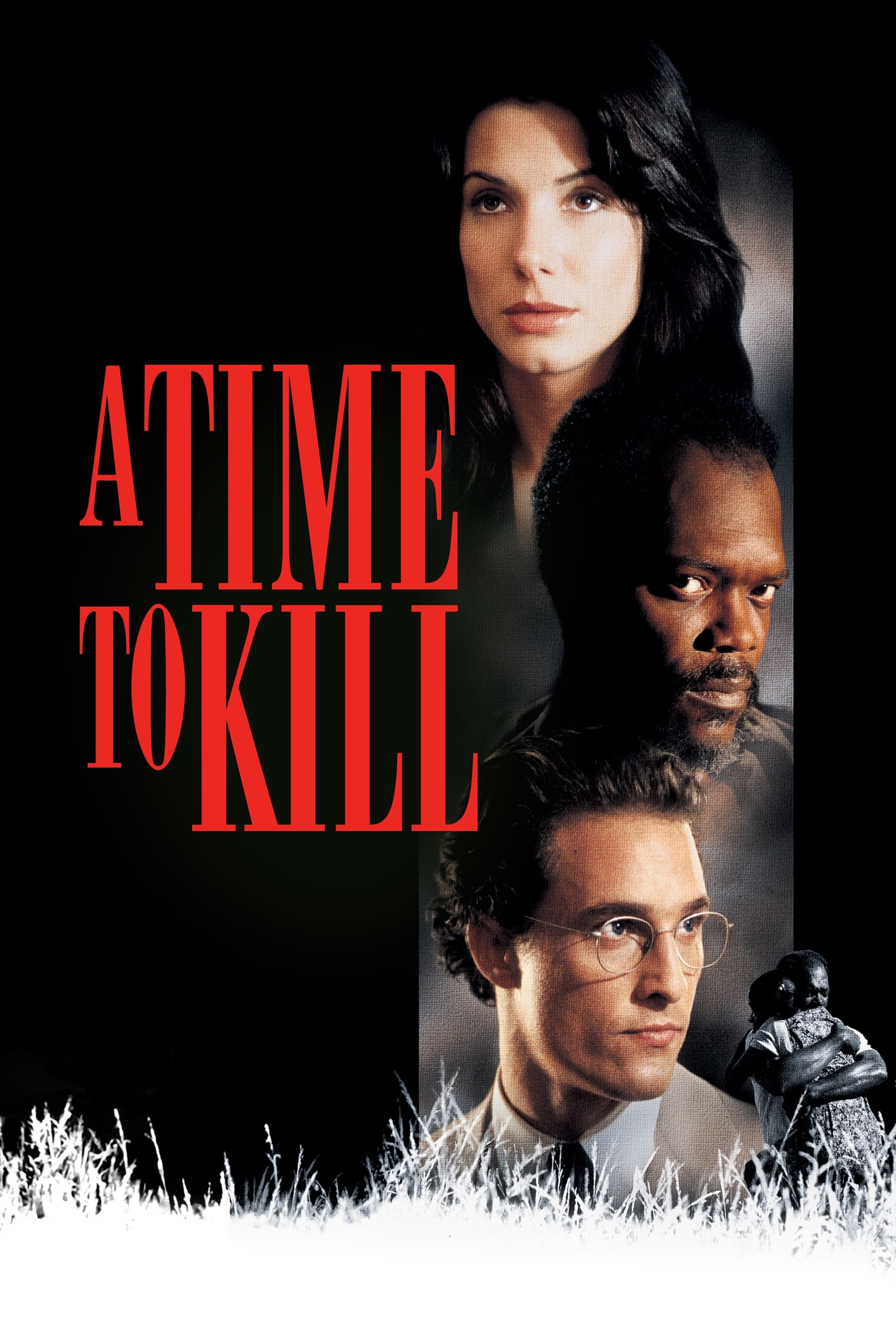
A Time to Kill poster

A Time to Kill

149 minutes

Cast

Selected cast credits · Film reference

Matthew McConaughey Jake Brigance
Sandra Bullock Ellen Roark
Samuel L. Jackson Carl Lee Hailey
Kevin Spacey Rufus Buckley
Ashley Judd Carla Brigance
Donald Sutherland Lucien Wilbanks
Oliver Platt Harry Rex Vonner
Charles S. Dutton Ozzie Walls
Brenda Fricker Ethel Twitty
Kiefer Sutherland Freddie Lee Cobb
Patrick McGoohan Judge Omar Noose
Tonea Stewart Gwen Hailey
John Diehl Tim Nunley
Chris Cooper Dwayne Looney
Nicky Katt Billy Ray Cobb
Doug Hutchison Pete Willard
Kurtwood Smith Stump Sisson
Tim Parati Winston
Beth Grant Cora Mae Cobb
Anthony Heald Wilbert Rodeheaver
M. Emmet Walsh Willard Tyrell Bass (uncredited)
Octavia Spencer Roark's Nurse
Darrin Mitchell Skip Hailey
LaConte McGrew Slim Hailey
Devin Lloyd Willie Hailey
Mark W. Johnson Willie Hastings
Joe Seneca Reverend Isaiah Street
Thomas Merdis Reverend Ollie Agee
Alexandra Kyle Hannah Brigance
Terry Loughlin Jury Foreman
Andy Stahl Reluctant Male Juror
Joe Bullen Joe Frank Perryman
Lorraine Middleton Blonde Woman Juror
Graham Timbes Male Juror
Jonathan Hadary Norman Reinfield
Benjamin Mouton Klan Bomber
Byron Jennings Brent Musgrove
Patrick Sutton Militant Teenager
Greg Lauren Taylor
Danny Nelson Bud Twitty
Mike Pniewski Deputy Tatum
Elizabeth Omilami Woman Angry at Klan
Lukas Cain Looney's Son
Stacy Rae Toyon Looney's Wife
Wayne Dehart Claude
Helen E. Floyd Waitress at Claude's
David Brian Williams Customer at Claude's
James M. Crumley Jr. Guardsman Mackenvale
Jim Ritchie Tom Hardy
Perry Ritchie Sarah Hardy
Mike McLaren Administrator at Whitfield
Tim Monich Reverend Fink
Leonard L. Thomas Man in Lumberyard
Brance H. Beamon Noose's Butler
Mildred J. Gilbreath Noose's Housekeeper
Will Crapps Minister
David U. Hodges Bailiff
Maggie Wade Dixon T.V. Anchor
Russell Hambline Old Man Bates
Robert Chapman Young Fisherman
Robert R. Bell Jr. Fisherman
Tommy McCullough Old Fisherman
Bettina Rose Evelyn
Terrance Freeman Court Deputy
Alice Julius-Scott N.A.A.C.P. Woman
William Truly Jr. N.A.A.C.P. Man #1
Walter L. Hutchins N.A.A.C.P. Man #2
Jerry Hunt John
Howard Ballou Reporter #1 with Hastings
Todd Demers Reporter #1 with Jake
Stephanie Strickland Stephanie (Reporter #1 with Buckley)
Kim Hendrix Kim (Reporter #2 with Buckley)
Rob Jay Reporter #3 with Buckley
Sherri Hilton Reporter #2 with Jake
Steve Coulter Klansman
Jackie Stewart Fire Chief
Rosebud Dixon-Green Woman at Rally

A Time to Kill | The Rewatchables

Explore episodeClose episode

The Stephen A. Smith Hottest Take Award

McConaughey peaked before stardom; career ambition and hairline speculation; Bullock’s appearance

In the discussion (3)
Approx. transcript time · 00:18:26Read transcript
  • This is proposed as Bullock’s most attractive screen appearance, explicitly offered as a backup hot take.
  • The favorite McConaughey performances are Dazed and Confused and this film, both made before his stardom; the following decade failed to deliver on the breakthrough promise.
  • McConaughey’s hairline and reluctance to perform the work of maintaining fame are proposed as factors limiting his career, with Cusack and Cage comparisons; this is speculative interpretation.

Most Rewatchable Scene

Carl Lee’s jail speech and Jake’s closing summation, combined

In the discussion (13)
Approx. transcript time · 00:37:35Read transcript
  • Dutton arresting the two attackers in a Southern bar, followed by Jake learning what happened from Cooper, is praised as an effective setup.
  • Carl Lee’s courthouse shooting is nominated as an effective, shameless action sequence, including his preparation the night before.
  • The early hearing with Bullock’s motion and Kiefer’s hostile sideways look is nominated.
  • Carl Lee visiting Cooper after shooting him is an emotional favorite.
  • Carl Lee turning the tables on the reverend and civil-rights organization is nominated.
  • Jake and Ellen’s flirty lunch while recruiting her to the case is praised for the actors’ chemistry, distinct from the later hotel sequence.
  • The jury-selection sequence is nominated.
  • Deputy Looney’s insistence that Carl Lee is a hero who should be freed is a major witness-stand highlight.
  • Carl Lee’s declaration that the attackers deserved to die and should burn in hell is another explosive courtroom highlight.
  • Carl Lee’s jail speech identifies Jake as his secret weapon precisely because he shares the white jury’s perspective.
  • Jake’s final summation is one participant’s first choice and proposed as McConaughey’s greatest career moment.
  • The verdict itself is also nominated.
  • The final preference combines the jail speech and summation because Carl Lee’s challenge supplies the emotional and moral foundation for Jake’s closing.

What’s Aged the Best?

Mississippi atmosphere; cast presence; surnames; familiar character actors; lawyer’s office

In the discussion (8)
Approx. transcript time · 00:45:56Read transcript
  • The sweaty Mississippi atmosphere makes the setting physically palpable.
  • Bullock and Judd’s screen presence and Kiefer’s committed villainy remain strengths.
  • Platt’s prepared but spontaneous presence and playful chemistry with Bullock are praised.
  • Attractive female characters addressed by surname, such as Roark, are nominated.
  • Anthony Heald’s familiar smarmy-doctor persona makes his unreliability instantly recognizable from The Silence of the Lambs.
  • John Diehl’s sympathetic Klansman role is recalled, while the idea that a Klansman can be a good guy is explicitly challenged.
  • Research reportedly claims McConaughey began filming while dating Judd and subsequently dated Bullock for two years; the claim surprises the other participant and is not independently established.
  • The old-fashioned lawyer’s office with a secretary announcing visitors and managing the day is a timeless movie device.

What’s Aged the Worst?

Accents; thin Black characters; Spacey; Lucien; dynamite; near-affair

In the discussion (6)
Approx. transcript time · 00:53:00Read transcript
  • Fricker’s Southern accent is criticized as an unnecessary use of an Irish actor in Mississippi.
  • The lack of developed Black characters and Schumacher’s suitability as a white director are challenged.
  • Spacey’s later reputation and broadly villainous performance are both criticized, while the film itself is not blamed for later events.
  • Donald Sutherland’s drunken mentor and accent disappoint; Richard Harris, Peter O’Toole, Hopkins or an actual Southern veteran are imagined as alternatives.
  • The dynamite disposal, throwing it toward a tree before it explodes, is called ridiculous.
  • Jake and Ellen’s drunken near-affair is considered implausibly restrained; the discussion distinguishes physical fidelity from emotional adultery and notes Hollywood’s need to preserve audience sympathy.
In the discussion (1)
Approx. transcript time · 00:57:50Read transcript
  • Roark’s purpose and ending are questioned: she volunteers, approaches an affair, suffers severe violence and is left with only a hospital reaction to the acquittal; missing scenes or test-screening cuts are speculation.

Is There a Better Title for This Movie?

Town-based title; specific wording not supplied

In the discussion (1)
Approx. transcript time · 00:59:16Read transcript
  • A title using the town’s name is proposed because the community and its residents should be the real subject; no specific replacement wording is supplied.
In the discussion (5)
Approx. transcript time · 01:10:04Read transcript
  • Patrick McGoohan is the principal choice.
  • John Diehl is another candidate.
  • Anthony Heald is nominated, with the participant suggesting he is recognizable by name.
  • Joe Seneca is nominated through his familiar Verdict role, with a brief eligibility dispute because one participant knows his name.
  • LaTanya Richardson is nominated and praised for theater work; this is the conversation’s nomination, not an independently confirmed cast credit.

Apex Mountain

Grisham’s mid-1990s adaptation boom; Nicky Katt villains, qualified

In the discussion (7)
Approx. transcript time · 01:14:32Read transcript
  • McConaughey’s later Dallas Buyers Club, True Detective, Magic Mike and Wolf of Wall Street period is preferred over this film.
  • Jackson’s peak is placed around Jackie Brown the following year rather than here.
  • Grisham is placed in this mid-1990s adaptation boom, with The Pelican Brief’s release corrected back to 1993.
  • Bullock is judged not yet at her peak, with The Blind Side Oscar offered as a later milestone.
  • Judd’s peak is assigned to Double Jeopardy.
  • Nicky Katt villains receive a qualified affirmative choice over Dazed and Confused, based on the impact of a few minutes as an overt racist.
  • The early-1960s green Porsche is rejected in favor of Dylan McKay’s longer television run.

Sequel, Prequel, Limited Series, or All-Black Remake

Prestige TV; A Time for Mercy adaptation reported in development

In the discussion (1)
Approx. transcript time · 01:33:36Read transcript
  • Prestige television is considered promising; the reported 2020 sequel novel A Time for Mercy and McConaughey’s attachment to an HBO adaptation supply the concrete possibility, with development status unknown.

The Coach Finstock Award for Best Life Lesson

White people; racial identification wins the case, a depressing conclusion

In the discussion (2)
Approx. transcript time · 01:37:33Read transcript
  • White people is offered as an exasperated lesson rather than a clear moral conclusion.
  • The apparent happy ending is challenged as depressing: Carl Lee avoids prison by exploiting racial identification, which offers little genuine resolution for Black viewers.