
‹ All movies
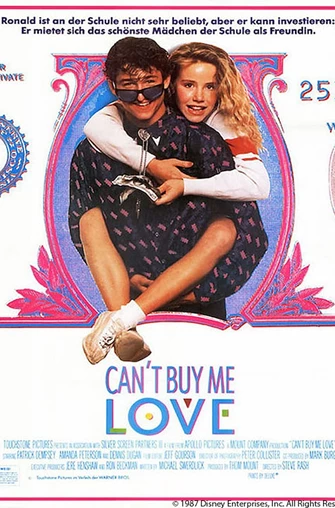
Can't Buy Me Love poster

Can't Buy Me Love

94 minutes

Cast

Selected cast credits · Film reference

Patrick Dempsey Ronald Miller
Amanda Peterson Cindy Mancini
Courtney Gains Kenneth Wurman
Tina Caspary Barbara
Seth Green Chuckie Miller
Sharon Farrell Mrs. Mancini
Dennis Dugan David Miller
Eric Bruskotter Big John
Cort McCown Quint
Cloyce Morrow Judy Miller
Steve Franken Moda Clerk
Ami Dolenz Fran
Max Perlich Lester
Phil Simms Rock
George Gray III Bobby Hilton
Jimmie Lee Mitchell Mr. Webbly
Jan Rooney Mrs. Hagmer
James Gooden Mr. Wurman
Erin O'Flaherty Jr. Wurman
Ty Gray Duane
Will Hannah Camera salesman
Todd Walsh Stocky Jones
Wayne Chandler African host
Meredith Wagelie Freshman #1
Jennifer Nelson Freshman #2
Corissa Miller Transfer girl
Lisa Givens Bambi La Brock

Can't Buy Me Love | The Rewatchables

Explore episodeClose episode

The Stephen A. Smith Hottest Take Award

Popularity template; borrowed tropes; boyfriend’s accusation structurally essential

In the discussion (3)
Approx. transcript time · 00:03:06Read transcript
  • The film is called exceptionally influential for making the pursuit of popularity a teen-movie template, with Drive Me Crazy and 10 Things I Hate About You as descendants.
  • The film’s obliviousness-to-romance and abandoning-old-friends patterns are seen again in Mean Girls and Beverly Hills 90210.
  • The college boyfriend explicitly naming the transactional relationship is argued to be essential to the film’s structure.

Probably Unanswerable Questions

Transactional teen romances; Beatles licensing; slow clap origins; reunion plausibility

In the discussion (4)
Approx. transcript time · 00:04:41Read transcript
  • Other teen romances centered on a monetary transaction are sought, with Pretty Woman as a later comparison.
  • The Beatles song was reportedly licensed for$110,000 from Michael Jackson; the claimed screening for his approval is doubted.
  • The film did not invent the slow clap; research identifies Brubaker as an earlier example, tentatively the first.
  • Whether Cindy would take Ronald back after his other relationships is questioned; the reunion is imagined to falter after a few months.

Half-Assed Internet Research

Peterson career; finances; production; dance; cars; reunions; music

In the discussion (17)
Approx. transcript time · 00:16:24Read transcript
  • Peterson followed the film with the one-season A Year in the Life.
  • Listen to Me with Kirk Cameron and Roy Scheider was considered a poor next film for Peterson.
  • The discussion reports her parents’ account of a sexual assault during her teenage television work and its lasting harm; subsequent struggles are treated as a tragic story.
  • An initial denial that Peterson died from overdose is explicitly corrected to accidental overdose; her acting credits are said to end in 1994.
  • The stated gross is$31.6 million against a reported$1.7 million budget, though the independently made film’s budget is acknowledged as uncertain.
  • Dempsey reportedly still receives requests to perform the dance.
  • The actor playing Kenneth is recalled as Malachi in Children of the Corn and as reuniting with Dempsey in Sweet Home Alabama.
  • Gains reportedly said the studio wanted the house accusation removed as too edgy, but the producers defended it.
  • Paula Abdul choreographed the film.
  • Striking crew members reportedly can be seen picketing during cheerleader scenes.
  • Dempsey reportedly spent his salary on a 1963 Porsche 356 convertible that remains meaningful to him.
  • The airplane graveyard is located outside Davis-Monthan Air Force Base in Tucson.
  • Dempsey and Green reunited in a two-episode Grey’s Anatomy story.
  • Darcy DeMoss was reportedly 23, eight years older than Peterson.
  • The project went through TriStar turnaround to Apollo Pictures, was independently made, then sold to Disney for$6 million; it is described as Disney’s second licensed film.
  • Chuck Lorre wrote a song heard in the car.
  • The production reportedly compensated the school with a football field and stage; whether cash would have been better is debated.

What’s Aged the Best?

Cindy; young Dempsey; Cabriolet; Tucson; Easy A homage; Seth Green; jokes; fashion; makeover

In the discussion (16)
Approx. transcript time · 00:19:24Read transcript
  • Cindy is unusually likable for a teen-film heroine: genuine, morally grounded, poetic, and aware of her boyfriend’s and friends’ faults.
  • Seeing young Dempsey before his Grey’s Anatomy fame is praised.
  • Cindy’s Volkswagen Cabriolet is admired as an iconic car; a roommate’s similar convertible inspired teasing about its feminine image.
  • The Cabriolet’s unsafe open design is part of its appeal, with memories of crowded, unbelted rides.
  • Tucson’s palm trees, Spanish tile, and low houses make 1980s Arizona an appealing film location.
  • Easy A’s explicit tribute to the ending reinforces the film’s influence.
  • Early Seth Green as the mischievous younger brother is enjoyed, especially his constant presence in the car and freedom from consequences.
  • The49.95dating offer is funny after Ronald hits bottom.
  • Cindy’s increasingly absurd telephone excuses are funny.
  • The performer known for Rico Suave appears as Ricky and reportedly called the film more enduringly popular than his hit song at a reunion.
  • Cindy’s retort to her friends about recognizing a lady displays her moral judgment.
  • Big John’s farting gag is enjoyed as juvenile humor, and the character is considered likable.
  • Cindy’s outfits remain fashionable, including skirts, boots, crop tops, jeans, and the opening jacket combination.
  • Ronald’s NASA shirt and Adidas sneakers now resemble desirable fashionable vintage clothes.
  • The$1,000 offer remains an understandable incentive.
  • Removing glasses for an instant makeover remains an influential trope.

Roger Ebert's review

In the discussion (2)
Approx. transcript time · 00:21:33Read transcript
  • Ebert gave 0.5 stars; no denominator is stated.
  • Ebert’s review condemns the film’s materialism and argues that the premise would work only as satire.

Most Rewatchable Scene

Kenneth’s arcade confrontation

In the discussion (24)
Approx. transcript time · 00:26:59Read transcript
  • The telescope-shopping encounter where Ronald pays Cindy to date him is nominated.
  • Accepting the dating offer is considered understandable, and Ronald’s purchase of access to a new social world is defended as a smart decision.
  • The car-wash scene marks the couple beginning to connect, with Cindy sharing her secret poetry.
  • Cindy’s poem is mocked as badly written; its earnest delivery and Ronald later stealing it make the scene increasingly funny.
  • The final contracted date at the airplane graveyard is nominated.
  • The real airplane graveyard is praised as an exceptional date location.
  • Ronald introduces Cindy to an unfamiliar part of her hometown, reversing who opens a new world for whom.
  • Ronald failing to recognize Cindy’s obvious romantic interest on their last date is considered implausible.
  • The African Anteater Ritual scene is nominated as an encapsulation of1980s teen films.
  • The band, terrible songs, and nerd-herd insult contribute to the dance scene’s period character.
  • Everyone copying Ronald’s strange dance makes the scene both funny and painfully awkward.
  • Cindy watching the others imitate Ronald highlights her better judgment.
  • Peterson’s drunk acting in Cindy’s exposure scene is praised.
  • Cindy exposing the paid relationship after hearing the stolen poem is praised as a devastating attack on the followers.
  • Can’t Hardly Wait is praised for adapting the public-exposure scene with a different accusation rather than merely copying it.
  • The Halloween prank against Kenneth’s house is nominated as the moment Ronald betrays his friend to gain approval.
  • Kenneth rejecting the arcade apology with the house accusation is praised as an iconic and unusually specific comic explosion.
  • The friendship is considered beyond repair after the prank, despite the eventual reconciliation.
  • Ronald defending Kenneth in the cafeteria and rejecting social factions is nominated as the moral turnaround.
  • The handshake and earnest slow clap are praised as famous teen-film conventions, later used ironically.
  • The lawnmower ending is praised as clever symbolism and cited as an influence on Easy A.
  • The apparently departed lover reappearing is compared with Reality Bites and later romantic comedies.
  • The arcade confrontation is the first final scene choice, with the dance explicitly second.
  • The second final choice also selects the arcade confrontation, praising Kenneth’s look-away and emphatic performance amid the video games.

Picking Nits

Costs; car; prank; time jump; sleeves; television; romance; supervision; Bobby; exposure; surname; college

In the discussion (15)
Approx. transcript time · 00:27:32Read transcript
  • The replacement jacket and telescope conveniently cost the same amount.
  • Cindy letting Ronald drive her car is questioned as an unjustified extra benefit of the deal.
  • Ronald should recognize the annual prank’s target because he knows Kenneth and his history.
  • Sharing a confined vehicle with dog feces is considered too disgusting to justify any popularity reward.
  • The pranksters make identification easy by using real names and a recognizable van.
  • The departure jumps immediately from midday to sunset.
  • The$1,000s uede outfit price is disputed: high-quality material might justify it, while how Cindy’s mother affords it is a separate question.
  • Cindy tearing off the shirt sleeves so easily is considered implausible.
  • American Bandstand’s continuing relevance is questioned but defended for a sheltered nerd; mistaking the other program for it is considered implausible.
  • Ronald missing Cindy’s affection and moving on without falling in love with her are considered implausible.
  • The younger brother’s unsupervised freedom is questioned.
  • Bobby receiving little attention at the party is questioned; high-school seniors protecting their own status is a possible explanation.
  • Ronald could deny the paid arrangement or counterattack when Cindy exposes him rather than retreat.
  • The pronunciation of Mancini is questioned against the name’s apparent Italian origin.
  • The absence of college plans, entrance tests, or discussion is considered unrealistic.

Sequel, Prequel, Limited Series, or All-Black Remake

Dempsey as father; darker gender-reversed television series

In the discussion (8)
Approx. transcript time · 00:34:12Read transcript
  • The 2003 Nick Cannon film is identified as an already-completed all-Black remake.
  • A sequel would make Dempsey the father of a daughter trying to become popular.
  • An eight-episode television version would reverse the genders and become much darker.
  • A character learning the paid relationship’s secret could be murdered, leaving the popularity-seeker to cover it up.
  • Using the payment for drugs rather than a replacement outfit is another proposed variation.
  • Sam Levinson is imagined as an executive producer involved in the pilot rather than the writer.
  • Sarah Michelle Gellar is proposed as the mother alongside Dempsey as the father.
  • Gains is proposed as a schoolteacher, with the new story again set in Arizona.

Dracula the Musical Award for Best Imitation of Real Art

African Anteater Ritual television program

In the discussion (2)
Approx. transcript time · 00:50:33Read transcript
  • The fake television program featuring the African Anteater Ritual is selected as convincing period television.
  • Cindy’s poetry is suggested but rejected as an example of the worst rather than best imitation of art.

Cindy Mancini Worst Poetry Award

Cindy’s poetry; joking proposal

The panel proposes a new category here.

In the discussion (1)
Approx. transcript time · 00:51:15Read transcript
  • A Cindy Mancini Worst Poetry Award is jokingly proposed without a distinct sustained category answer.

What’s Aged the Worst?

Age gap; Bobby’s acting; remake; mother’s date; moon prediction; restroom hygiene; slurs; stereotyping; locker-room depiction

In the discussion (9)
Approx. transcript time · 00:53:40Read transcript
  • The lead actors’ filming ages, Peterson 15 and Dempsey 20, are raised as surprising.
  • Bobby’s acting is criticized, though his disengaged television interview is defended as realistic for a college quarterback.
  • Love Don’t Cost a Thing is rejected as a poor remake, including its changed title.
  • Cindy’s mother’s date flirting with Cindy has aged poorly but helps explain the family relationship.
  • Ronald’s prediction of ordinary moon habitation has not come true.
  • The teacher leaving the restroom without washing her hands is criticized.
  • Disability slurs and special-education insults are criticized.
  • The African program and dance naming are criticized for stereotyping.
  • The girls’ locker-room depiction is criticized as an unrealistic adult male fantasy.
In the discussion (7)
Approx. transcript time · 01:02:37Read transcript
  • Iris is an initial heat-check candidate.
  • Big John is an initial heat-check candidate.
  • Seth Green is an explicit heat-check choice.
  • The Seth Green choice is reaffirmed after the case for Cindy’s mother.
  • Cindy’s mother is selected because her view of Ronald effectively establishes his outsider status.
  • The mother’s sketchy boyfriend helps explain Cindy’s circumstances.
  • The mother buying the suede outfit causes the story, and the mother–daughter relationship works with little screen time.

Recasting Couch

Roberts; Connelly; Applegate; Ryder; Doherty; tentative Milano

In the discussion (7)
Approx. transcript time · 01:03:14Read transcript
  • Cindy’s friends should be played by actors closer to the characters’ ages.
  • Julia Roberts is proposed as one of Cindy’s friends.
  • Jennifer Connelly is proposed as one of Cindy’s friends.
  • Christina Applegate is proposed as one of Cindy’s friends.
  • Winona Ryder is proposed as one of Cindy’s friends.
  • Shannen Doherty is proposed as one of Cindy’s friends.
  • Alyssa Milano is proposed for Iris despite concern she might be too young.

Apex Mountain

Amanda Peterson; lawnmowers; Courtney Gains; Cabriolet; Arizona films; borderline transactional rom-coms

In the discussion (10)
Approx. transcript time · 01:06:59Read transcript
  • Dempsey is rejected.
  • Peterson receives an agreed yes.
  • Lawnmowers receive a yes, with the Mad Men accident as a comparison.
  • High-school movies are rejected as a whole.
  • Striving-for-popularity films are tentatively proposed, then tempered by Mean Girls and the distinction between influence and peak quality.
  • Courtney Gains receives a yes.
  • Tucson is proposed without a resolved comparison; Spielberg’s hometown is uncertain.
  • The Volkswagen Cabriolet receives an emphatic yes.
  • Arizona films receive an agreed yes after Raising Arizona is mentioned.
  • Borderline transactional-romance comedies receive a yes, distinguishing the film from overt prostitution stories and the payment structure of 10 Things I Hate About You.

Just One Oscar

Nobody; forced choice Dempsey

In the discussion (2)
Approx. transcript time · 01:16:03Read transcript
  • Nobody is judged to deserve an Oscar.
  • If forced to select someone, Dempsey is chosen.

Keep Getting Them Checks Award

Michael Jackson

The panel proposes a new category here.

In the discussion (1)
Approx. transcript time · 01:16:21Read transcript
  • Michael Jackson receives the payment award for licensing the Beatles song.

The Andy and Red – Zihuatanejo Award for What Happens the Next Day?

Breakup at college; unresolved space career; Cindy’s university future

In the discussion (3)
Approx. transcript time · 01:18:05Read transcript
  • Ronald and Cindy are expected to date only until college, roughly three or four more months.
  • Ronald’s possible NASA career and disappointment in space exploration are posed as unresolved future questions.
  • Cindy is imagined attending an Arizona university, joining a sorority, and finding someone better or repeating bad relationship choices.

The Coach Finstock Award for Best Life Lesson

Stay loyal; respect borrowed clothes; dry-clean suede; be yourself

In the discussion (4)
Approx. transcript time · 01:19:13Read transcript
  • Never betray your friends.
  • Do not borrow a parent’s best clothing without permission.
  • Do not put water on stained suede; seek a dry cleaner.
  • Remain yourself instead of changing to please others.
In the discussion (3)
Approx. transcript time · 01:20:07Read transcript
  • Dempsey receives the first final choice because the film launched him and helped fuel his later revival.
  • The second final choice revises an original-release preference for Peterson to Dempsey after 35 years, while lamenting Peterson’s lost opportunities.
  • Green receives an additional commendation for the unusual role not derailing his career.
Podcast choices
Speaker not identified
Patrick Dempsey
Speaker not identified
Patrick Dempsey

Producer review

Strong premise, shoddy execution; Peterson essential

In the discussion (1)
Approx. transcript time · 01:21:15Read transcript
  • The invited producer argues that 1980s films had strong concepts but weaker execution, with Peterson’s convincing performance essential here.

More from the conversation

The two-Bachelorette season and upcoming cruise setting are discussed before the film.
Approx. transcript time · 00:01:11Read transcript
The episode explicitly marks the film’s thirty-fifth anniversary.
Approx. transcript time · 00:02:15Read transcript
The film is placed in the teen-movie progression from Fast Times and Risky Business through Hughes films, sports variants, and gender-comedies; Breakfast Club is a possible earlier popularity precedent.
Approx. transcript time · 00:05:29Read transcript
Its continued appeal to younger viewers raises the question of whether teen films describe high school or teach audiences what to expect.
Approx. transcript time · 00:06:25Read transcript
The cast apparently not remaining a close clique is considered unusual for a breakout teen film.
Approx. transcript time · 00:06:57Read transcript
Without internet or much high-school television, repeated cable movies shaped expectations of other schools and social possibilities.
Approx. transcript time · 00:07:54Read transcript
Peterson’s performance inspired intense admiration and expectations of stardom; an alternate Lori Loughlin-style television career is imagined.
Approx. transcript time · 00:08:58Read transcript
Dempsey’s later Grey’s Anatomy revival benefited from affection for this film; a personal account recalls crying over McDreamy’s death spoiler and pandemic-era dream return.
Approx. transcript time · 00:09:36Read transcript
Whether Dempsey seems likable offscreen is questioned, leading to discussion of his age-gap first marriage and disputed chronology of friendship with his stepson.
Approx. transcript time · 00:10:30Read transcript
Some Girls, Loverboy, Run, Mobsters, and With Honors failed to establish Dempsey as expected before his later television revival.
Approx. transcript time · 00:11:37Read transcript
The simple popularity, self-betrayal, and redemption structure is praised despite substantial flaws.
Approx. transcript time · 00:12:41Read transcript
Sweet Home Alabama is credited with restoring Dempsey’s lovable adult image before Grey’s Anatomy.
Approx. transcript time · 00:13:15Read transcript
The Southwest setting and school architecture resemble 90210 and Just One of the Guys, with cafeteria table hierarchy becoming a familiar teen-film visual.
Approx. transcript time · 00:14:48Read transcript
Teen films repeatedly reduce school to jocks, cheerleaders, nerds, and outsiders, with Ferris and Cameron another popular/unpopular friendship.
Approx. transcript time · 00:15:38Read transcript
Posthumous focus on Peterson’s drug use is criticized as intrusive after she left public life; contemporaneous coverage of these stars is described as sparse.
Approx. transcript time · 00:17:39Read transcript
Teen heroines are compared unfavorably with Cindy, including Ringwald, Joey Potter, Kelly Taylor, Brenda, and Kat; Ferris’s girlfriend, Just One of the Guys, and Secret Admirer provide more sympathetic alternatives.
Approx. transcript time · 00:19:24Read transcript
Nostalgia and foundational influence are offered in defense of flawed 1980 steen movies, contrasting their accessible realism with musicals and earlier darker films.
Approx. transcript time · 00:22:07Read transcript
Whether film-based teen heartthrobs emerged in the 1980 sis debated, with music and television stars, Kirk Cameron, Perry, and Priestley as comparisons.
Approx. transcript time · 00:23:37Read transcript
Thoughtful adult-written teen screenplays are contrasted with formulaic streaming versions; recent television series are praised as a counterexample.
Approx. transcript time · 00:24:40Read transcript
Dennis Dugan’s later Sandler directing career prompts enthusiasm for Just Go With It and its unlikely characters.
Approx. transcript time · 00:53:11Read transcript
Slow Clap February is proposed as a future theme, not the current episode theme.
Approx. transcript time · 01:17:40Read transcript
Easy A is described as a spiritual remake reversing the transactional roles; Dempsey is imagined as Olive’s father.
Approx. transcript time · 01:21:49Read transcript
The closing credits producer Craig Horlbeck.
Approx. transcript time · 01:24:14Read transcript