Film credit
John Witherspoon
Also referred to as Johnny Witherspoon, John Weatherspoon
Stats
- Episodes featuring their films
- 1
- Movies in this archive
- 1
Rewatchables episodes featuring John Witherspoon’s films
Mentioned in discussions

In the discussion (4)
- The candidates include Chris Rock, John Witherspoon, BB Drake, Eartha Kitt, the unnamed man commenting on the nipple, and the girl in the art class. — Bill Simmons
- Witherspoon’s dinner is considered possibly the movie’s most memorable scene. — Van Lathan
- His nine minutes are compared to a 29-point performance that swings the score. — Bill Simmons
- The panel keeps the Dion Waiters name but places Witherspoon in the prospective category Hall of Fame. — Bill Simmons


Most Rewatchable Scene
Split: John Witherspoon’s dinner sequence; Grace Jones’s first perfume-boardroom scene
In the discussion (13)
- The opening lunch establishes the three friends through Marcus’s dating philosophy and Martin’s asparagus riff.
- Marcus sleeping with Lady Eloise and then meeting Jacqueline at work is praised as a perfect six-minute comic sequence. — Bill Simmons
- Jacqueline’s party flirtation works because Robin Givens matches Eddie Murphy’s confidence and control.
- The art-class scene is praised for Eddie Murphy imitating the little girl, recalling his earlier comic appeal. — Bill Simmons
- The John Witherspoon dinner is praised for its mushroom outfit, sexual advice, bathroom reveal and improvised family chaos. — Bill Simmons
- One host argues the dinner also explains Gerard’s vulnerability and why Marcus’s later betrayal hurts him. — Van Lathan
- The pool game makes Marcus’s embarrassment over Angela visible while preserving the friendship’s comic rhythm.
- The rooftop reconciliation culminates in Martin arriving late to demand another hug and then moves into the P.M. Dawn song.
- Two hosts select the Witherspoon sequence. — Wesley Morris
- Wesley selects Grace Jones’s first boardroom pitch and the “Steel Vagina” suggestion. — Wesley Morris
- One objection is that the dinner sequence was shoehorned into the story and is not needed for the plot, even though its comic digression is pleasurable. — Wesley Morris
- The scene evokes Black theater and its later Tyler Perry counterpart, bringing class tensions into the comedy. — Wesley Morris
- The chitlins in a wealthy household and Angela being asked to handle them are described as a collision of Black culture and snobbery. — Wesley Morris
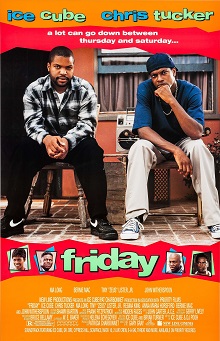

Picking Nits
Chris Tucker's smoking looks fake while Craig's looks real; Cube's voiceover appears only twice; the pivot to the message and Witherspoon's speech is inelegant; the drive-by feels unnecessary to one host; Debbie's attraction to Craig is unearned; Felicia as the roving crackhead type; the credits spell the name Felisha; the $200 Big Worm plot is not urgent
In the discussion (11)
- Chris Tucker's smoking does not look right: he holds the smoke in his mouth, the telltale sign of a non-smoker, while Craig, the supposed non-smoker, actually inhales and exhales; it is noticeable when Craig takes the joint and leans back, but not off-putting, and a first viewing before ever smoking would not catch it.
- Cube's voiceover appears at the beginning and once in the middle, when they go to rob the house next door and he says not to always get him into shit, then never returns; it feels like a detective-noir intrusion they forgot to cut.
- The film flips around the hour mark into Witherspoon's speech after Chekhov's gun; F. Gary Gray is quoted wishing there were more of a transition to the message, which crashes in and is inelegantly executed, and a host agrees the film pivots into an after-school special when the gun and the drive-by arrive.
- The events in the movie could stay the same; what makes it feel after-school is John Witherspoon's speech. — Justin Charity
- The speech about not needing a gun and taking an ass-whipping is played; the fix proposed is an acted rather than spoken vehicle for Witherspoon, not a black-and-white flashback of a younger Witherspoon losing a fight, but a pensive beat as Cube confronts Deebo before dropping the gun and decking him, a scene instead of a speech.
- One host did not mind the speech much, only because of loving Witherspoon giving it; the drive-by, with Uzis spraying and people jumping on cars, felt unnecessary to that host, while another counts it among favorites because it is so sharp and sudden in a laid-back stoner movie, even if poorly lit at night, a last-minute reminder that things are still real.
- A final nitpick asks whether Debbie would be that attracted to Craig when he did little to earn it, with the joke that it was conveniently written into the script by Cube; a prior neighborhood relationship blossoming is believable.
- Debbie falling for Craig over one day is not believable, so the ending feels unearned and abrupt even though it is only her saying she will call tomorrow, a reminder that a man, specifically Ice Cube, a first-time screenwriter, wrote it.
- Felicia, and the Bye Felicia meme, prompt the observation that many nineties movies have a roving crackhead character, often a light-skinned woman, used for comic relief and pathos, begging for money with an uncomfortable sexualized undertone.
- The real nit is the spelling: the credits spell the name Felisha, so everyone writing 'Bye Felicia' is spelling it wrong, and they should check IMDb, or do half-assed internet research.
- Early on, before nits were officially open, the $200 owed to Big Worm was called neither urgent nor necessary as a plot device, answered that it brings amazing lines and confrontations and Faison Love (as transcribed) in hair curlers.

In the discussion (4)
- Cube: no, but close; the film is a memento of the best of Cube, who went on to Three Kings, Barbershop and several Kevin Hart movies yet has made no better movie than Friday, so it might be his apex as an actor, though Three Kings has him in a supporting role and this is Cube's movie only in a constitutional sense since it plays as a Chris Tucker vehicle.
- Barbershop is defended as low-key really good; Friday is not Cube's commercial or stardom peak but the peak of him balancing the realistic gangster figure and the softer comedy type, the crux and pivot point of every angle of his career, the one movie that holds all his multitudes.
- Chris Tucker: the question is whether he is better here than in Rush Hour or The Fifth Element, with the caveat that calling anyone's apex their early twenties is cruel; Rush Hour 2 Tucker is judged better, leading the movie and hamming it up ten degrees higher, with the outtakes credits and the gefilte fish rant as peak, which is allowed.
- John Witherspoon is proposed since the others stalled; he has been in a ton of movies, was the dad on The Wayans Brothers and granddad on The Boondocks, but this is still called peak Witherspoon (transcribed 'Pete Witherspoon'), with the bathroom scene, the food scene and the gun speech cited; one voice says it feels comfortable with that while reserving the right to reset later, and nobody objects.
In the discussion (4)
- The field is wide: Tiny Lister as Deebo, John Witherspoon, Bernie Mac, Faison Love (as transcribed), Paula J. Park (as transcribed) as Joy, Regina King, Stanley, little Chris and Smokey's mom, who is only in a couple of scenes asking Smokey to buy cigarettes and talking on the phone; Craig and Smokey are excluded as principals.
- One host would have said Joy for her iconic scene but after rewatching lands on John Witherspoon for the gun speech, that a gun does not make you a man and you fist fight, win or lose, and stay alive, which plays a little after-school but he goes for it; a John Witherspoon impression by Charity is teased.
- Red is argued for as the most thankless role, getting beaten up and clowned the whole movie, played well, with the touching scene of him sobbing at his car and pulling off.
- Witherspoon and DJ Pooh's Red are called great, but Deebo gets it: he has his own music, his name persists as a word for a bully, and he is so iconic that Tiny Lister throwing the detonator off the ship in The Dark Knight reads as Deebo moved to Gotham, arrested and folded into the Joker's plot.
Half-Assed Internet Research
Shot on F. Gary Gray's old block at 126 and Normandy (as transcribed), with the Red knockout in front of his childhood house; Gray directed Cube's It Was a Good Day video; a Crip neighborhood, so nothing red appears; clothes from the Slauson swap meet; cast paid about $5,000 each on a $3.5 million budget that grossed $27 million; Kathleen Bradley was the first Black Barker Beauty; Smokey's 1976 Ford Pinto was spotted on Western Avenue with the lockup sound added in post; Chris Tucker ran uninvited into the knockout shot; Anthony Johnson drew on relatives for Ezal; Craig's firing was based on Cube's UPS cousin
In the discussion (7)
- The movie was shot on director F. Gary Gray's old block, where he lived in junior high, 126 in Normandy (as transcribed), and the scene where Deebo knocks out Red is in front of the house Gray grew up in; asked whether Gray ever owed someone $200 or knew a Deebo, the answer is that he directed but did not write it, and it is mostly Cube.
- Gray directed Cube's It Was a Good Day video and other Cube videos, which is how they connected; the neighborhood is a Crip neighborhood, so nothing red appears to avoid the ire of local gangs; nearly all the clothes were bought at the Slauson swap meet, where a host used to go.
- According to John Witherspoon the cast all got paid around $5,000 each, some of it reportedly out of Cube's pocket; the budget is put at $3.5 million against $27 million grossed, with mostly unknown actors; the hosts wonder about residuals and feel Witherspoon should eat out on the film forever, which he pretty much does.
- Kathleen Bradley, Miss Parker from across the street, was the first Black Barker Beauty on The Price Is Right and was spotted there by a casting director; Smokey drives a 1976 Ford Pinto, called the best character and the ugliest car ever in a movie; Gray saw it on Western Avenue and knew it was Smokey's car, and the lockup sound was added in post.
- The best shot of the Pinto is the slow shot of Smokey parking in front of Craig's house after the store where the crackhead gets him to buy a 40, the one long look that shows how broken the car is and makes the broke character feel real; a host relates, having grown up driving a 1989 Nissan Pathfinder despite being born in 1987.
- Chris Tucker was not originally in the 'you got knocked the fuck out' scene and just ran into the shot, all the more reason nobody else could have played the role; Anthony Johnson, who played Ezal, drew on a brother and sister who were on crack, which is dark but may have fed a more compelling performance.
- From Wikipedia: Craig being fired on his day off was based on Cube's cousin, who worked for UPS; a host believes it, calling UPS and USPS evil organizations, which draws the joke about beef with the mail and a Stamps.com ad.