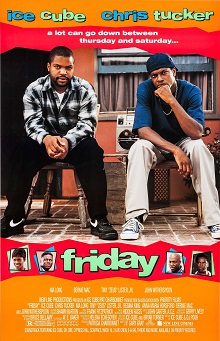
Chris Tucker's smoking looks fake while Craig's looks real; Cube's voiceover appears only twice; the pivot to the message and Witherspoon's speech is inelegant; the drive-by feels unnecessary to one host; Debbie's attraction to Craig is unearned; Felicia as the roving crackhead type; the credits spell the name Felisha; the $200 Big Worm plot is not urgent
Chris Tucker's smoking does not look right: he holds the smoke in his mouth, the telltale sign of a non-smoker, while Craig, the supposed non-smoker, actually inhales and exhales; it is noticeable when Craig takes the joint and leans back, but not off-putting, and a first viewing before ever smoking would not catch it.
Cube's voiceover appears at the beginning and once in the middle, when they go to rob the house next door and he says not to always get him into shit, then never returns; it feels like a detective-noir intrusion they forgot to cut.
The film flips around the hour mark into Witherspoon's speech after Chekhov's gun; F. Gary Gray is quoted wishing there were more of a transition to the message, which crashes in and is inelegantly executed, and a host agrees the film pivots into an after-school special when the gun and the drive-by arrive.
The events in the movie could stay the same; what makes it feel after-school is John Witherspoon's speech. — Justin Charity
The speech about not needing a gun and taking an ass-whipping is played; the fix proposed is an acted rather than spoken vehicle for Witherspoon, not a black-and-white flashback of a younger Witherspoon losing a fight, but a pensive beat as Cube confronts Deebo before dropping the gun and decking him, a scene instead of a speech.
One host did not mind the speech much, only because of loving Witherspoon giving it; the drive-by, with Uzis spraying and people jumping on cars, felt unnecessary to that host, while another counts it among favorites because it is so sharp and sudden in a laid-back stoner movie, even if poorly lit at night, a last-minute reminder that things are still real.
A final nitpick asks whether Debbie would be that attracted to Craig when he did little to earn it, with the joke that it was conveniently written into the script by Cube; a prior neighborhood relationship blossoming is believable.
Debbie falling for Craig over one day is not believable, so the ending feels unearned and abrupt even though it is only her saying she will call tomorrow, a reminder that a man, specifically Ice Cube, a first-time screenwriter, wrote it.
Felicia, and the Bye Felicia meme, prompt the observation that many nineties movies have a roving crackhead character, often a light-skinned woman, used for comic relief and pathos, begging for money with an uncomfortable sexualized undertone.
The real nit is the spelling: the credits spell the name Felisha, so everyone writing 'Bye Felicia' is spelling it wrong, and they should check IMDb, or do half-assed internet research.
Early on, before nits were officially open, the $200 owed to Big Worm was called neither urgent nor necessary as a plot device, answered that it brings amazing lines and confrontations and Faison Love (as transcribed) in hair curlers.
The field is wide: Tiny Lister as Deebo, John Witherspoon, Bernie Mac, Faison Love (as transcribed), Paula J. Park (as transcribed) as Joy, Regina King, Stanley, little Chris and Smokey's mom, who is only in a couple of scenes asking Smokey to buy cigarettes and talking on the phone; Craig and Smokey are excluded as principals.
One host would have said Joy for her iconic scene but after rewatching lands on John Witherspoon for the gun speech, that a gun does not make you a man and you fist fight, win or lose, and stay alive, which plays a little after-school but he goes for it; a John Witherspoon impression by Charity is teased.
Red is argued for as the most thankless role, getting beaten up and clowned the whole movie, played well, with the touching scene of him sobbing at his car and pulling off.
Witherspoon and DJ Pooh's Red are called great, but Deebo gets it: he has his own music, his name persists as a word for a bully, and he is so iconic that Tiny Lister throwing the detonator off the ship in The Dark Knight reads as Deebo moved to Gotham, arrested and folded into the Joker's plot.