
‹ All movies
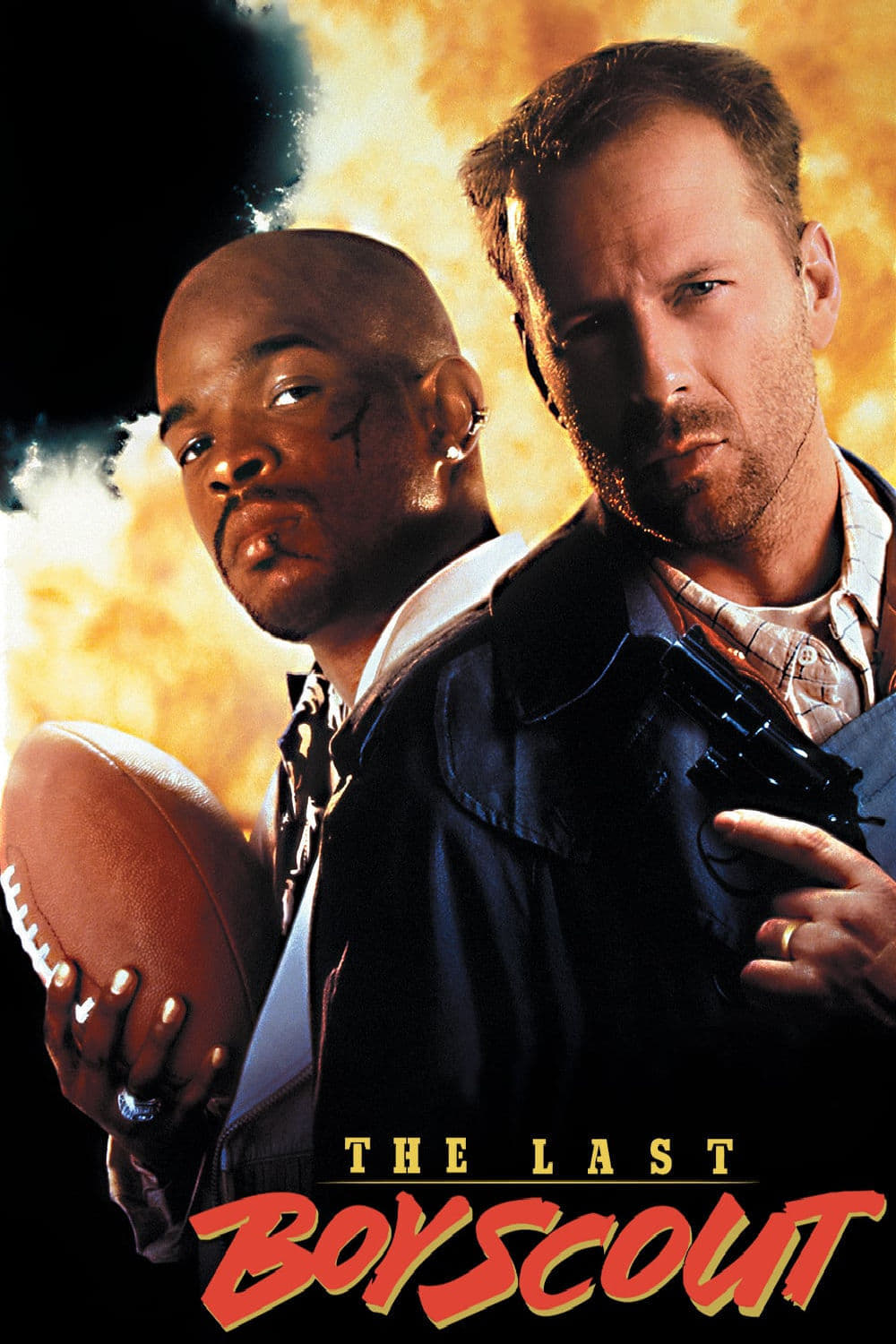
The Last Boy Scout poster

The Last Boy Scout

105 minutes

Cast

Selected cast credits · Film reference

Bruce Willis Joe Hallenbeck
Damon Wayans Jimmy Dix
Chelsea Field Sarah Hallenbeck
Noble Willingham Sheldon "Shelly" Marcone
Danielle Harris Darian Hallenbeck
Bruce McGill Mike Matthews
Kim Coates Chet
Chelcie Ross Senator Calvin Baynard
Joe Santos Lieutenant Ben Bessalo
Billy Blanks Billy Cole

The Last Boy Scout | The Rewatchables

Explore episodeClose episode

Roger Ebert's review

In the discussion (2)
Approx. transcript time · 00:17:10Read transcript
  • 'Our guy, Raj' did not hate it as expected; he gave it three stars.
  • The review is quoted as calling it a superb example of what it is: a glossy, skillful, cynical, smart, utterly corrupt, and vilely misogynistic action thriller, described as one of the weirdest sentences he ever wrote.

Most Rewatchable Scene

The opening Billy Cole scene

In the discussion (16)
Approx. transcript time · 00:23:33Read transcript
  • The scene is set at halftime of a Cleveland versus Los Angeles game with Vern Lundquist, Dick Buckkiss and Lynn Swan as sideline reporter, who berates the L.A. owner about ratings, attendance and where all the heroes have gone.
  • The hosts want sideline reporters to ask NBA players like Brandon Ingram and LeBron James where all the heroes have gone.
  • Billy Cole is alleged to take PCP in the locker room, though one host always thought it was cocaine until reading Wikipedia.
  • Early nits: whether he had the gun in his pants the whole quarter, how it did not affect his burst while breaking four tackles, and whether his touchdown would count for gamblers.
  • He says 'Ain't life a bitch' as he shoots himself, and the broadcast presumably cuts to a test signal.
  • Only one spotlight seems to be on in Cleveland Stadium, like a German expressionist film; Tony Scott's football is closer to Zach Snyder's 300 and the rain device returns in The Fan.
  • The scene was a watershed; the movie arguably peaks in the first six minutes, helped by the Bill Medley Friday Night Football song.
  • Other rewatchable scenes offered: Joe finding the guy in the closet, which leads to the first of several car bombs.
  • Jimmy's speech on the NFL stance on drugs and gambling, played back by Craig, reads like Shane Black at 3:30 in the morning.
  • Joe versus Kim Coats, where Joe warns him not to touch him again and then kills him.
  • The quirky hitmen, like Pablo playing piano and Taylor Negron, feel Tarantino-like before Tarantino made a movie.
  • The stuffed-animal scene with the car chase, despite not knowing how the gun fits in the stuffed animal.
  • The big football-game ending: a throw from a wounded hand to the senator's box, Damon Wayans on a horse, and Bruce Willis's fight with Taylor Negron ending in a jig.
  • The Hollywood Hills car chase with cars going down the hill that lands in the pool.
  • The strip club with Corey and the Corey car-chase murder right after it are offered as another rewatchable scene; the other side left it out because seeing Halle Berry murdered hurts, wishing she had just taken one in the shoulder.
  • Asked for a most rewatchable pick, the answer is the opening scene, watchable a hundred times in a row; it is jokingly why football had to leave L.A.

What’s Aged the Best?

Friday Night Football montage; Joe Hallenbeck's beatings; the title on the football card; the disgraced-hero backstory; bad guys saying a full name derisively; Wayans's hat; the witty exchanges; Halle Berry's brief role; the conspiracy explanation scene

In the discussion (11)
Approx. transcript time · 00:37:35Read transcript
  • The Friday Night Football montage, with a question about who Bill Medlay is.
  • Joe Hallenbeck is hit in the face seven times, three times in the back of the head, tasered and stabbed; he is compared with Marvin in Midnight Run for most abuse.
  • Nobody is better at getting beaten up in movies than Willis, who lacked the ego seen in the Pacino speech in Once Upon a Time in Hollywood.
  • The football card signed to the daughter works the title into the movie about as well as it gets; research traced it to the early-90s Pro Set.
  • The trope of a hero who did the right thing about something terrible, then falls into a much worse job, often a former Secret Service agent, with In the Line of Fire and The Sentinel cited.
  • Private detectives in movies are always drinking alcoholics sitting in cars.
  • Bad guys saying someone's full name derisively, as Taylor Negron does, is a great way to mark a villain.
  • Wayans's fez-style hat with the tassel is cool, also worn by Hallie Berry in Boomerang, and should come back.
  • The exchanges are witty in script form and Willis somehow pulls them off; the movie is tired, drunk, sarcastic and dead inside.
  • Hally Berry brings so much to a small part in only four or five minutes, which makes Boomerang's premise ludicrous.
  • The owner Shelley explaining the conspiracy recalls Donald Sutherland in JFK, and the gambling-and-blackmail conspiracy could still work today.

What’s Aged the Worst?

Joe's hatred for rap music; the Jimmy Carter look-alike; the first dad-daughter scene; Tony Scott's conception of football contact; the Joel Silver–Bruce Willis relationship

In the discussion (6)
Approx. transcript time · 00:50:19Read transcript
  • Joe's hatred for rap music was a throwaway grizzled line in 91 while rap and hip-hop were exploding.
  • The Jimmy Carter look-alike is terrible, like a doll from the Land of Confusion video, and would now be done with CGI.
  • The first dad-daughter scene is too long and the daughter too angry; Daniel Harris is praised for Halloween 4.
  • Homophobia and misogyny in the humor are noted but felt on brand for the late 80s and early 90s and did not stand out at the time.
  • The film's idea of roughing the passer is so violent that it questions whether Tony Scott ever watched a football game.
  • The movie aged better than expected; the Joel Silver and Bruce Willis relationship seemed combustible.
In the discussion (6)
Approx. transcript time · 00:53:03Read transcript
  • There were fewer casting what-ifs than expected.
  • A report that Jack Nicholson was up for Joe Hollenbeck is not believed.
  • Tony Scott wanted Grace Jones for the Halle Berry part and the studio overruled him, which the hosts approve.
  • John McTiernan declined to direct because it was another Bruce Willis project, having also not done Die Hard 2.
  • Admittedly a stretch: Tony Scott hated Joel Silver so much that he based Lee Donowitz in True Romance on him, played by Saul Rubinick, and Silver went nuts when he saw it.
  • An open question is which Joel Silver movie Coming Home in a Body Bag parodies.
In the discussion (5)
Approx. transcript time · 00:54:27Read transcript
  • McGill doesn't count.
  • Kim Coates is chosen as someone long recognized without knowing his name.
  • Pablo is unquestionably that guy, and the actor playing Shelley the owner is also noted; Noble Willingham plays Sheldon Marcon.
  • Pablo is played by Frank Collison, chosen as the other pick, and the award is given as a tie between Kim Coates and Frank Collison.
  • Joe Santos, the police sergeant who had him in his hands, is another good That Guy who has faded after peaking in the 70s, 80s and 90s.
In the discussion (2)
Approx. transcript time · 00:55:08Read transcript
  • A Bruce McGill Award for a That Guy who graduated is floated, or bequeathing the Joey Pants award to McGill as 'the McGillicuddies'; taking it from Joey Pants is resisted, though designations have moved before.
  • Joey Pants graduates named are Bruce McGill and Chelsea Ross, who plays the senator and completes a sports-movie Mount Rushmore with Hoosiers, Rudy and Major League.
In the discussion (5)
Approx. transcript time · 00:56:43Read transcript
  • With respect to Kim Coates, Taylor Nagron is everything wanted from the award, in the best performance of his career.
  • He is one of the better bad guys, walking out of a burning car in a pool to keep shooting people; he is mesmerizing, and it is surprising he did not become a bigger star.
  • His formal-introductions scene set up the ironic, funny but scary villain later seen in Conair; Alan Rickman may have invented it, but Negron showed a lesser-known actor could do it.
  • Negron was a Los Angeles stand-up comic seen on Letterman and in Punchline; a modern equivalent would be Kyle Mooney.
  • Lines like 'Officer, there are too many bullets in this gun' push the movie to another level.
In the discussion (6)
Approx. transcript time · 00:58:39Read transcript
  • The recasting is done for the original era.
  • Chelsea Field could be improved on, with respect to her as Mrs. Scott Bacula, though the part is better as written.
  • Renee Rousseau is floated for the wife, but the reply is that Chelsea Field wears the toll of the failed marriage and Rousseau would not be dragged down by someone like Joe.
  • A jab about finally doing a Two for the Money pod follows.
  • Treating Renee Russo as vetoed, Don Johnson is proposed for Joe and welcomed, seven years out of Miami Vice.
  • Don Johnson never had the right movie part and lobbied Oliver Stone to play Jim Garrison; this could have been an awesome Sonny Crockett part.

Half-Assed Internet Research

Troubled production; O.J. Simpson and Al Cowlings as football experts; a Lethal Weapon deleted scene; a near riot of extras; the body count; the original script

In the discussion (8)
Approx. transcript time · 01:00:33Read transcript
  • The assistant director attributed on-set tension to an overabundance of alpha males; Joel Silver told the New Yorker it was one of the three worst experiences of his life.
  • Shane Black was forced to keep rewriting; the studio wanted a Die Hard-style Bruce Willis follow-up, and the save-the-wife plot was changed because it repeated Die Hard.
  • The two football technical experts were O.J. Simpson and A.C. Cowlinks, per a Taylor Nagrond interview; it is called possibly the best research item ever.
  • The $650 pants conversation was a deleted Lethal Weapon scene Shane Black repurposed.
  • During filming at the Los Angeles Coliseum, extras who were told to go home after a canceled recall nearly rioted.
  • About 27 people die in the movie.
  • Shane Black's original script had a different second half: bigger roles for Milo and Shelley Marcombe, Milo directing snuff films and killing a family, a boat chase, two more shootouts, and Joe's wife killing Milo.
  • Script scenes like Jimmy throwing a football at a player abusing a woman build character, and the shooting script is worth reading or maybe making as a Netflix series.

Apex Mountain

Bruce Willis; the Wayans brothers; L.A. NFL home games; $650 leather pants; dripping blood from the mouth and nose

In the discussion (9)
Approx. transcript time · 01:04:59Read transcript
  • Bruce Willis is an all-time yes.
  • The Wayans brothers get a yes, with Damon here and the family on In Living Color.
  • L.A. NFL home games get a yes because L.A. football never got better.
  • Halliberry is still Boomerang, and Daniel Harris is still Halloween 4.
  • Tony Scott is a no, and Joel Silver probably not because of The Matrix and Die Hard.
  • Early-90s kooky L.A. still goes to True Romance.
  • The $650 leather pants are called an apex.
  • The movie is proposed as the Apex Mountain for hangover acting, but Sonny Crockett and Jack Cates are raised against it and the claim is left contested rather than settled.
  • Later, dripping blood from the mouth and nose is added as an apex for this movie.

Picking Nits

Jimmy shrugging off his girlfriend's murder; football continuing after the Billy Cole shooting; the daughter not in school; Joe as a Jimmy Dix fan; the fall from grace ending his love of football; the reconciliation; Joe's pay; the bleeding-hand throw

In the discussion (9)
Approx. transcript time · 01:06:21Read transcript
  • Jimmy should be far more upset that his girlfriend was murdered in front of him, seeming more worried about his football comeback.
  • Football continues after the Billy Cole shooting with no consequences, and a senator attends a game soon after.
  • Craig, who had never seen the movie, is invited to comment; the reply says the Billy Cole scene was shocking and the stadium was pitch black.
  • Whether the NFL would shut down depends on the week; the first game is placed in Cleveland in late fall or early December.
  • Why the daughter was not in school, perhaps Christmas break since Shane Black movies are Christmas movies.
  • Joe, who hates rap and just likes getting drunk, being a big fan of the young Black quarterback Jimmy Dix is doubted.
  • Nobody stops liking football because one player turned out to be a prick.
  • Joe and his wife getting back together three days later is questioned, as is whether Joe gets paid, though they have the suitcase of money.
  • A bleeding-hand perfect spiral into the upper deck to save a senator from a sniper is the main nitpick, with mock calls imagined.

Probably Unanswerable Questions

Did the movie foreshadow the gambling era?; Was Shelley a Jerry Jones character?; How did Shelley end up owning the LA Stallions?; Would Urban Meyer find the movie accurate?

In the discussion (5)
Approx. transcript time · 01:12:26Read transcript
  • The movie more than foreshadowed the sports gambling era.
  • Shelley overlaps heavily with Jerry Jones, with some Glanville and possibly Bud Adams, fitting a trope of giddy Southern owners.
  • How Shelley ended up owning the LA Stallions and why that name suits L.A., perhaps moved from San Antonio.
  • The script referenced real NFL teams, and Pete Roselle denied the real uniforms after reading three pages.
  • A late question asks whether Urban Meyer would watch it and find it pretty accurate.

Crazier Game to Attend

The final game

In the discussion (3)
Approx. transcript time · 01:14:36Read transcript
  • The nominees are the rainstorm game where Billy Cole shoots four defenders and himself, and the final game with Jimmy Dix's throw, a sniper, a horse and a man falling to his death.
  • The second game is chosen as the crazier one because so much more happens, and that is agreed.
  • The Billy Cole game is easier to explain at home, while the finale is a longer story, like Pete Rose running out of a dugout, shooting seven umpires and sliding into home.
In the discussion (5)
Approx. transcript time · 01:16:50Read transcript
  • Willis is incredible, but the pick is Damon Wayans for a dynamite movie-star performance he never got the chance to repeat.
  • The pick is agreed with: multiple people could have played the Bruce Willis role, including Don Johnson, but nobody else in 1991 could have been Jimmy Dix (Eddie too old, Denzel too established, Wesley Snipes weird, Jamie Fox too early).
  • It was right time, right place for Wayans, who is likable, and it is a bummer he never got better scripts.
  • Tony Scott was considered but rejected because this is not seen as a signature Tony Scott movie and it sounds agonizing to make.
  • In a book about cocaine-era late 80s and 90s movies, this would be a chapter.
Podcast choices
Speaker not identified
Damon Wayans

More from the conversation

A vintage trailer ends with the film starting Friday, December 13th.
Approx. transcript time · 00:01:54Read transcript
The movie came out 30 years ago, was not well received, and is bigger than a cult classic; the hosts search for a word between successful and cult classic and land on a delayed hit or just a rewatchable.
Approx. transcript time · 00:02:18Read transcript
After a year of action episodes (both Terminators, the first two Lethal Weapons, Beverly Hills Cop, 48 Hours), this is called their messed-up younger cousin, pumped with steroids and HGH, and darker than JFK.
Approx. transcript time · 00:03:19Read transcript
It feels made in a lab at the bloated end of the action era; the Joel Silver approach keeps cranking the volume, unlike the more 80s-rooted Cobra.
Approx. transcript time · 00:04:18Read transcript
Tony Scott and Joel Silver hated each other; Willis came off Hudson Hawk and needed a hit; Damon Wayans was trying to prove himself; Shane Black sold the script for a record $1.75 million after a bidding war.
Approx. transcript time · 00:05:22Read transcript
The script sale was news before the movie in the Premiere and New York magazine era, prompted a record Basic Instinct sale, and Black did it again with Long Kiss Good Night.
Approx. transcript time · 00:05:54Read transcript
Shane Black's stage directions banter with the reader, which hooked executives; he is ripping off his own Lethal Weapon, and Die Hard was said to be his original title for this movie until Joel Silver took it.
Approx. transcript time · 00:07:33Read transcript
The film is unfairly called a buddy-cop movie since Joe Hallenbeck is not a cop and they are not buddies, but the mismatch device works.
Approx. transcript time · 00:08:20Read transcript
Calling Joe Hallenbeck Willis's best role is dismissed as overthinking versus Die Hard; Willis is proposed as the greatest hungover actor, with Don Johnson and Nolte offered as rivals.
Approx. transcript time · 00:09:31Read transcript
Willis and Wayans have strong antagonistic chemistry despite not getting along on set.
Approx. transcript time · 00:11:21Read transcript
Wayans was known but not famous, and his casting as a lead opposite Bruce Willis felt like a big deal; he crushed it, and a Jamie Fox-like career seemed possible.
Approx. transcript time · 00:12:02Read transcript
Wayans's later films never followed up, perhaps because he was pigeonholed as a comedy or TV actor, though Jimmy is a tragic figure; one host goes on record liking Bulletproof.
Approx. transcript time · 00:13:26Read transcript
Wayans became a big sitcom star, and his last big thing was the Lethal Weapon TV show, returning to Shane Black.
Approx. transcript time · 00:15:12Read transcript
Geffen bid $1.75 million; Shane Black and Tony Scott said the original script was better, with the wife killing Milo; the $43 million budget went heavily to post-production with multiple editors, and it made $124.5 million.
Approx. transcript time · 00:16:14Read transcript
The film's darkness, violence and cynicism stand out for a mainstream blockbuster; cuts were made to avoid NC17, and a director's cut would be interesting.
Approx. transcript time · 00:17:21Read transcript
The trailer promised more football than the movie delivers; the Billy Cole opening became a column reference for about 20 years and one of the most stunning movie openings.
Approx. transcript time · 00:18:35Read transcript
The film anticipated football themes like gambling, painkillers, corrupt owners and LA football, including the idea that fans are hooked with gambling; one host began betting on football in 1990.
Approx. transcript time · 00:19:52Read transcript
Football movies such as Rollerball, North Dallas 40, Any Given Sunday, Varsity Blues, The Program and Draft Day are darker than credited, with Rudy the exception; Any Given Sunday might be redone.
Approx. transcript time · 00:21:39Read transcript
Closing credit: produced by our guy Craig Horlebeck; one more movie next week will be the last for 2021; plug for The Watch, now covering Station 11 after Succession ended.
Approx. transcript time · 01:18:35Read transcript