
‹ All movies
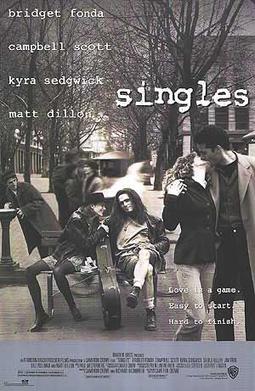
Singles poster

Singles

99 minutes

Cast

Selected cast credits · Film reference

Bridget Fonda Janet Livermore
Campbell Scott Steve Dunne
Kyra Sedgwick Linda Powell
Sheila Kelley Debbie Hunt
Jim True David Bailey
Bill Pullman Dr. Jamison
Matt Dillon Cliff Poncier
Jeremy Piven Doug Hughley
Tom Skerritt Mayor Weber
Peter Horton Jamie
Bill Smillie Boston doctor
Chuck McQuary Garage opener clerk
Jaffar Smith Kid #2
Dana Eskelson Club girl
Mykol Hazen Club bouncer
Art Cahn Magazine stand clerk
Jane Jones Denise
Paul Giamatti Kissing man
Alicia Roper Kissing woman
Xavier McDaniel Himself
Wayne Cody Himself
Eddie Vedder Eddie
Jeff Ament Jeff
Cameron Crowe Club interviewer
Thomas A. Doyle Wrong phone number
Alice Marie Crowe Dr. Jamison’s nurse
Joan Giammarco Receptionist
Jim Hechim Rich
Tim Burton Brian
Bruce Pavitt Bruce
Sandra Grant Waitress
Tom Herbert Deputy mayor
Jerry Ziesmer Councilman Jordan Fisher
Nina Escudero Airline clerk
Dan Wartman Single kid on plane
Amy Hill Hospital nurse
Mike Parker Mover

Singles | The Rewatchables

Explore episodeClose episode

Picking Nits

Character ages; garage opener; filthy apartment; one-sided friendship; ethical surgeon; insufficient Seattle talk; accident reaction

In the discussion (7)
Approx. transcript time · 00:05:50Read transcript
  • The characters seem around thirty while presented as twenty-three to twenty-five, an age mismatch that affected early understanding.
  • Giving a near-stranger a garage opener as he supposedly leaves for Spain is odd; having a spare explains access but not the trust.
  • Steve’s apartment deteriorates implausibly into a food-covered hoard, making Linda’s willingness to have sex there especially unconvincing.
  • Linda dominates conversations with Ruth without asking about her life, making the friendship feel one-sided.
  • The compassionate plastic surgeon is considered implausible compared with a perceived industry eagerness to sell procedures.
  • More ordinary coffee-shop talk about Seattle bands or the Sonics would root the friends in the city; X-Man’s existing mention is acknowledged but considered insufficient.
  • The couple’s severe retreat after the accident seems abrupt; the defense is that the collision breaks their dream state and exposes how unprepared they are.

Probably Unanswerable Questions

Romantic pairings; modern athlete cameo; Janet’s money; train viability; accident; Ruth

In the discussion (12)
Approx. transcript time · 00:18:00Read transcript
  • Janet’s career ambitions remain largely unknown; pursuit of Cliff seems to be her chosen last youthful experiment.
  • A February or March 1992 release might have preceded the trend and avoided criticism of cashing in, potentially making the film bigger.
  • Modern equivalents for the sexual-distraction athlete include DeAndre Jordan, Steph with opposite encouragement, Patrick Beverley as an unsatisfying likely choice, city-dependent Tobias Harris or another Philadelphia player whose name is unclear in the transcript, Kobe and finally Grant Williams for his annoying presence.
  • Why Steve lost his job is unclear and deferred to the supertrain discussion.
  • Steve and Janet are proposed as the couple who should have ended together; her new confidence and calm make her seem exactly what he needs after her own romantic disappointment.
  • Their chemistry seems stronger than Steve and Linda’s, prompting speculation about an alternative cut; mostly silent Steve–Linda bonding scenes and the earlier failed Steve–Janet relationship complicate that reading.
  • Ruth’s immediate rejection of Bailey seems unexplained; a possible sexuality implication is floated without certainty.
  • Janet’s ability to afford elective surgery, repay loans and return to school raises questions about savings or family money; architecture-school funds are offered as a possible explanation.
  • If Janet has money, why not support Citizen Dick’s production or posters? A Steve Albini demo is a joking suggestion.
  • A train might be useful, and Seattle’s later light rail is mentioned, but Steve’s café-like pitch lacks travel-time or cost evidence; Big Dig experience reinforces skepticism.
  • The pediatrician’s strong regional accent raises a joking Boston-character hall-of-fame question, with Rhode Island offered as a correction.
  • Responsibility for the traffic accident is questioned through the long-yellow light; a signal malfunction is suggested after correcting the women’s names.

Half-Assed Internet Research

Origins; Seattle shift; band timing; soundtrack; critical reception; production conflicts; locations; Spoonman; Friends connection

In the discussion (21)
Approx. transcript time · 00:18:36Read transcript
  • Crowe’s stated aim was to show people who love a city and make a family from friends they do not want to leave.
  • Crowe reportedly felt Singles had unresolved casting and writing issues; seeing Pulp Fiction solve interlocking vignettes impressed him, while testing and reshoots delayed this film about eighteen months after spring 1991 shooting.
  • The script began in 1984 as a Phoenix story; Andrew Wood’s death and Seattle’s communal response reportedly led Crowe to relocate it before the major 1991 grunge albums appeared.
  • Spring 1991 filming preceded Ten, Nevermind and Badmotorfinger; Pearl Jam was still called Mookie Blaylock during its scenes.
  • Alice in Chains is described as playing live rather than miming to playback.
  • Crowe’s inspiration included Stone Gossard and Jeff Ament working together at a coffee shop and Chris Cornell holding a kitchen job while making music, feeding Cliff’s working-musician milieu.
  • Nirvana reportedly refused involvement in the love story.
  • Crowe’s journal recalls the cast first meeting at a hotel and bonding at a packed Off Ramp show featuring Mookie Blaylock and Alice in Chains.
  • The soundtrack was released early on June 30,1992 and became a bestseller; exclusive material such as State of Love and Trust encouraged fans to buy the whole album.
  • Cornell reportedly recommended the Smashing Pumpkins, after which Corgan offered three songs including Drown.
  • The film is reported to have a $9 million budget and $18 million gross.
  • The Stranger’s review accused Crowe of relying on Seattle’s hipness and musician cameos without memorable substance; that sellout criticism is rejected as unfair to a love letter and rare access to the scene.
  • An MTV soundtrack-launch party appears in the Pearl Jam documentary and online, showing an intoxicated band and familiar MTV presenters; Adam Curry’s presence is questioned.
  • Scott’s recent leukemia-patient role in Dying Young left him thin with short hair; the studio reportedly worried about wigs, and Crowe’s journal describes a volatile working relationship.
  • Crowe’s journal describes his relationship with Scott deteriorating and the difficulty of writing an ordinary man without quirks; their eventual confrontation suggests real on-set conflict.
  • The central café was filmed at the since-closed OK Hotel.
  • Dillon wore much of Ament’s wardrobe; Ament’s invented Citizen Dick song titles inspired Cornell to write material, including Spoonman, whose opening riff appears in the film.
  • Touch Me I’m Dick parodies Mudhoney’s Touch Me I’m Sick.
  • Returning to the apartment building for Pearl Jam Twenty reportedly led to an annoyed landlord ordering the crew away and telling Crowe the film had ruined his life through constant visitors.
  • Warner Bros. reportedly sought a Singles series, Crowe declined, and Kauffman and Crane went on to Friends; Crowe’s quoted 2017 account recalls his mother’s regret over the missed financial opportunity.
  • The answering-machine material was reportedly added in reshoots, with Scott wearing a wig, to supply missing longing that made the couple’s reunion understandable.

Roger Ebert's review

In the discussion (1)
Approx. transcript time · 00:38:43Read transcript
  • Ebert gave three stars, describing amusement, recognition and affection for the characters.

Recasting Couch

Mathis as Linda; Cusack or Stoltz as Steve; Hamilton considered

In the discussion (5)
Approx. transcript time · 01:07:23Read transcript
  • Cusack initially seemed the obvious post-Say Anything Crowe avatar, though affection for Scott has grown.
  • Samantha Mathis as Linda is welcomed as a younger alternative to Sedgwick.
  • Josh Hamilton as Steve is considered but may be young and would make the film resemble Kicking and Screaming.
  • River Phoenix is rejected as too handsome; Slater is considered too young.
  • Cusack or Stoltz are proposed as stronger Steve options, though Stoltz may seem too cool.

Casting What-Ifs

Depp; Dillon; Cornell; Abdul; disputed Jennifer Jason Leigh

In the discussion (5)
Approx. transcript time · 01:23:13Read transcript
  • Depp reportedly declined Steve partly because he did not want a character who says I love you; his extreme good looks are also considered a poor fit, though an alternative view thinks he could do it.
  • Dillon also reportedly declined Steve; his looks are offered as a reason the decision worked.
  • Cornell was Crowe’s intended Cliff but could not fit acting around Soundgarden touring and recording; the idea is appealing but potentially impractical.
  • Paula Abdul was reportedly a very close runner-up for Debbie, with excellent audition material still in the archives.
  • A Jennifer Jason Leigh–Linda casting story is disputed and left unverified after initial confusion with Janet; a Single White Female reunion produces joking hostility between the characters.
In the discussion (6)
Approx. transcript time · 01:46:08Read transcript
  • Reality Bites or Kicking and Screaming are initial pairing choices.
  • Say Anything works as a Seattle high-school prequel to post-college Singles.
  • Action Jackson is a joking double-feature suggestion.
  • Love Jones is an appealing alternative with a similar vibe.
  • Vanilla Sky is proposed and immediately withdrawn as a joke before the Jerry Maguire choice.
  • Jerry Maguire completes a Crowe progression from high school through post-college life to professional adulthood.

Producer review

Favorite young-adult ensemble; questions about garages, strangers’ rides and answering machines

In the discussion (4)
Approx. transcript time · 01:50:40Read transcript
  • Singles joins Kicking and Screaming as a favorite early-twenties ensemble movie for a viewer born two years after its release.
  • The garage-opener gift raises questions about regional garage access, with Seattle and San Francisco offered tentatively rather than established as common practice.
  • The readiness to offer strangers rides seems surprising; picking up the roadside mime is distinguished from giving an acquaintance a lift after a bar.
  • A broken answering machine seems an inadequate explanation for never reconnecting; the response stresses playing it cool and treats machine failure largely as a movie device, later supplanted by voicemail and pagers.