
‹ All movies
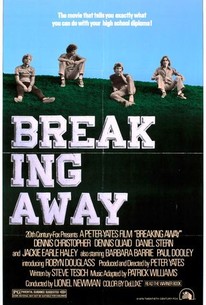
Breaking Away poster

Breaking Away

100 minutes

Cast

Selected cast credits · Film reference

Dennis Christopher Dave Stoller
Daniel Stern Cyril
Barbara Barrie Evelyn Stoller
Paul Dooley Ray Stoller
Robyn Douglass Katherine
Amy Wright Nancy
Peter Maloney Doctor
John Ashton Mike’s brother
Lisa Shure French girl
P.J. Soles Suzy
David K. Blase 500 race announcer
William S. Armstrong 500 race official
Howard S. Wilcox 500 race official
J. F. Briere Mr. York
Carlos Sintes Italian rider
Eddy Van Guyse Italian rider

Breaking Away | The Rewatchables

Explore episodeClose episode

Producer credits not yet identified.

Most Rewatchable Scene

The Little 500 finale

In the discussion (8)
Approx. transcript time · 00:15:10Read transcript
  • The father-son hug and the mother’s emotional reaction form the strongest dramatic scene.
  • Cyril looking for someone to hug after the victory adds loneliness to the expected sports-movie celebration.
  • The opening quarry sequence establishes the setting and all four personalities almost immediately, including the uncertainty of being nineteen and Dave’s Italian obsession.
  • Mike’s feigned drowning and speech about aging while college athletes are continually replaced make him a tragic figure.
  • Dave drafting the Cinzano truck creates an expectation of disaster but becomes a pleasant encounter ending in a speeding ticket for the driver.
  • Mike racing the college antagonist in the pool is another nominated scene.
  • The Italian riders’ unsportsmanlike behavior destroys Dave’s idealization; the aftermath with his father and crying mother is especially moving.
  • The Little 500 is the emphatic final choice: the friends take turns after Dave’s injury, Mike pushes through his despair, and Dave returns for a continuous wide shot of the thrilling last two laps.

What’s Aged the Best?

College towns; Indiana sports; cycling movies; Rod; Robyn Douglass; Mercedes; Amy Wright; John Ashton; Barbara Barrie; P.J. Soles; Cutters nickname

In the discussion (11)
Approx. transcript time · 00:39:31Read transcript
  • College towns remain excellent film settings, with townie-student tension and familiar streets, bars and pizza places.
  • Indiana sports in 1979 hold up especially well, coinciding with Larry Bird’s college season.
  • Cycling movies are more cinematic than running movies because crashes and interference create additional possibilities.
  • Rod’s pink polo, blue convertible, swimming and handsome college-villain persona remain excellent, as does Bochner’s later Die Hard connection.
  • Robyn Douglass is praised among a crowded field of seventies stars and for The Lonely Guy.
  • Rod’s blue Mercedes and the reverse-driving shot are admired, alongside simpler seventies downtown streets.
  • Amy Wright’s run through The Deer Hunter, The Amityville Horror, Breaking Away and Inside Moves demonstrates her character-actor strengths.
  • John Ashton as Mike’s brother efficiently conveys their relationship when threatening to take the car away.
  • Barbara Barrie is an outstanding screen mother with her own sexual life and a moving passport scene.
  • P.J. Soles’s busy six-year run and appeal are praised, alongside the reported marriage to Quaid and lost Princess Leia role.
  • Changing the local nickname from Stoners or Stonies to Cutters avoids drug confusion and produces a memorable name.

The Stephen A. Smith Hottest Take Award

1979 Indiana peak; parents understanding their son; Yates’s America; Quaid–Costner career swap

In the discussion (4)
Approx. transcript time · 00:41:23Read transcript
  • The hottest take calls 1979 Indiana’s Apex: Knight recruiting Thomas, Bird, Gretzky and Messier’s WHA connection, Breaking Away, Michael Jackson’s Off the Wall, Mattingly’s draft, the Indy 500, Jane Pauley and Letterman.
  • The film is fundamentally about parents finally understanding their son before he leaves, rather than about sports.
  • Yates is said to understand America better than most American directors, with his city portraits and this film’s documentary-like final stretch.
  • A counterfactual argues Quaid could have had Costner’s career if their roles and timing were exchanged, with No Way Out, American Flyers, Bull Durham, JFK and Yellowstone offered as plausible fits.

The Great Shot Gordo Award for Most Cinematic Shot

The final two laps’ continuous wide shot

In the discussion (2)
Approx. transcript time · 00:48:36Read transcript
  • The continuous wide shot of the final two laps is preferred for technical achievement; the quarry wide shot is another strong choice.
  • The pump entering Dave’s wheel and breaking it is another exciting visual moment.

The Butch’s Girlfriend Award for the Weakest Link in the Film

Moocher’s relationship subplot, tentatively; the father’s business strategy

In the discussion (2)
Approx. transcript time · 00:51:17Read transcript
  • Moocher’s weightlifting and secret-marriage subplot is the tentative weak link, qualified by the film’s leanness and lack of an obvious cut.
  • The father’s repeated lemon-selling strategy seems unsustainable in a small town, although poor used-car protections at the time offer a defense.

What’s Aged the Worst?

Swimming in jeans; Haley’s lost casting impact; scooter; cycling; Italian deception; serenading; cigarettes; TV adaptation; broadcast window; concealed age; idle time

In the discussion (11)
Approx. transcript time · 00:53:50Read transcript
  • Mike swimming in jeans is emphatically disliked.
  • Haley’s casting has lost the contemporary impact of bringing Kelly Leak into another film; he was then the biggest star of the cast.
  • Katherine’s oversized scooter looks bizarre.
  • Recreational campus cycling is questioned in the scooter era, prompting strong complaints about Los Angeles cyclists and narrow roads.
  • Dave’s Italian persona might prompt parental concern today, but it is defended as a young man’s attempt to reinvent himself without leaving home.
  • Serenading outside a dorm and falsely posing as Italian across multiple dates seem much less acceptable today.
  • Mike continually displaying cigarettes without smoking them is frustrating despite the character explanation.
  • The 1980–81 TV adaptation is criticized, with Shaun Cassidy leading and Barrie, Haley and Ashton returning; Barrie’s move directly from an Oscar nomination is unusual.
  • NBC reportedly paid $5 million for a May 1980 broadcast, outbidding HBO; the once-short theatrical-to-TV window contrasts with modern release patterns.
  • Christopher allegedly claimed a 1955 birth year rather than 1950, illustrating the pre-IMDb ability to conceal age.
  • The friends’ abundant idle time feels remote today, when they might spend their days playing video games.

Apex Mountain

Dennis Christopher; cycling movies; irritable Italians; Masi Gran Criterium; scarce Blu-rays; villains named Rod

In the discussion (11)
Approx. transcript time · 01:15:52Read transcript
  • Dennis Christopher is unequivocally at Apex despite a later career that did not match the initial stardom expectations.
  • Dennis Quaid is rejected; Robyn Douglass is a probable yes, qualified by praise for The Lonely Guy.
  • Jackie Earle Haley is rejected in favor of Kelly Leak, with Little Children and Watchmen also mentioned.
  • Cycling movies receive agreement, ahead of American Flyers; Quicksilver and other films are considered while discussing a possible cycling month.
  • Used cars and Daniel Stern are rejected, with Stern’s Home Alone, City Slickers and The Wonder Years period preferred.
  • Irritable Italians and the 1978 Masi Gran Criterium bicycle receive affirmative selections.
  • Peter Yates is initially rejected for Bullitt, then reconsidered because of this film’s Oscar success and unknown cast; no settled final answer emerges.
  • Hart Bochner is rejected in favor of Die Hard, with his directing of PCU also praised.
  • Indiana movies divide opinion between this and Hoosiers, with a tentative preference for Hoosiers.
  • Hard-to-find Blu-rays receive an affirmative nomination, illustrated by the expensive out-of-print Twilight Time release.
  • Villains named Rod receive an affirmative late Apex nomination.
In the discussion (1)
Approx. transcript time · 01:22:32Read transcript
  • Hanks is the clear choice, imagined as Dave or Cyril; Cruise might play Mike but could not convincingly do Dave.

Is This Movie Better With…?

Italian Wayne Jenkins; the Hanson Brothers

In the discussion (2)
Approx. transcript time · 01:30:24Read transcript
  • Italian-speaking Wayne Jenkins is the comic better-with performance, sending Dave back to the quarry.
  • The Hanson Brothers are an alternative cycling team, starting fights and demanding attention to Dave’s song.

Just One Oscar

Screenplay

In the discussion (1)
Approx. transcript time · 01:31:47Read transcript
  • The screenplay is the clear one-Oscar choice, matching the actual award.
In the discussion (5)
Approx. transcript time · 01:37:56Read transcript
  • Steve Tesich is the first winner choice because of the Academy Award.
  • Quaid is considered through the category’s career-benefit definition but explicitly rejected; Indiana is proposed for the film’s portrait of the state.
  • Peter Yates is the settled choice for a film that strengthens his place among major directors; Bullitt and Breaking Away are described as his enduring signature works.
  • Indiana receives renewed support as the subject of a love letter, and Barbara Barrie is proposed for the performance and long subsequent career.
  • The final recap establishes a three-way split: Peter Yates, Barbara Barrie and the state of Indiana. Tesich’s earlier nomination is not retained as a final choice.
Podcast choices
Speaker not identified
Indiana