‹ All movies
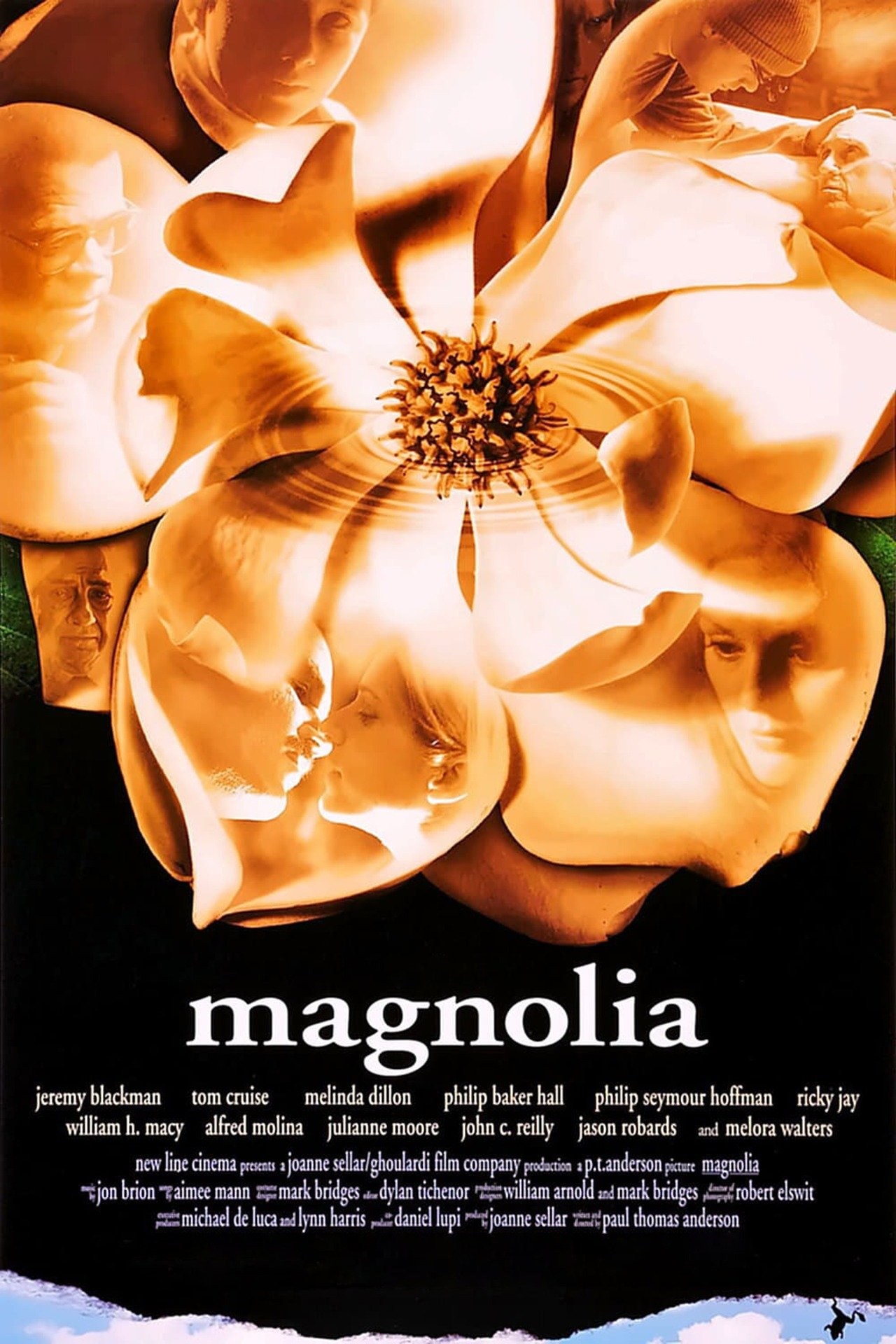
Magnolia poster

Magnolia

188 minutes

Cast

Selected cast credits · Film reference

Tom Cruise Frank T.J. Mackey
Jason Robards Earl Partridge
Julianne Moore Linda Partridge
Melora Walters Claudia Wilson Gator
Philip Baker Hall Jimmy Gator
Melinda Dillon Rose Gator
John C. Reilly Jim Kurring
William H. Macy Donnie Smith
Jeremy Blackman Stanley Spector
Michael Bowen Rick Spector
April Grace Gwenovier
Ricky Jay Burt Ramsey / narrator
Alfred Molina Solomon Solomon
Michael Murphy Alan Kligman
Henry Gibson Thurston Howell
Don McManus Dr. Landon
Danny Wells Dick Jennings
Thomas Jane Young Jimmy Gator
Cleo King Marcie
Clark Gregg WDKK employee
Robert Downey Sr. WDKK employee
Patton Oswalt Delmer Darion
Miriam Margolyes Faye Barringer
Pat Healy Sir Edmund William Godfrey / young pharmacist
Paul F. Tompkins Chad (voice)
Mary Lynn Rajskub Janet (voice)

Magnolia | The Rewatchables

Explore episodeClose episode
In the discussion (3)
Approx. transcript time · 00:03:03Read transcript
  • The introduction identifies this discussion as the origin of Linda Partridge joining the overacting award name.
  • Julianne Moore’s pharmacy scene prompts renaming the award for Linda Partridge; the intensity is considered overwhelming and unrealistic.
  • Linda Partridge formally replaces Rubinek in the award name; Cruise is considered but defended through the complete emotional arc, while Bowen remains a contender.

Half-Assed Internet Research

Budget; biblical references; scene improvisation; planning; marketing; influences; frogs

In the discussion (9)
Approx. transcript time · 00:08:33Read transcript
  • The reported budget is 37 million and gross 48.5 million; Cruise’s presence is thought commercially helpful.
  • Repeated 8–2 references reportedly invoke Exodus’s frog plague, including the blackjack vignette; elaborate Easter eggs are criticized as unnecessary.
  • Anderson reportedly asked Cruise to draw on his father’s death for the bedside scene, requiring considerable trust.
  • The documentary That Moment reportedly shows extensive planning meetings necessary for the complex filming.
  • A large research collection is deliberately not read in full; the Apple performance-art documentary story is revisited, and Hoffman reportedly said Cruise improvised after refusing to cry, prompting Hoffman’s genuine tears.
  • Anderson reportedly resisted Cruise-focused marketing and designed the poster and edited the trailer himself, provoking criticism of unchecked control.
  • Network was reportedly screened for the production team; Anderson’s Quiz Kids Challenge assistant job informed the film.
  • Reported trivia includes A Day in the Life as a structural model, 190 uses of the profanity and a working seduction-infomercial phone number playing Cruise’s pitch.
  • More than 7,900 rubber frogs were reportedly used, with others digital; the effects are considered convincing.

Roger Ebert's review

In the discussion (1)
Approx. transcript time · 00:16:09Read transcript
  • Ebert awarded four out of four and celebrated operatic intensity over logic and restraint.

What’s Aged the Best?

Frank’s foresight; Oswalt; soundtrack; filmmaking craft; Hoffman; bar; ponytail; Jimmy Gator’s relevance

In the discussion (9)
Approx. transcript time · 00:22:29Read transcript
  • Frank anticipates masculine self-help, Tucker Max and the later pickup-artist movement associated with The Game and Neil Strauss.
  • Frank’s performance and foresight remain strengths; the early Patton Oswalt appearance is appreciated.
  • Aimee Mann’s soundtrack and its artist-centered structure are praised, compared with Nashville; a Counting Crows song-based movie is imagined.
  • The frantic style captures Anderson’s state and displays difficult choreography/editing, despite its exhausting length and derivative elements.
  • Hoffman’s unusually restrained, empathetic nurse showcases decency and growing versatility; 25th Hour is compared.
  • The two Supertramp songs and music generally are praised.
  • The bar and its flirtatious unattainable bartender feel specifically Los Angeles.
  • Frank’s top ponytail anticipates the man bun.
  • Jimmy Gator anticipates later exposure of abusive television figures; Anderson’s broadcast-family upbringing supplies context.

Most Rewatchable Scene

Frank confronting Earl at the deathbed

In the discussion (5)
Approx. transcript time · 00:25:02Read transcript
  • Rapid crosscutting repeatedly interrupts developing performances, especially Cruise’s bedside breakdown.
  • Opening coincidence vignettes are nominated as thematic entry points, though less compelling on repeat viewing; the scuba story is preferred over the drawn-out suicide story.
  • All Cruise scenes are favored in principle, especially Frank’s grand entrance.
  • Moore’s pharmacy meltdown, the frog downpour and Stanley needing to urinate during the quiz show are nominees.
  • Frank confronting Earl is the agreed winner, from his arrival through the breakdown; Hoffman crying in the background deepens it and the frogs awaken Earl.

What’s Aged the Worst?

Length; disputed subplots and performances; weather; singalong familiarity; threatening interview

In the discussion (9)
Approx. transcript time · 00:34:25Read transcript
  • Anderson’s 1999 prediction that Magnolia would be his best film is rejected; its personal ambition and flaws make it tempting to mentally repair.
  • Reilly’s subplot, Moore’s excessive intensity and overall length are criticized; removing Stanley and Donnie is proposed.
  • Unlike For Love of the Game’s obvious proposed cuts, this film invites disagreement over which stories are expendable; the quiz material is compelling but its necessity uncertain.
  • Walters is criticized as inadequate for a complicated role and its final scene, but defended as deliberately portraying an unpleasant, introverted cocaine addict rejecting kindness; later Adams or Stone is imagined as an alternative caliber.
  • Reilly’s simplicity is compared unfavorably with Forrest Gump and considered too prolonged, though defended as purposeful incompetence.
  • Moore’s subplot is proposed for removal; the pharmacy behavior seems implausibly intrusive and her lawyer-office confession excessively unhinged.
  • Rain and 99 percent humidity seem unlike Los Angeles, with the frog storm acknowledging the film’s unreality.
  • The Wise Up singalong loses novelty after years of musical television episodes.
  • Frank’s threatening intrusion into the interviewer’s space feels uncomfortable.

The most "year the movie came out" thing

Frank Mackey; singalong; television; telephone orders; Anderson and Fiona Apple

In the discussion (3)
Approx. transcript time · 00:42:57Read transcript
  • Frank’s self-help persona, the singalong, 1970s Hollywood nostalgia and television as a portal to tawdry distractions feel 1999.
  • Ordering porn magazines and deliveries by telephone feels pre-app 1999.
  • Anderson’s Fiona Apple relationship and bucket hat define the era; their intense creative interaction in That Moment and later friendship/video collaborations are admired.
In the discussion (1)
Approx. transcript time · 00:47:54Read transcript
  • Debra Winger was reportedly considered for Linda and Brando for Earl; Winger might improve a performance deemed too similar to Amber Waves and emotionally unprepared.
In the discussion (3)
Approx. transcript time · 00:52:00Read transcript

Apex Mountain

Melora Walters; Aimee Mann’s solo career; a participant’s mother

In the discussion (3)
Approx. transcript time · 00:57:51Read transcript
  • Cruise and Anderson are rejected; Walters and Aimee Mann’s solo career are affirmed, with Mann especially favored; the Valley is floated.
  • Frogs are disputed against the Bible and prince-transformation stories; Stanley is merely mentioned.
  • One speaker jokingly picks his mom, who fiercely defended the movie and its frogs for twenty years.

Picking Nits

Frank’s biography; bathroom break; teeth; Samuel Johnson; marriage; dry car

In the discussion (6)
Approx. transcript time · 00:59:33Read transcript
  • Frank should expect a journalist to check his biography; the George O'Leary résumé scandal is compared.
  • The quiz show should pause taping to let a child use the bathroom; Los Angeles rain is again questioned.
  • Donnie’s unremarkable teeth seem insufficient to drive his entire story.
  • Donnie’s Samuel Johnson comparison is said to ironically describe exploitation that actually happened to Johnson.
  • Robards and Moore as a couple are disputed, with the trophy-wife arrangement defended; Robards’s personal history lends weight to his regret.
  • Linda’s car changes from rain-covered to dry after she passes out.

The Neil McCauley “A Book about Metals” Award for Best Line from the Movie

“Respect the cock”; “I’m not going to cry for you”; “I’m quietly judging you”

In the discussion (5)
Approx. transcript time · 01:01:57Read transcript
  • The past never being finished with us and Frank’s refusal to cry are nominated; Respect the cock is considered especially memorable.
  • Earl’s regret over losing his love is played as an intense contender.
  • Reilly’s monologues are challenged as too simple; Frank quietly judging the interviewer is another choice.
  • Sharing everything to survive the lies that destroy others is quoted.
  • The line about people needing help, forgiveness or jail is a final nominee.

Probably Unanswerable Questions

Frogs; next-day relationships; Claudia’s abuse

In the discussion (4)
Approx. transcript time · 01:06:11Read transcript
  • The frog storm’s meaning, national significance and geographic reach are questioned; a mother’s interpretation treats it as life-changing unpredictability rather than realism.
  • The unexpected theatrical shock, Claudia’s apparent hallucination and story-changing consequences defend the frogs as a bold essential choice; poster clues were overlooked.
  • Linda and Frank’s next conversation and Claudia’s third date with the officer are imagined; the Trump presidency is jokingly used to make the frogs feel plausible.
  • Claudia’s apparent abuse by Jimmy is considered sufficiently clear despite ambiguity; its necessity and possible echo of the Woody Allen story are debated.

Producer review

Unforgettable performances; ambitious gamble; modern Frank Mackey sequel

In the discussion (2)
Approx. transcript time · 01:20:07Read transcript
  • The 2024 producer review finds unforgettable Moore and Cruise performances in a film unlikely to be rewatched; a modern online Frank Mackey sequel is desired and Cruise’s unusual comic range preferred to one-note action roles.
  • Babylon is preferred but compared as another ambitious overlong post-breakthrough gamble; directors receiving such opportunities is welcomed.

More from the conversation

The 2019 Rewatchables 1999 recording is rereleased during 2024 Rock Bottom Month with a 2017 Anderson interview appended.
Approx. transcript time · 00:02:11Read transcript
The frog climax baffles a child; the film is admired but frustratingly overlong, and Anderson reportedly wished to cut 35 minutes.
Approx. transcript time · 00:04:51Read transcript
Age deepens its themes of regret and atonement; relentless crises, frantic camera movement and Moore’s unhinged scenes make it feel exceptionally cocaine-fueled and perilously close to Crash.
Approx. transcript time · 00:05:41Read transcript
The style is framed as an Altman ensemble shot like Scorsese; Boogie Nights earned Anderson unusual creative freedom, which can discourage necessary cuts.
Approx. transcript time · 00:07:23Read transcript
The ensemble is admired, but Reilly’s entire subplot would be cut by one participant; the film is seen as a necessary strange phase for a major filmmaker.
Approx. transcript time · 00:08:54Read transcript
Cruise’s exploratory 1990 s work culminates in what is argued to be his best and most physically/emotionally expansive performance; losing the Oscar to Caine in The Cider House Rules is condemned.
Approx. transcript time · 00:09:39Read transcript
An ongoing Cruise–Anderson partnership might have altered both careers; commercial disappointments and missing Oscar validation are proposed reasons Cruise retreated from experimentation.
Approx. transcript time · 00:11:08Read transcript
The director-as-star-rehabilitator impulse is compared with Tarantino, with Anderson thought uncertain about his direction until There Will Be Blood.
Approx. transcript time · 00:12:31Read transcript
An alternate career with this recurring ensemble is imagined; Magnolia may exhaust Anderson’s autobiographical pain across many characters, beginning with Claudia.
Approx. transcript time · 00:13:24Read transcript
The CruiseRobards bedside scene is profoundly moving, increasingly relatable with age, and painfully personal; Robards reportedly took the role after surviving cancer.
Approx. transcript time · 00:14:54Read transcript
Its excessive length is criticized while its all-out ambition, frog climax and desire to depict the San Fernando Valley are respected.
Approx. transcript time · 00:16:48Read transcript
Its regional specificity is disputed: interiors may undercut the Valley ambition, but studio work, bars and producer homes feel authentically Los Angeles.
Approx. transcript time · 00:17:42Read transcript
Melinda Dillon’s rediscovery and Anderson unlocking Philip Baker Hall are celebrated; Hall’s restrained work deserved supporting-actor attention.
Approx. transcript time · 00:18:52Read transcript
Following an acclaimed success can be paralyzing; Anderson’s subsequent stylistic reinvention is admired, while Cruise’s mesmerizing presence may save this overlong film.
Approx. transcript time · 00:20:58Read transcript
The cast forms pairs: quiz children, television patriarchs and drug-addled women.
Approx. transcript time · 00:51:06Read transcript
Fight Club, Blair Witch, Being John Malkovich and Three Kings share 1999 uncertainty about reality; such a film would now likely become streaming television.
Approx. transcript time · 01:08:26Read transcript
The film’s exceptional portrayal of unresolved business with a dying loved one and complicated love for damaged people outweighs its flaws.
Approx. transcript time · 01:09:59Read transcript
The original 1999 series ends with future Fight Club and Ripley coverage discussed; Hoffman’s 1999–2000 range and earlier work are admired.
Approx. transcript time · 01:12:54Read transcript
In the appended 2017 interview, Anderson says Boogie Nights built confidence and Magnolia expressed personal experience with perhaps too much confidence.
Approx. transcript time · 01:14:31Read transcript
The director cites Rain Man, Born on the Fourth of July and The Color of Money as evidence of Cruise’s acting range and difficult charisma.
Approx. transcript time · 01:16:36Read transcript
Cruise’s extraordinary screen presence and long career are admired; a mature dramatic reinvention like Newman’s The Verdict is anticipated.
Approx. transcript time · 01:17:57Read transcript
The outro credits producer Craig Horlbeck, confirms current Rock Bottom Month and emphasizes fascinating discussion rather than literal rewatchability.
Approx. transcript time · 01:23:13Read transcript