Kirsten Dunst is named at Apex; The Power of the Dog and Marie Antoinette are raised against it, but Apex is defined as when she had the most juice, with Bring It On mattering more.
The lead actor is a yes, with Spider-Man 2 considered combined with this film. — Van Lathan
For Spider-Man films overall, No Way Home is judged the Apex because of its box office after Endgame. — Van Lathan
This is called the director's Apex unless Multiverse of Madness surpasses it, although Army of Darkness is a personal favorite; a counterpoint says Spider-Man will always be his Apex. — Van Lathan
Heath Ledger is Apex Mountain, with the 'all part of the plan' speech performed; this and Brokeback are his two shining achievements, he is an all-time great American, or Australian, actor, the performance is burned into the brains of a generation, and he has kind of ruined comic book villains.
Tangent: basically all other comic book villains are bad or problematic; Marvel punted with various space monsters, Thanos is a rip-off of Darkseid, and apart from Magneto there is no psychological depth to apply.
Two exceptions are offered: Magneto, especially the Fassbender iteration, and Sam Raimi's Dr. Octopus as played by Alfred Molina in the second Spider-Man, good for the opposite reason to Ledger because he is vulnerable, with a story about his wife driving him mad. — Sean Fennessey
There are only a handful of great villains, Anton Chagru (as transcribed), Hannibal Lecter and the Joker; a great villain thinks he is the hero, which cannot apply to a cartoon Nazi like the Red Skull, while the Joker understands he is the flip side of Batman; Lex Luthor was left on the table, Gene Hackman's version a great movie character if schlocky.
Taken on its face, Ledger's Joker literally asks the audience why they care about anything, lighting a mountain of money on fire, which pokes at the heroism and financial motivations of these movies.
Bale is the most interesting Apex question: his only huge non-ensemble success is Batman, Big Short and American Hustle were ensembles and his top-lined films are strange, a couple of Malicks and Scott Coopers; The Fighter is arguably his greatest role, one host personally picks Empire of the Sun though he was a child, and some are partial to American Psycho.
The vote is American Psycho: he is extraordinarily well suited to that role and not to Bruce Wayne; this host has never liked his Batman, finding many of his choices grating, particularly the voice. — Sean Fennessey
Does the movie work without Ledger: no. Not being all the way in on Christian Bale, with American Psycho his most interesting and The Fighter his most realized performance, leads to this not being Apex Mountain for him as a performance, though probably as a movie star, a framing that is agreed to.
American Psycho is also picked, as an investigation of the dark side of the handsome, square-jawed movie-star image, where Bruce Wayne is a blank mirror for the far more interesting Joker; the tonal similarity between Bane's and Bruce's voices is part of why Dark Knight Rises did not resonate.
Batman might be the hardest role in movies: a performer with any sense of irony cannot play Bruce Wayne, which is why Bale's funny American Psycho turn and Affleck's larded irony are problems; Keaton did a good job and nobody has tried the snappy Adam West version.
Aaron Eckhart's canon is read out: In the Company of Men, Any Given Sunday, Erin Brockovich (as transcribed, Aaron Brockovich), The Core, Thank You for Smoking, Battle for Los Angeles, President Benjamin Asher in Olympus Has Fallen and London Has Fallen, and Jeff Skiles, Sully's loyal co-pilot.
Is Harvey Dent Apex Mountain for Eckhart: yes, citing a Twitter meme that one of the great movie moments is Dent not recognizing the Joker in the hospital until the surgical mask comes off, a scene liked a lot, with the comment that it is a good scene for Eckhart too and a huge flex for Ledger, every line of his great; Eckhart is a pretty good actor, a really good number two, and well cast and good here.
Maggie Gyllenhaal: no, that goes to The Honorable Woman or Secretary, and she is phenomenal in The Deuce.
Nolan: in terms of cultural impact, yes; whether it is his best movie splits the room among Dunkirk, Inception, and Dark Knight first with Inception second; what he accomplishes even in fits and starts is above almost all his peers, he can be John Ford, Howard Hawks or Spielberg, which is why one host is harder on him than on anyone.
Does Nolan need a David Coop (as transcribed) or William Goldman to write his scripts, the way Andy Reid needs a time-management coach; his Dark Knight dialogue is more comic-booky than remembered, telling you the theme of each scene, and the set pieces hold the movie up while seams show in the small moments.
Nolan and Fincher together would be the greatest filmmaker of all time, since Fincher cares about the precision of intimate one-on-one scenes while Nolan's set pieces are incredible but he does not know how two people talk to each other; another host accepts comic-book corniness but finds the plotting of almost all his movies too convoluted for no reason, charming only in Memento.
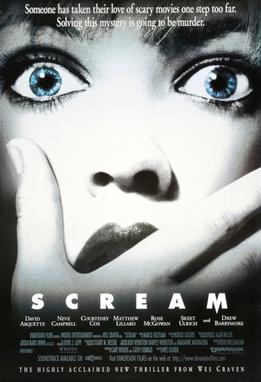
Santa Rosa High School refused to host the shoot and got a 'no thanks' credit; eight ratings submissions to avoid NC‑17; the Gainesville Ripper inspiration; Romero and Raimi almost directed; Craven's phone-hit cameo; the mask found while location scouting; Linda Blair's reporter cameo; a 21-day final scene with 50 gallons of fake blood; Craven told Drew Barrymore animal-torture stories; Williamson wrote it in three days as Scary Movie
Santa Rosa High School was to host the high school scenes and refused, so they shot at a community college, and the credits include a pointed 'no thanks' to Santa Rosa.
The movie was almost NC‑17 for violence and went back eight times; Williamson's script was reportedly extremely specific about organs dripping down legs, so the disemboweling was originally even more disgusting.
Williamson was obviously inspired by the Gainesville Ripper, who murdered students in Florida and was executed after the movie's release, one of the grisliest American crimes of the period; it was a ripped-from-the-headlines idea for a young screenwriter looking for anything to get a script sold.
George Romero and Sam Raimi almost directed; Raimi's version would probably have been a lot funnier, Romero never made a movie like this, and Scream is not thought improvable, only different; this was Craven's second act after peaking in the eighties.
Craven's one cameo is being hit by Drew Barrymore with the phone while wearing the Ghostface costume; the mask was found at a house during location scouting; Linda Blair cameos as a reporter who bumps into Sidney outside the school after the attack.
The final scene took 21 days of a roughly 60-day shoot for a $15 million movie and used 50 gallons of fake blood.
A return to research corner: to keep Drew Barrymore upset through the opening, Wes Craven told her real stories of animal torture, since she was an animal activist, and then turned the camera on.
Earlier, Kevin Williamson is said to have written the script in three days in Palm Springs under the title Scary Movie, after failing to sell Teaching Mrs. Tingle, and pitched it as a trilogy package.
Earlier, the opening death was reportedly worse originally, with the guts coming out, and had to be fixed to avoid an NC‑17.