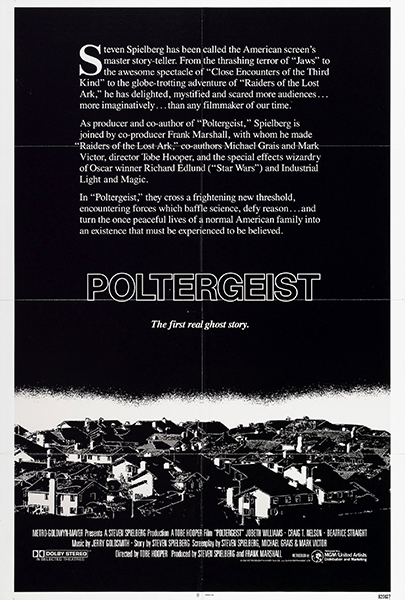
The discussion places Poltergeist alongside Raiders of the Lost Ark and E.T. in Spielberg’s early-1980s dominance.
The project is described as growing from Night Skies, with Spielberg’s E.T. commitments preventing him from directing.
Spielberg’s visual fingerprints feed the disputed account that he effectively took over directing.
The discussion recounts Directors Guild involvement, a fine and Spielberg’s public letter praising Hooper.
Frank Marshall is quoted crediting Spielberg’s storyboards and near-daily presence while identifying Hooper as the on-set director.
Zelda Rubinstein is reported to have said Spielberg directed all six days she worked.
The film is said to have lost its effects, sound-effects and score Oscar nominations to E.T.
JoBeth Williams’s career is traced through Kramer vs. Kramer, Stir Crazy, The Big Chill and major television films; she is praised as this film’s driving force.
Craig T. Nelson’s long career is surveyed from film roles through Coach, Parenthood and The Incredibles.
The curse discussion recounts Dominique Dunne’s murder by her boyfriend and its connection to her father’s later reporting.
Heather O’Rourke’s death at twelve during the third film’s production is discussed as part of the curse lore.
Lou Perriman’s murder and other deaths are cited in the curse discussion, with a documentary series suggested for further context.
Williams is reported to have found pictures repeatedly crooked at home during production.
Rubinstein’s reported vision of her dog before learning of its death is presented as another strange anecdote.
The clown apparatus is reported to have malfunctioned and actually choked the child actor before the crew intervened.
The film’s roughly $10.7 million budget and strong 1982 box office are cited; the transcript garbles the gross.
Richard Lawson’s family connections and earlier acting work are discussed.
Spielberg’s childhood fear of clowns and a tree outside his window is said to have inspired the movie.
The house is said to remain in Simi Valley, California.
The televised Rams–Saints game is identified as a 1980 Monday Night Football game, with the Saints losing and Archie Manning struggling.
A late-nineteenth-century Denver cemetery incident is cited as an inspiration, correcting an initial garbled date.
The collapsing house is said to have been a roughly four-foot model.
The film reportedly cost 40 million dollars and earned 672.8 million worldwide.
Six Oscar nominations covered picture, director, screenplay, supporting actor, supporting actress and editing.
Frank Marshall reportedly wanted the revealing cut toward Willis removed after Cole says he sees dead people.
Wahlberg reportedly lost 40 pounds and shaved his eyebrows for his brief appearance.
The claim that this was Shyamalan’s second film is explicitly corrected: Praying with Anger preceded Wide Awake, making it his third.
Shyamalan also reportedly rewrote She’s All That without credit and held a Stuart Little writing credit.
David Vogel reportedly paid 3 million for the script and Shyamalan’s directing guarantee without corporate approval, then lost his Disney position.
Disney reportedly sold production rights to Spyglass while retaining distribution and 12.5 percent of receipts.
Osment impressed Shyamalan by reading the entire script three times rather than only his part.
The movie reportedly had 80 million rentals in 2000 and was omitted from Entertainment Weekly’s 1999 summer preview.
Early drafts made Malcolm a crime-scene photographer, potentially explaining the wardrobe.
Willis reportedly owed Disney films after Broadway Brawler collapsed and accepted 10 million dollars, half his usual fee.
A claim that the kitchen glass originated as Philadelphia-only sour-cream packaging is explicitly doubted.
Red marks contact with the other world or heightened emotion, including the church, birthday, tent, recorder, basement doorknob, restaurant, wake and Anna’s shawl.
Young Sherlock Holmes’s novelization reportedly uses the phrase Sixth Sense; shared filmmakers and Osment’s later AI role are noted.
Malcolm’s clothes are reportedly pieces worn or touched on the night of his death.
A reported Are You Afraid of the Dark? inspiration involves a boy who discovers he is dead because only his sister can see him.
The soundtrack reportedly spoils the ending with a final track titled Malcolm Is Dead.
Profit participation, production shorthand, Tunisia, animal work, reused footage and sets, props, stunts, costume origins, and the physical cost to Ford
Lucas reportedly received between one and four million dollars plus gross participation, while Spielberg received $1.5 million plus participation.
The script described the Ark opening only as “all hell breaks loose,” leaving the effects team to invent the sequence.
Tunisia stood in for Egypt in extreme heat; widespread dysentery spared Spielberg because he ate imported canned food.
The monkey salute reportedly required about 50 takes and a grape on fishing line; depleted stunt staffing led producer Frank Marshall to pilot the airplane for days in severe cockpit heat.
Stock footage came from Lost Horizon and The Hindenburg, while the canyon location and hieroglyphs connect visually to Star Wars.
Indy’s bullwhip sold for about $43,000 in 1999, and the Well of Souls occupied the same soundstage set footprint as the writing room in The Shining.
Vivian Kubrick reportedly halted production over snake handling until additional protections were provided.
Ford performed many stunts, bruising ribs, tearing a knee ligament, and narrowly avoiding worse injury under the airplane.
The German-mechanic fight was largely improvised as Spielberg kept adding ideas, and Indy’s clothing was based on Charlton Heston in Secret of the Incas.