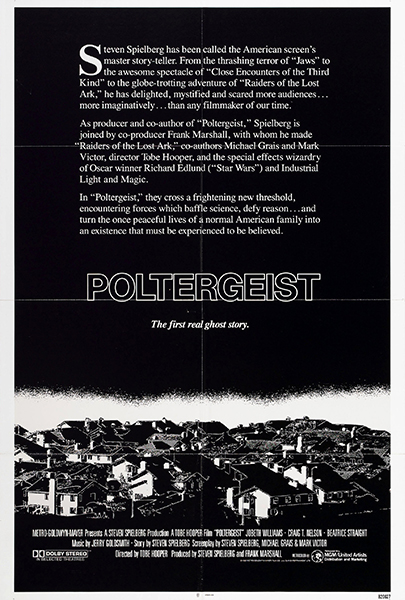
Richard Lawson’s presence is appreciated, with surprise that his character remains in the haunted house. — Bill Simmons
The evil businessman knocking down headstones could have been Black; the reply jokes that this would not happen. — Bill Simmons
The doctor is suggested as another role that could have been played by a Black actor; the response ultimately expresses satisfaction with Lawson. — Bill Simmons
The film is said to have lost its effects, sound-effects and score Oscar nominations to E.T. — Bill Simmons
JoBeth Williams’s career is traced through Kramer vs. Kramer, Stir Crazy, The Big Chill and major television films; she is praised as this film’s driving force. — Bill Simmons
Craig T. Nelson’s long career is surveyed from film roles through Coach, Parenthood and The Incredibles. — Bill Simmons
The curse discussion recounts Dominique Dunne’s murder by her boyfriend and its connection to her father’s later reporting. — Bill Simmons
Heather O’Rourke’s death at twelve during the third film’s production is discussed as part of the curse lore. — Bill Simmons
Lou Perriman’s murder and other deaths are cited in the curse discussion, with a documentary series suggested for further context. — Bill Simmons
Williams is reported to have found pictures repeatedly crooked at home during production. — Bill Simmons
Rubinstein’s reported vision of her dog before learning of its death is presented as another strange anecdote. — Bill Simmons
The clown apparatus is reported to have malfunctioned and actually choked the child actor before the crew intervened. — Bill Simmons
The film’s roughly $10.7 million budget and strong 1982 box office are cited; the transcript garbles the gross. — Bill Simmons
Spielberg’s childhood fear of clowns and a tree outside his window is said to have inspired the movie. — Bill Simmons
The house is said to remain in Simi Valley, California. — Bill Simmons
The televised Rams–Saints game is identified as a 1980 Monday Night Football game, with the Saints losing and Archie Manning struggling. — Bill Simmons
A late-nineteenth-century Denver cemetery incident is cited as an inspiration, correcting an initial garbled date. — Bill Simmons
The collapsing house is said to have been a roughly four-foot model. — Bill Simmons