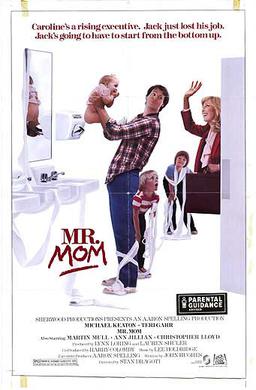
Terry Garr is a yes despite not being good here, because the Tootsie, Mr. Mom and Letterman combination is her apex; Keaton is a no, Martin Mull probably not, and John Hughes a no.
The concept of a Mr. Mom is probably at its apex here because the film created it; Detroit as a movie city is not, since Gung Ho and Beverly Hills Cop came a year later.
Terry Garr is called not good, not really a good actress, in a part that is interesting in the right hands and which she is not interested in exploring; the defense offered is that the script gives her little material.
She could have played it sexier or more mom-ish, but the character is hard to describe: not really a mom, throwing the kids away for an hour, showing up frazzled, never asking about them or her husband until he gains weight and she throws darts, leaving the question of what is supposed to be likable about her.
A millennial brain trained that women should be ambitious says she should get on the plane after convincing a guy to spend $12 million, yet the film sets up a recession and a layoff and then treats it as no big deal; if she is ambitious, it is never clear in the first hour, so the character is undercooked in both script and performance, and she has no chemistry with Keaton, who has more with Angelian (as transcribed).
It is hard to believe she becomes successful at work since she seems like a clueless dipshit, going from two years of advertising experience and years at home to a high-powered executive, which is not how the workplace treats women after kids.
Michelle Pfeiffer is the replacement: it changes the whole dynamic and makes it interesting, but then the creep must be recast too, since Martin Mull is no threat to her, so Richard Gere; there are five more interesting versions of this film, and the Pfeiffer version ends with the mom leaving the family or having an affair while the husband watches soap operas.
Jack should have been much madder when Martin Mo (as transcribed) answers Carolyn's hotel phone in front of his friend and the kids, which is never resolved, and Carolyn finding Joan lying on her own bed is waved off too easily; Pfeiffer, queen of the 80s, 90s and 2000s, looks fantastic on the Maleficent 2 press tour.
There is a reason Terry Garr's career never exploded through the 80s, although she is good in Young Frankenstein and great in Tootsie; the frustration is that Tootsie Terry Garr is a character while this is only a sitcom mom, with Keaton given the fun things to do.
Meryl Streep is offered as one more idea, a fun part since she did weighty movies in the 80s, but she brings guilt and shame wherever she goes and would need a scene crying over missing Bobby's violin recital, which one host wanted and the other did not.
A parent who missed seven soccer games and a graduation during four weeks on the road at the NBA playoffs says the film never taps into that; the other host's mother, a successful lawyer who traveled, felt guilty, whereas this character does not care about her children at all, and Halloween, the best day for kids apart from birthdays, is the proof, though the $12 million pitch is conceded as a reason she has to be there.
The overmatched dad handling multiple kids; the film not treating a man at home as a novelty; Jack's real friendships with the other moms; Ann Jillian (transcribed as Angelian); Keaton watching soap operas; the Rocky, Jaws and Chariots of Fire references; the tuna-with-a-heart commercial; the abrupt ending; 1980s parenting; Martin Mull, Jeffrey Tambor and Christopher Lloyd
The overmatched dad handling multiple kids at home is always an enjoyable gimmick, and the film does not treat a man at home as a huge novelty, only as a moron at home; the mean, judgy moms still exist in 2019 on mommy boards, and the hosts credit the film for not dwelling on whether a man could stay home.
Jack makes real friends with the other moms, playing poker and being taken to a male strip joint; Angelian (as transcribed) was really good, remembered as the breakout star of the sitcom It's a Living about waitresses at a club, with a dance background, playing the horny divorced friend who is in on the joke, though one host cannot defend the character even while liking her.
Keaton watching soap operas is both aged best and aged worst: one host watched General Hospital in that era, when daytime TV with only ten channels meant game shows and soap operas and a sick day meant making sure to catch The Price is Right, and Jack goes from mocking the show to yelling at it within five minutes; Rocky training montages are always liked.
The pop culture references, Rocky, Jaws and a fake Chariots of Fire during the race, have aged well where timely references usually die and date a film instantly, as Wayne's World 2 does.
The tuna-with-a-heart commercial is very 80s but smart, since the idea that brands need a heart is exactly what every brand on Twitter does now.
The abrupt ending is a point in its favor: the 80s habit of saying everything and getting out is missed, since comedies now tack on four more scenes, and Night Shift ends abruptly the same way.
The parenting seems pretty good: no helicopter freaking out, kids who make their own lunch, the speech about giving up the blanket, no crying or punching, and the film accepts on face value that staying home with the kids is hard full-time work, which is relatively progressive for 1983; Martin Mull, Jeffrey Tambor and Christopher Lloyd are a pretty good troika.
To close, one host goes with Keaton watching soap operas, the other with 1980s parenting, which seemed normal and soothing rather than what was expected, prompting a joke about missing peanut allergies, ADD medication and therapists.
One host's candidates begin with Jack getting fired, where everybody is trying to strangle each other and Jeffrey Tambor and Christopher Lloyd share the scene, which feels very 80s and would not be written that way today; the clip is played.
Martin Mull, as Terry Garr's creepy boss, makes his first visit to the house and Keaton comes to the door holding a chainsaw, overalls and a backwards Lions trucker hat, the two men sizing each other up over the 220, 221 wiring line; the clip is played, and the other host decides this is where Michael Keaton and Mr. Mom invented the hipster dad seen in Brooklyn and Silver Lake.
A Grantland interview a friend named Daniel did with Keaton, about 12,000 words long, had him recalling the 220, 221 line as an ad lib he was really proud of, and he is fond of the movie generally.
The house attacking the family, with the washer and dryer going nuts, the self-starting vacuum chasing the kids and a baby being fed chili, is next; the host who had his kids alone that weekend says being thrown into the fire really is like that, down to a son microwaving three-day-old sushi.
The improbable, elaborately built obstacle-course race at a work function, with hundreds of people cheering, is a specific 80s thing that would not happen now, built from borrowed playground equipment for grown men; the concept of letting your boss win because it is better for you professionally is enjoyed, and Keaton throws the race at the end.
The Halloween scene, where Carolyn has two hours' notice to fly to Los Angeles after convincing a man to spend $11 million on her idea, is the only time the film confronts Jack losing the family; one host notes she simply stops being a mom for an hour, while the other finds her lack of guilt refreshing against the constant anxiety of content aimed at thirty-something women, and Keaton dressed as a prisoner is good in it.
The goofy, abrupt ending, with Angelina (as transcribed) in Jack's room with a drink as he comes out of the shower and Terry Garr arriving, plays like they ran out of film; the other host's pick is the utilities, Keaton versus the washing machine and the vacuum, which leads to the realization that ironing a grilled cheese on the ironing board came from this movie, with Craig asked whether he has done it.
One host has ironed a grilled cheese and calls it the best way to make one, except that the butter and cheese ruin the iron, so a dedicated grilled cheese iron would be needed, which is argued to be cheaper than a panini grill.