
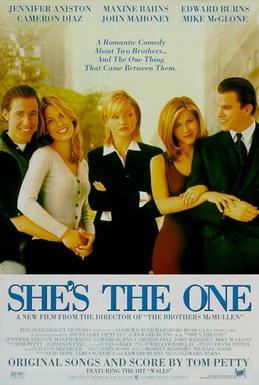
Heather entering Mickey’s cab; the brothers’ silent sizing-up; the gay-question montage; the final confrontation.
The family introduction, cab arguments, television retrieval, parents, boxing, Heather’s agency, and farewell are retained separately.
In the discussion (18)
- The first Fighting Fitzpatrick family scene is proposed.
- The cab ride with Aniston and McGlone arguing about sex is proposed.
- Mickey arriving with his new bride is proposed as a separate beat.
- Mickey picking up Heather and retrieving his television is proposed.
- Heather entering Mickey’s cab elevates the movie and is a leading choice.
- Mike McGlone repeatedly calling disliked people animals is proposed as a running bit.
- Francis and Renee arguing about a sexual down cycle is proposed.
- Mickey, Renee, and Francis together are proposed.
- The parents interrogating Francis are proposed, with Frank Vincent praised.
- Mickey and Heather considering whether they made a mistake is proposed and treated as dangerous for him.
- The montage asking whether Francis is gay is selected.
- Mickey discovering Francis’s affair and the boxing-glove confrontation are proposed.
- The final apartment argument is proposed.
- Heather is interpreted as deliberately manipulating both men and giving Francis the watch to provoke them.
- The competing interpretation says the film gives Heather unusual agency and happiness instead of punishing her.
- Heather getting what she wants is defended even though both brothers insult her.
- Heather and Mickey silently sizing each other up is a final choice.
- Heather telling Francis she is engaged and his “ruined my life” response are proposed.
Mike McGlone shouting after Heather’s departure.
His emphatic reaction is selected.
In the discussion (1)
- Francis shouting after Heather leaves is selected as overacting.
Jennifer Aniston’s Rachel-era hair; the valuable heavy television; a cab rather than Uber; 1990s character names.
Franny’s feminization and the Woody Allen/Tony Roberts comparison are also discussed as period artifacts.
In the discussion (6)
- Jennifer Aniston’s partial Rachel haircut is selected.
- Mickey’s large, valuable television is proposed.
- Driving a cab rather than using ride-share is proposed.
- A femme fatale named Heather is proposed.
- Connie, Francis, Mickey, Renee, and Franny are proposed as period-specific names.
- The repeated feminizing nicknames and concern over being best man are discussed as part of Francis’s characterization.
Cameron Diaz, Jennifer Aniston, Mike McGlone, Edward Burns, John Mahoney, and brotherly conflict.
Burns’s attempt to inherit New York relationship cinema and the no-women-on-the-boat rule are also discussed.
In the discussion (6)
- Cameron Diaz and Jennifer Aniston are praised.
- Mike McGlone and Edward Burns butting heads are praised.
- John Mahoney is singled out for praise.
- Burns’s effort to inherit a New York relationship-film tradition is praised while his limited psychological darkness is debated.
- The father’s no-women-on-the-boat rule is enjoyed as a period-specific family rule.
- Brothers settling disputes with boxing gloves is proposed.
The brothers walking at dusk; Maxine leaning forward in Mickey’s cab.
Both compositions are praised.
In the discussion (2)
- The brothers walking beside the water at dusk are selected.
- Maxine leaning forward into the two-shot while Mickey drives is selected.
Irish Goodbye; Irish Curse; She’s the One retained.
Franny’s Down Cycle is added as an intentionally indie-sounding alternative.
In the discussion (3)
- She’s the One is defended as a good existing title.
- Irish Goodbye and Irish Curse are proposed, with Irish Goodbye strongly preferred.
- Franny’s Down Cycle is proposed as another title.
Francis refusing sex with Renee; Maxine’s underwritten role.
The first is mocked as implausible, while the movie’s failure to use Maxine or Leslie Mann fully is treated as a structural weakness.
In the discussion (3)
- Francis refusing sex with Renee is selected as implausible.
- The movie’s thin use of Maxine is criticized.
- Jennifer Aniston’s movie career is debated as a product of poor choices and crowded competition, while her eventual hits are acknowledged.
Maxine’s jealousy and France subplot; shallow psychology; gender perspective.
Mickey’s misogynistic attacks are criticized but defended as hurt lashing-out rather than a stable worldview.
In the discussion (4)
- Maxine’s jealousy and possible move to France are criticized as underdeveloped.
- The film is criticized for lacking psychological depth and richer subtext.
- The male perspective and potential misogyny are raised as objections.
- Mickey’s cruel comments to Heather are defended as situational hurt and humiliation rather than his treatment of everyone.
Amanda Peet is the movie’s hottest woman; Burns could have been Noah Baumbach with a stronger co-writer.
The first prompts career-wide appreciation; the second is agreed and tied to Burns’s reluctance to explore darker behavior.
In the discussion (5)
- Amanda Peet is selected as the hottest woman in the movie.
- Her directness, intelligence, and willingness to commit to roles are praised.
- If Edward Burns had hired a stronger co-writer, he could have occupied Noah Baumbach’s space.
- Burns’s comfortable worldview and reluctance to show uglier behavior are offered as the limitation.
- The response is “I think you’re right” and agrees Burns had that opportunity.
Mike McGlone; Robert Weil; Malachy McCourt.
McGlone is the leading choice, with two veteran New York character actors also proposed.
In the discussion (3)
- Mike McGlone is selected as someone viewers may recognize without knowing his name.
- Robert Weil is proposed through Moonstruck and Saturday Night Fever.
- Malachy McCourt is proposed through Brewster’s Millions and his literary family.
Amanda Peet; Frank Vincent.
Peet wins the quick vote, while Vincent’s nonviolent paternal menace is praised.
In the discussion (2)
- Amanda Peet receives repeated final choices.
- Frank Vincent is proposed and praised for redirecting his threatening energy toward his daughter’s marriage.
Edward Burns, Maxine Bahns, Mike McGlone, and mid-1990s Long Island.
Amanda Peet, Cameron Diaz, John Mahoney, and Long Island history are debated separately.
In the discussion (5)
Tom Hanks as Mickey; Tom Cruise as Francis.
Cruise as Mickey is also briefly considered before Francis wins.
In the discussion (2)
- Tom Hanks is selected for Mickey.
- Tom Cruise is selected for Francis after being considered for Mickey.
An Apple TV series circa 2006.
The movie is judged naturally suited to television.
In the discussion (1)
- The story is proposed as an Apple TV series in a mid-2000s style.
A 13-year-old third Fitzpatrick brother modeled on Sean Fennessey.
The missing younger brother could admire the older men and pursue Amanda Peet’s character.
In the discussion (3)
- A young Sean Fennessey is proposed as a third Fitzpatrick brother.
- A Lucas Hedges-era young actor is proposed as the archetype.
- The younger brother flirting with Amanda Peet’s character is proposed.
Cameron Diaz; Mike McGlone as an alternative.
McGlone’s broad classical-comedy energy receives an extended defense.
In the discussion (3)
- Cameron Diaz is an explicit choice.
- Mike McGlone is an explicit alternative choice.
- McGlone is praised as a broad comic performer suited to 1930s and 1940s Hollywood.
The television; fishing rods; boxing gloves; watch.
The boxing gloves and watch receive support.
In the discussion (2)
- The television and fishing rods are proposed.
- The boxing gloves and watch are proposed.
No women on the boat; do not become sensitive mid-argument.
Both repeated lines are selected as best-worst lessons.
In the discussion (2)
- No women on the boat is selected.
- Do not get sensitive now is proposed.
Cameron Diaz in the short term; Edward Burns in the long term; Mike McGlone and Tom Petty as alternatives.
Diaz wins the performance discussion while Burns’s lasting filmmaking career drives the long-term answer.
In the discussion (3)
- Cameron Diaz is previewed as the winner and then selected in the actual category.
- Mike McGlone and Tom Petty are proposed as alternatives.
- Edward Burns is selected as the long-term winner for establishing a sustained filmmaking career.
Podcast choices