
‹ All movies

Ray meeting Terrence Mann in Boston

First nominee: Ray meets Shoeless Joe, is this heaven, no it's Iowa; a quick Liotta imitation; this was a year before Goodfellas, when he was a critic's darling after Something Wild; he still has never seen the movie and thought the script was dumb.

Liotta plays Joe Jackson like a sensitive, dew-eyed guy from 1989 rather than a period Black Sox type, which is perfect because he seems like a ghost who doesn't know he is one; a Chantix commercial with him in the cornfield and a second-half-of-Goodfellas Henry Hill emerging from the corn are joked about.

"You see, that's the sort of crap people are always trying to lay on me"

A lot of candidates: Ray never having done a crazy thing until he heard the voice, you build it, he will come, that's the sort of crap people are always trying to lay on me, it's not my fault you wouldn't play catch with your father, hey, Dad, you want to have a catch, and the this is Terrence Mann, Easter Bunny exchange, which is really funny.

The film

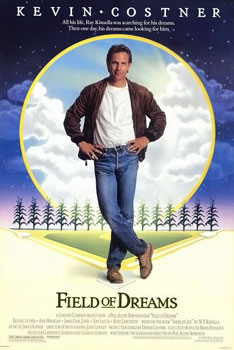
Field of Dreams (1989)

Directed by Phil Alden Robinson · Drama

106 minutes

Cast

Selected cast credits · Film reference

Kevin Costner Ray Kinsella
Amy Madigan Annie Kinsella
James Earl Jones Terence Mann
Ray Liotta Shoeless Joe Jackson
Burt Lancaster Dr. Archibald "Moonlight" Graham Frank Whaley as young Archibald Graham

Everything from the episode

In the order the hosts got to it. Open a row for the discussion.

19:18

Roger Ebert's review

In the discussion (1)
Approx. transcript time · 00:19:18Read transcript
  • Ebert gave the film four stars, a very positive review; one host was proud of Rog.
58:23

Casting What-Ifs

Tom Hanks reportedly offered Ray Kinsella; Costner not originally considered after Bull Durham; Jimmy Stewart the ori...

Tom Hanks reportedly offered Ray Kinsella; Costner not originally considered after Bull Durham; Jimmy Stewart the original choice for Moonlight Graham; Burt Lancaster turned it down until a friend changed his mind

In the discussion (4)
Approx. transcript time · 00:58:23Read transcript
  • The internet claims Tom Hanks was offered Ray Kinsella and turned it down, though nobody knows if it happened and a host will ask him if he's ever on a podcast; Costner wasn't considered because they thought he wouldn't follow Bull Durham, then got interested thinking it would be this generation's It's a Wonderful Life, which it probably is.
  • There are strands of Jimmy Stewart, especially Harvey; late-80s Hollywood, often Castle Rock, made throwbacks to Capra like City Slickers and Big, and Robin Williams tried to make that movie four times, What Dreams May Come being the worst version of this one.
  • Jimmy Stewart was ironically the original choice for Moonlight Graham and turned it down; Burt Lancaster turned it down too, then a baseball-fan friend told him he had to do it.
  • Earlier, during the scene nominees: Lancaster's last movie, and the part was supposed to be or offered to Jimmy Stewart. — Chris Ryan
1:01:29

Half-Assed Internet Research

Original title Shoeless Joe, book working title Dreamfield, changed after test audiences; the voice's identity unknow...

Original title Shoeless Joe, book working title Dreamfield, changed after test audiences; the voice's identity unknown, rumored Ed Harris; Damon and Affleck as Fenway extras; filming sped up for Costner's Revenge; the corn outgrew Costner; the Lansing and Ameskamp farms, 65,000 annual visitors, sold in 2011 for about $5.4 million; 1,500 volunteers' headlights in the final shot; Moonlight Graham's real game was June 1905; the line-drive reaction was genuine; James Earl Jones hates baseball; deleted scenes; George W. Bush's favorite film; AFI quote number 39; W.P. Kinsella bored on set; Ray Kinsella named for Salinger characters; Don Buford and USC coaches as advisers

In the discussion (6)
Approx. transcript time · 01:01:29Read transcript
  • Behind on time, the research is zipped through: the original title was Shoeless Joe, the book's working title Dreamfield, and test audiences thought Shoeless Joe was about a homeless person; nobody knows who the voice was, the rumor is Ed Harris, one host is in the Liotta camp, but Liotta hasn't even seen the movie.
  • Matt Damon and Ben Affleck were legendarily extras at Fenway; filming began in 88 and was sped up because Costner had to shoot Revenge; the corn grew taller than Costner so they put boxes out for him to stand on.
  • Scenes were shot on Don Lansing's property and the baseball scenes on neighbor Al Amiskamp (as transcribed), who replanted corn while Lansing kept the field as a tourist destination without charging admission, only souvenirs; 65,000 visitors a year by the 20th anniversary; sold in 2011 for a believed $5.4 million, so Don Lansing's checkbook won.
  • The final shot used 1,500 volunteers flashing high beams; the real Moonlight Graham played one game in June 1905, not 1922; Shoeless Joe and Ty Cobb really were friends; the line drive knocking over the bag of balls was real and unplanned, Costner's reaction genuine and in character; James Earl Jones hates baseball yet did this and The Sandlot; deleted scenes include Ray's hearing test, buying equipment, getting lost on the way to Fenway, and watching batting practice with Terrence.
  • George W. Bush named it his favorite film; if you build it, he will come was voted the number 39 movie quote by AFI; W.P. Kinsella was on set a lot and found it incredibly boring, though his daughter had a romance with Ray Liotta.
  • Ray Kinsella is not named for the author but for two Salinger characters, Richard Kinsella in Catcher in the Rye and a Ray Kinsella in a 1941 story; Don Buford, the Oriole and father of Damon, coached the actors, and USC coaches were brought in to advise.
1:13:14

Picking Nits

Annie is impossibly understanding; the movie needs a sex scene; Ray Liotta bats righty as the lefty Shoeless Joe; the...

Annie is impossibly understanding; the movie needs a sex scene; Ray Liotta bats righty as the lefty Shoeless Joe; the Fenway scoreboard reads 10:30 in the third inning; no black players before 1947; the two-acre field at $2,200 an acre; professional lights beside splintery bleachers; Mark vanishes for a glass of water; Mark isn't thrown off the property; Ray doesn't recognize his father in the scrimmage; Dwyer Brown's catching; Annie wouldn't wait when Karen falls; Karen could be carried onto the field; Archie already existed off the field; the cornfield's ground rules; only one book-burner is opposed; Shoeless Joe's no-errors defense

In the discussion (19)
Approx. transcript time · 01:13:14Read transcript
  • Notes on Amy Madigan are held for nitpicks; the first written down is whether anyone's wife has ever been this understanding in the history of mankind: she objects to Boston but not to mowing the cornfield; only the people who marry serial killers in prison compare; it's the 60s.
  • The movie needs a sex scene to understand what fuels Annie's blind devotion; Terrence Mann's response to Ray is you're seeing a whole team of psychiatrists, while Annie's is follow your bliss, moving and aspirational but also ridiculous, probably an extension of the hippie ethos.
  • Annie's Fenway big green wall vision is when she really buys in, versus her initial don't go, we're underwater doubt; by the Christmas montage of Ray staring at the field in a snowstorm every relative would want him in a mental hospital; and once Joe Jackson shows up, why not replant the corn instead of hosting a 162-game season.
  • Ray Liotta batted righty while Shoeless Joe was a lefty, everybody's biggest nitpick for thirty years and indefensible since they could have flipped the shot and cheated the background; come on, Phil Alden-Robertson (as transcribed), bad job.
  • The Fenway scoreboard reads 10:30 p.m. in the third inning with no rain delay, obviously shot after a game; it has bothered one host for thirty years.
  • The movie gives second chances to Ray and his dad, Moonlight Graham (joked as Grom, the gelato), Terrence Mann, Shoeless Joe and the Black Sox, yet ignores every black player before 1947; instead of the cheating White Sox, Satchel Paige, Cool Papa Bell or Josh Gibson, and Terrence Mann would surely have raised it in the van; Robinson called it his greatest regret; it is the biggest flaw in the movie.
  • Mark's do you know how much this land is worth is undercut by Ray's $2,200 an acre: a baseball field is about two acres, so he isn't losing much on a farm of hundreds of acres; the counter is that he built and maintains a triple-A field with expensive electricity.
  • Why have the lights at all, where does a regular person get professional lighting, and why is the construction so perfect and precise while the bleachers are splintery unvarnished planks with smashed-in nails that aren't safe for a child; the lights do give an ethereal vibe and the film addresses how lights changed the game.
  • Busfield's Mark finally sees the ghosts after Karen is saved, Annie sends him inside for water, and he is never seen again; the counter is that interrupting the reunion with we can charge $20 a car would be in character; the opposite nitpick is that he should be kicked off the premises for nearly killing the child.
  • The editing is shady when Mark grabs and shakes Karen, and a parent would fight anyone who touched their six-year-old; Ray never recognizes his dad during the scrimmage despite catcher's gear and three hours in the stands.
  • Dwyer Brown's childlike catching has an explanation from research: the catch had to be shot in a ten-minute magic hour with an 85-year-old rock-hard catcher's mitt he feared dropping, so apologies to him, though his throwing wasn't loved; it wasn't as bad as the kid at the end of The Natural.
  • Karen falling off the bleachers eating the hot dog has holes: Annie would run to call the paramedics and no mom on the planet stops because her husband has an idea, since a mother whose child is hurt becomes superhuman.
  • Why not carry Karen five feet onto the field so Moonlight needn't cross; the counter is that young Moonlight hasn't been through medical school, answered that he is a timeless ghost who has lived his life and knows the grand design; Ray doesn't yet know Graham can't cross back.
  • Archie already existed outside the field as a hitchhiker, and the implication that Terrence Mann will come back with a long-form piece on heaven raises why Moonlight can't return; none of them can come off the field; Archie is on a different timeline and had to be brought there; he left the field and became a drummer for the Doors.
  • One host is devastated the other doesn't like a scene seen 700 times; the fair questions raise whether you need to understand the rules of the magic to like the movie; it's magic and faith, believing what you can't see, so you opt in, which is why Mark seeing the ghosts at the end is disliked, since he never opened himself up.
  • Smaller nits: the park's ground rules, what a ground-rule double in the cornfield is, an outfielder vanishing into heaven shagging a fly, where all the baseballs go, Janet's void; if Terrence Mann could walk into the corn, why wouldn't Ray try; maybe the spirits have to bring you, and it's about what you are pursuing.
  • The town hall over salacious literature is moral panic, but only the one woman is actually opposed and nobody in the room supports her; the counter is that it's about how hysterical people get together; that scene could be aged-best because it's what the internet is like now.
  • A sequel vision: Mark comes back out after his cold drink and lectures the ghosts about walks, shifts and swing planes, disparages Shoeless Joe for not getting on base, and brings his friend Bill James with notes.
  • Shoeless Joe's no-errors stat is cited as proof he didn't throw the series, but outfielders rarely commit errors in one series and it would have to be an obvious overthrow; the Rothstein gambling contingent, Boardwalk Empire; the segment ends with Mark asked how his glass of water is.
1:38:47

Probably Unanswerable Questions

Did Terrence Mann come back from heaven, or was he dead all along? Does Ray ever feel guilty about charging $20 a car...

Did Terrence Mann come back from heaven, or was he dead all along? Does Ray ever feel guilty about charging $20 a car? Where do the visitors park and use the bathroom? When does the government notice the traffic? How did they talk the umpires into coming back? Who is the voice? Why could Archie exist off the field but not leave it? Can only good people see the ghosts?

In the discussion (5)
Approx. transcript time · 01:38:47Read transcript
  • Did Terrence Mann ever come back from heaven; a popular internet theory says he was dead the whole time, which is why he can enter the corn, countered by the Red Sox game, the newspaper article about him missing and his father's call; the hosts think he comes back, announcing heaven is real with the 1919 Black Sox and no Negro League players.
  • Does Ray ever feel bad about commodifying his emotional breakthrough by charging everyone 20 bucks; no, not in the least; the business plan is questioned, where the cars park, plow more corn, where they go to the bathroom, though hippies used to walking to Woodstock won't mind.
  • Did anyone get suspicious of a long line of traffic in Iowa, at what point does the government or the X Files get involved; how did they talk the umpires into coming back when being yelled at by Chick Gandil isn't fun, unless they sensed pitch framing coming.
  • Who is the voice, already covered; if Archie could live outside the diamond, why couldn't he leave it; whether only the good people can see the ghosts, answered that it's about open-mindedness and spiritual awakening rather than a judgment on morality.
  • During the nitpicks, the implication that Terrence Mann will come back prompts the question of whether he is dead, parked for unanswerable questions.