
‹ All movies
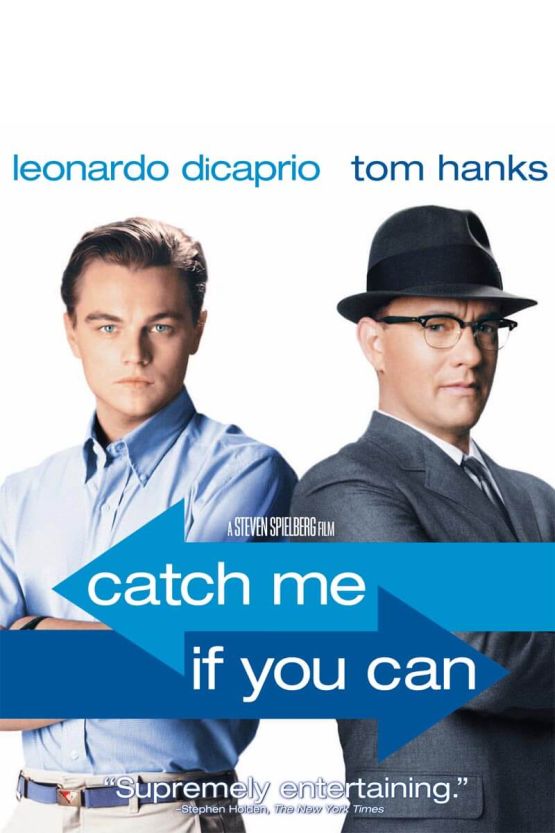
Catch Me If You Can poster

Catch Me If You Can

140 minutes

Cast

Selected cast credits · Film reference

Leonardo DiCaprio Frank Abagnale Jr.
Tom Hanks Carl Hanratty
Christopher Walken Frank Abagnale Sr.
Martin Sheen Roger Strong
Nathalie Baye Paula Abagnale
Amy Adams Brenda Strong
James Brolin Jack Barnes
Steve Eastin Paul Morgan
Chris Ellis Special Agent Wilkins
John Finn Assistant Director Marsh
Jennifer Garner Cheryl Ann
Nancy Lenehan Carol Strong
Ellen Pompeo Marci
Guy Thauvette Warden Garren
Matthew Kimbrough Loan officer
Frank W. Abagnale French policeman

Catch Me If You Can | The Rewatchables

Explore episodeClose episode

Producer credits not yet identified.

Most Rewatchable Scene

Hollywood hotel; stewardess recruitment and airport escape

In the discussion (13)
Approx. transcript time · 00:35:30Read transcript
  • Frank's substitute-teacher impersonation is a scene candidate that launches the story with conviction.
  • Becoming a Pan Am pilot, obtaining the uniform and experiencing his first flight in the cockpit form an extended scene candidate; Pompeo's presence adds to the fantasy.
  • Frank presenting his father with a new Cadillac is the next scene nomination.
  • Walken balances his recognizable mannerisms with warm, dishonest, increasingly defeated fatherhood; the award speech, dancing and aging are praised.
  • The short failed bank-loan visit, with Frank posing as chauffeur, is admired without being formally nominated; Frank succeeds at escaping problems his father cannot.
  • The Hollywood hotel escape is a major scene candidate, especially the wallet reveal, discarded labels, invented agent identity and hotel setting.
  • The Garner encounter is liked because Frank cannot be conned, but it is also considered a strange interlude.
  • A raunchy deleted Jaws scene and alternate Deep Throat title are explicitly joking inventions, not production facts or an actual-film nomination.
  • Garner's Alias-era appeal and the film's brief appearances by future stars Banks, Pompeo, Adams and Garner are noted.
  • Frank's conversation with Martin Sheen as the father of the woman he loves is another admired scene.
  • The engagement-party raid and bedroom confession are nominated, with cash-filled suitcases and Brenda struggling to understand Frank's collapsing identities.
  • The eight-stewardess airport diversion, Frank's possible final return and exploding check-printer imagery are praised.
  • The Hollywood hotel is one final scene choice; the complete stewardess recruitment and airport escape is the other.

What’s Aged the Best?

Father-son casting; period houses and mothers; surveillance recognition; television; airline glamour; cons; ensemble; credits

In the discussion (12)
Approx. transcript time · 00:44:03Read transcript
  • Walken and the father-son casting are aged-best choices; the mother's new home is identified as the Father of the Bride house.
  • A joke imagines collectively buying houses connected to the show, including Boogie Nights and a Danny Trejo property, as a podcast real-estate cluster.
  • Discreetly sexual mothers in period movies are an enjoyed trope, with Forrest Gump and The Ice Storm as examples; The Ice Storm receives explicit affection.
  • Frank recognizing airport surveillance before being caught is an aged-best pleasure.
  • To Tell the Truth is enjoyed as period television and identified as one of the story elements that really occurred.
  • The two-mice speech is considered memorably odd and possibly bad rather than straightforwardly praised.
  • The glamour of 1960s pilots and flight attendants is an aged-best choice, compared with Almost Famous and the Pan Am television series.
  • Enjoying a con man while hoping he escapes, and the Sheen–DiCaprio pairing before The Departed, are aged-best choices.
  • DiCaprio's 2002 moment just before his sustained adult-star run is an aged-best choice.
  • The cast's four future major actresses are praised; Adams nearly steals the film according to one speaker, anticipating disagreement.
  • Con-man process details, including model-plane decals, routing numbers and check manipulation, are aged-best pleasures.
  • The animated credits are praised and explicitly corrected as Saul Bass-inspired rather than created by Bass.

The Great Shot Gordo Award for Most Cinematic Shot

French arrest setting; first Christmas Eve phone call

In the discussion (2)
Approx. transcript time · 00:50:29Read transcript
  • The French arrest setting is also one cinematic-shot choice.
  • Hanks's first Christmas Eve call is another shot choice, contrasting cold blue-gray surroundings with a warm lamp to express how much the case means to him.

What’s Aged the Worst?

Missing stewardess-escape aftermath; checks; deteriorating motels

In the discussion (3)
Approx. transcript time · 00:53:19Read transcript
  • A missing scene showing the aftermath of the stewardess escape is an aged-worst complaint.
  • Writing personal checks and the weak verification that enabled fraud feel dated; checking-account and bounced-check memories illustrate the change.
  • The deterioration of Los Angeles motels, including the Tropicana and a True Romance location, is an aged-worst discussion.

The Stephen A. Smith Hottest Take Award

DiCaprio’s first great lead performance; Hanks’s greatest-actor credentials disputed

In the discussion (22)
Approx. transcript time · 01:03:23Read transcript
  • The first-great-DiCaprio-performance hot take argues that this film depends more fully on him than Titanic or Romeo + Juliet; This Boy's Life is offered as an earlier exception.
  • Hanks's greatest-actor claim is questioned through weak accents, while his extraordinary movie-star run, popularity and success are defended; Cruise and Denzel are personal alternatives.
  • Accent objections name Elvis, Charlie Wilson's War, The Post, Captain Phillips, The Terminal and Cloud Atlas, with disagreement over Captain Phillips.
  • Carl's composite identity makes the accent unnecessary; the performance is placed low in Hanks's career despite affection for his presence.
  • Hanks's two Oscars and serious films are weighed against Cruise's cultural force and comeback; Forrest Gump's standing draws disagreement.
  • Hanks's likability and storytelling are distinguished from greatest-actor status; Cruise's potential in Big or Cast Away is debated, while Greyhound illustrates a sturdy role Hanks handles well.
  • Cruise's consistent charismatic action lane is contrasted with Hanks's risky character work; hypothetical swaps include Philadelphia, Forrest Gump, Big, Mission: Impossible, Days of Thunder, Edge of Tomorrow, Minority Report, Taken, Eyes Wide Shut and A Few Good Men, with disagreement over equivalence.
  • Hanks is defended as the more accomplished actor while Cruise's longevity and Denzel's comparable stature complicate the comparison.
  • Hanks's post-Catch Me filmography is enumerated: The Ladykillers, The Terminal, The Polar Express, The Da Vinci Code, Charlie Wilson's War, Angels & Demons, Larry Crowne, Extremely Loud & Incredibly Close, Cloud Atlas, Captain Phillips, Saving Mr. Banks, Bridge of Spies, A Hologram for the King, Sully, Inferno, The Circle, The Post, Greyhound, A Beautiful Day in the Neighborhood, News of the World, Finch and Elvis. Cloud Atlas and the later dad-film run draw qualified defense.
  • A Man Called Otto is acknowledged as a hit and praised by a family member, while another speaker calls it only okay and a close Scandinavian remake.
  • Cruise's commercially bigger career is distinguished from Hanks's better career; comparing their 1988–2001 peaks prompts suggested Oscars for Hanks in Cast Away and Cruise in Jerry Maguire and Magnolia.
  • Denzel's paycheck films, including The Equalizer, Déjà Vu and The Taking of Pelham 123, are considered more entertaining; Hanks's self-imposed Jimmy Stewart image may constrain his roles.
  • Cruise losing for Magnolia to Caine in The Cider House Rules and for Jerry Maguire to Rush in Shine is challenged; Jude Law's Ripley performance is admired but placed below Cruise's Magnolia work.
  • Hanks's consecutive Philadelphia and Forrest Gump Oscars strengthen his case; Denzel's Glory and Training Day wins are recalled with Malcolm X considered another deserved award.
  • Cruise's 2005-onward filmography is enumerated: War of the Worlds, Mission: Impossible III, Lions for Lambs, Tropic Thunder, Valkyrie, Knight and Day, Ghost Protocol, Rock of Ages, Jack Reacher, Oblivion, Edge of Tomorrow, Rogue Nation, Never Go Back, The Mummy, American Made, Fallout and Maverick; several weak films temper the franchise-success defense.
  • Hanks's willingness to experiment is defended against Cruise's safe action lane, while Cruise's ongoing audience appeal and perceived rescue of theatrical movies are counterarguments; longevity versus peak quality is compared with basketball greatness.
  • Cruise's 1990s-to-Minority Report run is compared with Hanks's peak, with The Others explicitly corrected as only an executive-producing credit; Toy Story is considered a decisive Hanks asset.
  • Cruise's film library is the preferred desert-island entertainment choice for one speaker, while De Niro is called the best actor of that speaker's lifetime; Daniel Day-Lewis's great performances are distinguished from rewatchability.
  • Weak later films and Hanks's lack of a Michael Mann collaboration enter the debate; both stars may be trapped by personas, but Cruise's stunts are considered more entertaining than Hanks's accents.
  • The proposed top tier includes Cruise, Hanks and Denzel, before Harrison Ford's placement is debated.
  • Ford's capacity for morally compromised sexuality is contrasted with Cruise's usual innocence; Hanks is urged to try a direct villain role without hiding behind makeup and accents.
  • The industry's shift away from movie stars is offered as context for older stars' weaker later work; DiCaprio's future is compared with Nicholson's transition, including disagreement over Wolf and Hoffa.
In the discussion (4)
Approx. transcript time · 01:20:28Read transcript
  • Elizabeth Banks is a Dion Waiters choice, praised for her reaction to the steak-dinner invitation.
  • Frank's mother is another Dion Waiters choice.
  • Garner is explicitly rejected by one speaker as trying too hard.
  • James Brolin is another Dion Waiters choice; Josh Brolin's suitability for the same role and work in No Country for Old Men and Sicario are discussed.

Apex Mountain

No definite affirmative choice

In the discussion (10)
Approx. transcript time · 01:24:26Read transcript
  • Spielberg, DiCaprio and Hanks are rejected for Apex here.
  • Titanic's enormous freedom and leverage make it DiCaprio's accepted peak, despite a Django preference.
  • The Father of the Bride house retains its peak in Father of the Bride.
  • Con-man movies peak with The Sting rather than Catch Me.
  • Walken is rejected for Apex here; The Deer Hunter, more-cowbell fame and the 1993–94 SNL/True Romance/Pulp Fiction period are alternatives, with Annie Hall also a favorite performance.
  • Walken's Pulp Fiction and True Romance scenes continue the favorite-performance discussion.
  • Joe Garagiola's peak is placed at playing or broadcasting a World Series rather than here.
  • Pan Am receives tentative favorable Apex discussion but no firm resolution.
  • Goldfinger is preferred as the Aston Martin's peak.
  • The Aston Martin reportedly came from a Huntington Station dealership and a private owner because the specific car was difficult to find; its very high value is discussed as a reported estimate.

Is This Movie Better With…?

Kathryn Hahn as Brenda; Wayne Jenkins as pilot or Carl

In the discussion (2)
Approx. transcript time · 01:39:10Read transcript
  • One or two seasons of prestige television is the preferred remake format.
  • Kathryn Hahn replacing Adams and Wayne Jenkins as the first pilot are better-with choices, while another speaker imagines Jenkins as Hanks at the French arrest.

The Coach Finstock Award for Best Life Lesson

Check forgery over violent crime (challenged)

In the discussion (3)
Approx. transcript time · 01:42:55Read transcript
  • The proposed life lesson favoring check forgery over violent crime is challenged as a mere preference and not victimless; claims about bank insurance are mocked rather than established financial advice.
  • A hypothetical bank-robbery team discussion chooses driving or addressing the customers, while recalling an earlier Heat-related conversation.
  • Hypothetical robbery-mask choices include James Harden, Nikola Jokić, Sam Hauser and a smaller Lone Ranger-style mask, with practical objections and colored-contact jokes.