
‹ All movies
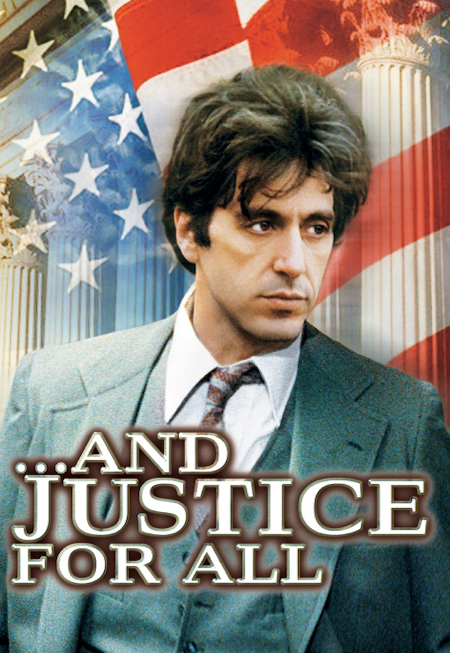
...And Justice for All poster

...And Justice for All

119 minutes

Cast

Selected cast credits · Film reference

Al Pacino Arthur Kirkland
Jack Warden Judge Rayford
John Forsythe Judge Fleming
Lee Strasberg Grandpa Sam
Jeffrey Tambor Jay Porter
Christine Lahti Gail Packer
Sam Levene Arnie
Robert Christian Ralph Agee
Thomas Waites Jeff McCullaugh
Larry Bryggman Warren Fresnell
Craig T. Nelson Frank Bowers
Dominic Chianese Carl Travers
Victor Arnold Leo Fauci
Vincent Beck Officer Leary
Michael Gorrin Elderly man
Joe Morton Prison doctor
Alan North Deputy sheriff
Tom Quinn Desk clerk Kiley
Charles Siebert Assistant D.A. Keene
Robert Symonds Judge Burns
Keith Andes Marvin Bates
Stephen Blackmore Robert Wenke
Terrence Currier George Reisler
Walter Davy Dapper defendant
Rita Fredricks Judge Howe
Jack Hollander Prison warden
Carl Pistilli Matt Gibson
Darrell Zwerling William Zinoff
John Hertzler Driver
Teri Wootten Leah Shepard
John Aquino Deputy sheriff
Sidney Clute Polic
Angus Duncan Gallagher
Johnny Haymer Crenna
Molly Kohler Young woman
Cathleen Schurr Mrs. Barnes
Donald S. Saiontz Defense attorney
Bill Polk Paramedic
Bonita Cartwright Woman in car
Frank Sliwka Court clerk
Julius Dunbar Court reporter
Angelyn Forbes Waitress
Newton Scott Prison guard
McLindsey Hawkins Escort officer

...And Justice for All | The Rewatchables

Explore episodeClose episode

Most Rewatchable Scene

The final opening statement and out-of-order eruption

In the discussion (12)
Approx. transcript time · 00:44:14Read transcript
  • The opening follows Aggie before unexpectedly revealing Arthur in jail, establishing the institution’s indignities.
  • Arthur’s visits with his grandfather divide opinion: the Godfather II reunion appeals, but one visit might suffice; the dementia and missed visits underline another personal failure caused by lack of time.
  • Arthur and Lahti’s character moving from an argument into flirting and a Chinese-food date is nominated.
  • The bathroom announcement of Fleming’s rape charge is praised for the difficult, sustained hysterical laughter and the choice of setting.
  • The helicopter ride is a fun but tonally separate sequence, and the unexpected actual crash into the water is especially effective.
  • Tambor’s plate-throwing breakdown is admired for its apparently practical staging and the transformation from joking lawyer to morally overwhelmed man.
  • Arthur attacking the car after Aggie’s death is the defining explosive Pacino showcase, with genuine grief and a demand that lawyers care about their clients’ humanity.
  • The incriminating photographs supplied by Chianese’s character are nominated for Fleming’s brazen posing and the strange glimpse of the sexual gathering.
  • Fleming’s admission of guilt exposes casual entitlement and his certainty of impunity; pointing out the complainant in court pushes Arthur toward breaking.
  • The final opening statement and Arthur’s out-of-order eruption are the unanimous scene choice, including his final insistence that he has completed the statement.
  • The final performance carries distinct stakes for the jury, the client, the complainant, the judge and the earlier victims of the system.
  • Tambor tipping his wig is belatedly recalled as one of the film’s most famous images.

What’s Aged the Best?

Failed negotiation; period music, disputed; Strasberg’s advice; Baltimore; Aggie; petty offenses; early cast roles

In the discussion (8)
Approx. transcript time · 00:44:48Read transcript
  • The late 1970s-to-early 1980s synthesizer, trumpet and jazzy soundtrack is proposed as a period feature but criticized for not fitting the action; Grusin’s later Firm score is favorably contrasted.
  • The failed attempt to talk an armed man down before he stands and is shot is an effective tragic trope and a crucial step in Arthur’s breakdown.
  • The period soundtrack’s saxophones, congas and disco elements remain enjoyable despite earlier reservations.
  • Strasberg reportedly urged the improvising Pacino to learn his lines, advice Pacino later appreciated.
  • Levinson’s Baltimore setting anticipates his later work and the systemic concerns of The Wire.
  • Aggie is treated with surprising sensitivity for 1979, with dignity and humanity central to Arthur’s defense rather than merely a joke.
  • The film questions devoting punitive institutional resources to petty offenses while more serious abuses persist.
  • Early roles for Tambor, Lahti and Nelson are praised as strong discoveries, alongside Jewison’s broader filmography.

The Great Shot Gordo Award for Most Cinematic Shot

Warden on the ledge; industrial harbor walk

In the discussion (2)
Approx. transcript time · 01:06:57Read transcript
  • Warden on the ledge is praised for its apparent danger and Baltimore backdrop; a hidden harness reportedly protected him.
  • Arthur and Lahti’s character walking past industrial buildings and the Domino sugar plant provide another admired Baltimore composition.

What’s Aged the Worst?

Metallica search results; pledge and credits; shaved head; Gail’s neutrality; white victim; score

In the discussion (6)
Approx. transcript time · 01:09:45Read transcript
  • The Metallica title overwhelming search results frustrates one participant, while others note both works borrow the Pledge of Allegiance.
  • The children reciting the pledge and lengthy opening credits feel conspicuously of their era; the credits receive a strong defense as acknowledgment of the filmmakers.
  • Tambor shaving his head no longer delivers the shock it did when the gesture signaled instability.
  • Lahti’s lawyer is criticized as an inconsistent, fence-sitting device with no firm beliefs, despite appreciation for the actor’s natural presence.
  • Centering a white man as the system’s most obvious victim in 1979 Baltimore is questioned, despite the character’s emotional effectiveness.
  • The score is criticized for immediately dating the movie.

The Stephen A. Smith Hottest Take Award

Pacino’s second-best performance after The Godfather Part II, strongly disputed

In the discussion (17)
Approx. transcript time · 01:15:50Read transcript
  • This is proposed as Pacino’s second-best performance after The Godfather Part II, with Heat placed third; another response rejects even a top-five ranking.
  • Dog Day Afternoon is preferred for greater nuance, and Donnie Brasco, Heat, Any Given Sunday, The Godfather, Scarecrow, Serpico and Sea of Love are offered as competing peaks.
  • Carlito’s Way is offered as a soulful alternative, and The Insider is added to the competing Pacino performances.
  • Dick Tracy and The Godfather Part III are added to the performance debate; this film is proposed as the moment Pacino overtook De Niro.
  • The top-two or top-three defense treats Arthur as the culmination of Pacino’s early mastery: quiet and explosive passages form a coherent journey as the system breaks him.
  • Both Godfather performances and Dog Day Afternoon are placed definitively above Arthur in the opposing ranking; Dog Day receives admiration but is called personally exasperating.
  • The Godfather’s Kay scenes and marital storyline are criticized as obstacles to placing Michael in the top two; the challenge of playing Brando’s son is offered in defense.
  • The distinction is clarified as carrying and justifying an entire film rather than delivering a bad performance within an ensemble.
  • Playing Michael in the first Godfather is provocatively called comparatively easy, while Part II is considered much harder; a particular scene remains admired without being named in this exchange.
  • Michael’s transformation is defended as indispensable to the film; the counterargument imagines De Niro or John Cazale in the role.
  • The ensemble is said to elevate Michael’s performance, and James Caan is ranked above Pacino by one participant; a suggestion that Cazale is better is retracted.
  • Arthur is defended as the full range of Pacino’s abilities, requiring trust in the director and editor, in contrast with Michael’s more observational role.
  • The Godfather ranking dispute returns: Part II is called the best male screen performance in 50 years, while the first film is framed as a young actor still discovering the role.
  • Raging Bull and Scarface are called damaging influences on later actors who imitate them, as an argument against accepting inherited performance rankings.
  • The first Godfather’s stature is argued to confer automatic greatness on Pacino, while the restaurant assassination is singled out as exceptional.
  • A defense enumerates Michael’s wedding exposition, revenge planning, Italian interlude and hospital protection of his father as stages of a demanding transformation.
  • Michael is defended as the role that made Pacino a star and helped make The Godfather great; the opposing argument distinguishes iconic characters from great acting to defend Arthur’s high ranking.

Apex Mountain

Warden’s era, qualified; courtroom meltdowns, competing with A Few Good Men

In the discussion (7)
Approx. transcript time · 01:33:45Read transcript
  • Pacino’s peak remains The Godfather Part II.
  • Warden is placed around this period, Heaven Can Wait and the years after Shampoo; a Muppets connection is rejected.
  • Tambor’s simultaneous sitcom activity marks an early rise, but Arrested Development or Transparent is preferred for his peak.
  • Lahti’s peak is assigned to her five-year Chicago Hope run.
  • Jewison’s alternatives are In the Heat of the Night and Moonstruck; Moonstruck’s endurance with younger viewers is praised without dismissing the former’s legendary status.
  • The courtroom meltdown is a strong candidate, competing with Jessup in A Few Good Men and described as possibly the most cited.
  • Diner is preferred for Baltimore movies, with Tin Men also mentioned.

Sequel, Prequel, Limited Series, or All-Black Remake

Prestige television about Baltimore courts

In the discussion (1)
Approx. transcript time · 01:39:14Read transcript
  • A prestige series about the Baltimore courts, potentially produced by Levinson, earns interest; Aaron Paul as Arthur is rejected, and The Night Of is compared for a similar sense of hopelessness.

Is This Movie Better With…?

Young Philip Baker Hall; tentative young Danny Trejo; Wayne Jenkins disputed

In the discussion (3)
Approx. transcript time · 01:39:55Read transcript
  • A young Philip Baker Hall is suggested because the film’s age complicates the usual casting list; a young Danny Trejo is briefly considered.
  • Adding Joe Pesci to the standing list is proposed, while a response praises his sparse filmography for keeping individual roles iconic.
  • Wayne Jenkins fits Baltimore but would overwhelm an already explosive movie; the performance is compared with Pacino in this period.

The Coach Finstock Award for Best Life Lesson

Distrust the system and avoid law; keep fighting for reform dissent

In the discussion (2)
Approx. transcript time · 01:49:18Read transcript
  • Distrusting the justice system and avoiding a legal career compete with the more optimistic lesson to keep fighting.
  • Reform is defended as necessary because the system improves through people who uphold its virtues; Arthur’s expulsion is tragic, and the film is treated as the beginning of an argument rather than a reason to surrender.