
‹ All movies
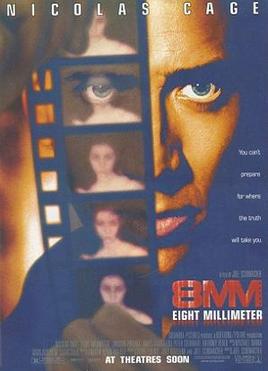
8MM poster

8MM

126

Cast

Selected cast credits · Film reference

Nicolas Cage Tom Welles
Joaquin Phoenix Max California
James Gandolfini Eddie Poole
Peter Stormare Dino Velvet
Anthony Heald Longdale

8MM | The Rewatchables

Explore episodeClose episode

Producer credits not yet identified.

Roger Ebert's review

In the discussion (2)
Approx. transcript time · 00:28:57Read transcript
  • The stated three-star review is contrasted with hostile critical reception; its defense of moral consequences is quoted.
  • The panel jokes that Ebert liked the Keener scenes and might have wanted more of her holding the baby.

Half-Assed Internet Research

Andrew Kevin Walker’s rejected screenplay and Joel Schumacher’s career

In the discussion (3)
Approx. transcript time · 00:29:46Read transcript
  • The panel reports that the studio wanted a less dark film, Schumacher sided with that approach, and Walker disowned the resulting movie; the disputed devil line is nevertheless defended.
  • After reading the earlier screenplay, the main difference is described as more explicit child-exploitation material. The panel argues that omitting it was defensible and the released film was already disturbing enough.
  • Schumacher’s uneven career is discussed with affection for his studio filmmaking style; Batman & Robin is identified as a turning point, while The Lost Boys is requested for a future episode.

Most Rewatchable Scene

The meatpacking-district confrontation

In the discussion (11)
Approx. transcript time · 00:37:03Read transcript
  • The second visit to the missing girl’s mother is praised for its sad social tension and for grounding the investigation in her need to know.
  • Max’s bookstore introduction is praised for instantly energizing the film and establishing chemistry with the investigator.
  • The panel digresses into the implausible length and audience of the adult novel used as a book cover.
  • The parking-lot negotiation and underground search are favorites; discovering that the same performer appears in two supposedly fatal films supplies dark comic relief.
  • The threatening phone call to Eddie is admired for Gandolfini’s reaction and sleazy characterization.
  • The meatpacking confrontation is praised for its location, revelation of the motive, and escape using the single bullet.
  • The subsequent call confirming the film’s reality is singled out.
  • Eddie’s death scene is praised for Gandolfini’s taunting excess and Cage’s emotional escalation. Stopping to telephone the mother for permission is also mocked as bizarre overthinking.
  • The final fight with Machine is praised, particularly the ordinary-looking face behind the mask and his lack of an explanatory traumatic history.
  • One preference is for the second and third Phoenix-and-Cage scenes as they enter the underground world.
  • Another contribution praises hiring Dino to make a custom film before choosing the meatpacking showdown; the next choice agrees, emphasizing that the villains anticipated the investigator.

Picking Nits

The investigator finds evidence the police missed

In the discussion (1)
Approx. transcript time · 00:40:10Read transcript
  • The bedroom search is mocked for conveniently revealing a crucial hidden diary after a long police investigation.

What’s Aged the Best?

The Los Angeles descent; Mrs. Christian; Cage’s reaction; Max’s rules; the Clevelander; Anthony Heald; the detective work; Machine; desperation

In the discussion (9)
Approx. transcript time · 00:53:00Read transcript
  • The stylized Los Angeles montage is praised even though its red-light district is described as a fabricated composite.
  • Mrs. Christian’s desire for the truth is appreciated; the panel wishes her first viewing of the film had been shown.
  • Cage’s extreme reaction to viewing the film is placed among his memorable overacting moments.
  • Max’s incomplete rules of life are admired and said to come from the original screenplay.
  • The Clevelander is named as an enduring detail.
  • Anthony Heald is praised for conveying the lawyer’s superiority and comfort around depravity.
  • Specific scenes and the traceable investigative process are praised, from the mother and former boyfriend to film enlargement, tattoos, and tedious searching.
  • Machine and the absence of a larger rational conspiracy remain effective.
  • The film’s atmosphere of desperation is considered particularly resonant at the time of the recording.

What’s Aged the Worst?

The opening; the wife-and-baby scenes; Max’s death; the pre-internet investigation

In the discussion (3)
Approx. transcript time · 00:59:44Read transcript
  • The opening eight minutes, Keener’s scenes, limited use of Max, and his death are criticized; dramatic motivation for the death is acknowledged without accepting it.
  • The investigation would function very differently online and might become a hacker film; a Blackhat comparison is rejected.
  • A recollection of buying porn by telephone and waiting six weeks illustrates how much access has changed.

Casting What-Ifs

David Fincher; Russell Crowe; disputed casting rumors

In the discussion (5)
Approx. transcript time · 01:02:11Read transcript
  • Fincher is discussed as an initially approached director. One view thinks it would repeat Se7en and The Game; another expects fundamentally different choices and a more lasting sensory impact.
  • Crowe is described as an earlier intended lead for a lower-budget version and is preferred by one speaker; Cage’s greater contemporary star power is said to explain the change.
  • An internet claim that Mark Wahlberg turned down Max California is treated as uncertain; he spends too much time in the gym for the role.
  • Friedkin, Verhoeven, and Gibson are mentioned as internet rumors whose reliability the panel questions.
  • Travolta in the lead is proposed as a way to make the film even stranger through overacting.

The Joey Pants “That Guy” Award

The tall shop patron also seen as the doctor in Funny People

In the discussion (2)
Approx. transcript time · 01:05:31Read transcript
  • The briefly seen tall blond shop patron is identified by his Funny People doctor role and immediately accepted as the winning deep cut.
  • Amy Morton, Norman Reedus, and the lawyer actor are other suggestions, conceded after that identification.

Recasting Couch

Remove the wife character

In the discussion (1)
Approx. transcript time · 01:07:59Read transcript
  • The recasting proposal is to eliminate the wife and her scenes entirely; another suggestion is deferred until later.

Half-Assed Internet Research

Eddie’s Stutz Blackhawk

In the discussion (1)
Approx. transcript time · 01:08:18Read transcript
  • Eddie’s car is described as a prestigious model associated with Elvis and Sinatra and surprisingly expensive for the character.

Apex Mountain

Seedy porn shops; snuff-film movies; the invented Los Angeles red-light district

In the discussion (3)
Approx. transcript time · 01:08:53Read transcript
  • Cage, Schumacher, Phoenix, Gandolfini, and Bauer are rejected: Cage’s earlier action run, peak Sopranos, and Bauer’s Wire role are invoked instead.
  • The panel supports the cinematic porn shops, Hollywood snuff-film treatment, and fictionalized seedy Los Angeles as affirmative peaks.
  • The pre-gentrification Meatpacking District is considered but Fatal Attraction is preferred, with Unfaithful also mentioned.

Picking Nits

The lawyer’s inaction; image technology; awkward dialogue; score; implausible behavior

In the discussion (8)
Approx. transcript time · 01:10:34Read transcript
  • The lawyer could have destroyed the reel, claimed it was unusable, or hired a sham investigator rather than enable the real inquiry.
  • The image-enhancement technology is questioned as too advanced for 1999; a counterargument notes the stated expense and effort for one usable image.
  • The discussion places this beside contemporary films exaggerating internet and surveillance capabilities.
  • Max’s extensive underground knowledge is questioned.
  • The greeting about the wife’s textbook business is criticized as unnatural exposition.
  • The score’s Middle Eastern flavor is considered an odd fit; a noir approach is preferred.
  • The investigator’s professed dislike of Miami is doubted; his concealed smoking is then considered a revealing detail about the marriage.
  • His failure to disguise himself during undercover work is mocked, and the lack of conventional detective narration is noted.

Sequel, Prequel, Limited Series, or All-Black Remake

A contemporary series or Dino Velvet prequel

In the discussion (2)
Approx. transcript time · 01:16:35Read transcript
  • An updated ten-episode streaming version is enthusiastically proposed.
  • A Dino Velvet prequel could explain his transition from aspiring filmmaker and show earlier opponents; a vice officer played by someone such as Patrick Wilson is suggested.

Probably Unanswerable Questions

What follows Machine’s death? Why is the shop simply called Adult Bookstore?

In the discussion (2)
Approx. transcript time · 01:17:50Read transcript
  • The panel questions who discovers Machine, whether an investigation follows, and whether the investigator must answer for the killings before resuming suburban life.
  • The generic bookstore name is mocked and more distinctive fictional names are proposed.
In the discussion (4)
Approx. transcript time · 01:20:02Read transcript
  • Phoenix is selected for adding edge and reality, over the obvious Cage choice and a possible Schumacher argument.
  • Another speaker initially considers Schumacher’s recovery after Batman & Robin but ultimately chooses Machine as a character and wishes he could have returned.
  • A sequel twist preserving both Machine and Max is imagined.
  • The final selection puts Phoenix first for his electric limited screen time, with Machine second for distinctiveness.
Podcast choices
Speaker not identified
Joaquin Phoenix
Speaker not identified
Machine
Speaker not identified
Joaquin Phoenix

More from the conversation

The panel calls the film a flawed but rewatchable descent into an underground world, particularly once the investigation reaches California; its execution is judged less extreme than its premise promises.
Approx. transcript time · 00:02:48Read transcript
The discussion connects the screenplay to Se7en and argues that repeated viewing turns some disturbing material into unintentional comedy.
Approx. transcript time · 00:05:22Read transcript
The performance is positioned at the beginning of the exaggerated Nicolas Cage period later associated with The Wicker Man.
Approx. transcript time · 00:07:00Read transcript
The panel traces Cage’s shift from an Oscar to action hits, uneven prestige projects, franchise work, and video-on-demand releases; National Treasure complicates a simple decline narrative.
Approx. transcript time · 00:07:57Read transcript
Cage’s unwavering commitment is admired even when it becomes funny. Another interpretation finds his effort to restrain the character’s breakdown more peculiar than outright screaming would have been.
Approx. transcript time · 00:10:25Read transcript
Catherine Keener’s wife-and-baby scenes are criticized as repetitive and beneath her abilities; cutting that subplot entirely is proposed.
Approx. transcript time · 00:12:38Read transcript
A counterargument sees the family as the ordinary life that makes the investigator’s trauma meaningful, though the closing leaf-raking scene is proposed as enough to convey that contrast.
Approx. transcript time · 00:15:07Read transcript
Hardcore is identified as a predecessor, with the film-viewing reaction treated as an homage; the earlier film is considered more graphic and disturbing.
Approx. transcript time · 00:16:10Read transcript
The ensemble is praised, particularly Gandolfini’s sleaziness, Phoenix’s emerging star presence, and Bauer’s unsettling persona; Stormare and Reedus also receive attention.
Approx. transcript time · 00:17:30Read transcript
Machine is argued to be especially frightening because his ordinary appearance and unexplained enjoyment of violence remove the reassurance of a fantastical monster or larger conspiracy.
Approx. transcript time · 00:19:47Read transcript
Machine’s name and mask are praised alongside other horror villains’ masks.
Approx. transcript time · 00:22:28Read transcript
Max California is praised as a charismatic, knowledgeable guide; a prequel is proposed to explain his connections and life before the investigation.
Approx. transcript time · 00:23:19Read transcript
Phoenix’s performance invites curiosity about the character’s unseen history. His death is lamented, and he is compared to a literary guide through hell and to Ratso Rizzo.
Approx. transcript time · 00:24:24Read transcript
Max is viewed as the audience’s last warning before the investigation becomes unbearable; his warning about images that cannot be forgotten is especially admired.
Approx. transcript time · 00:27:23Read transcript
The depiction of Los Angeles as an openly lurid red-light district is enjoyed as a film trope but disputed as a realistic experience of the city.
Approx. transcript time · 00:52:22Read transcript
Opening with Mrs. Christian discovering the reel is proposed as a more efficient introduction than the first eight minutes.
Approx. transcript time · 00:54:55Read transcript
A remake swapping Phoenix into the detective role and Cage into an older Max is proposed; Cage as Dino or Dino’s father is another idea.
Approx. transcript time · 01:20:31Read transcript
A contemporary detective could be Rosario Dawson, Michael B. Jordan, or Tom Hardy; Hardy is considered potentially too strange. Timothée Chalamet and Lucas Hedges are suggested for Max, with greater enthusiasm for Hedges.
Approx. transcript time · 01:22:59Read transcript