☆★☆★☆★☆★
2 stars.
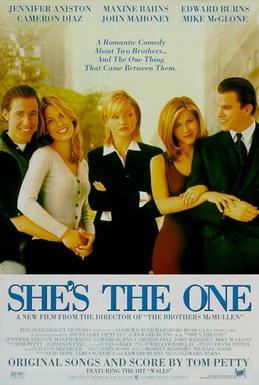
Ebert praises Burns’s craft but calls the movie an overhauled Brothers McMullen and urges him to move on; the panel partly agrees while defending McGlone’s broader comedy.
In the discussion (3)
- Roger Ebert’s two-star rating is reported.
- Ebert praises Burns’s command of scenes and human detail but calls the film a larger-budget reworking of Brothers McMullen.
- The movie is defended as funnier because Mike McGlone plays a broader, more compromised character.
Heather entering Mickey’s cab; the brothers’ silent sizing-up; the gay-question montage; the final confrontation.
The family introduction, cab arguments, television retrieval, parents, boxing, Heather’s agency, and farewell are retained separately.
In the discussion (18)
- The first Fighting Fitzpatrick family scene is proposed.
- The cab ride with Aniston and McGlone arguing about sex is proposed.
- Mickey arriving with his new bride is proposed as a separate beat.
- Mickey picking up Heather and retrieving his television is proposed.
- Heather entering Mickey’s cab elevates the movie and is a leading choice.
- Mike McGlone repeatedly calling disliked people animals is proposed as a running bit.
- Francis and Renee arguing about a sexual down cycle is proposed.
- Mickey, Renee, and Francis together are proposed.
- The parents interrogating Francis are proposed, with Frank Vincent praised.
- Mickey and Heather considering whether they made a mistake is proposed and treated as dangerous for him.
- The montage asking whether Francis is gay is selected.
- Mickey discovering Francis’s affair and the boxing-glove confrontation are proposed.
- The final apartment argument is proposed.
- Heather is interpreted as deliberately manipulating both men and giving Francis the watch to provoke them.
- The competing interpretation says the film gives Heather unusual agency and happiness instead of punishing her.
- Heather getting what she wants is defended even though both brothers insult her.
- Heather and Mickey silently sizing each other up is a final choice.
- Heather telling Francis she is engaged and his “ruined my life” response are proposed.
Mike McGlone shouting after Heather’s departure.
His emphatic reaction is selected.
In the discussion (1)
- Francis shouting after Heather leaves is selected as overacting.
Jennifer Aniston’s Rachel-era hair; the valuable heavy television; a cab rather than Uber; 1990s character names.
Franny’s feminization and the Woody Allen/Tony Roberts comparison are also discussed as period artifacts.
In the discussion (6)
- Jennifer Aniston’s partial Rachel haircut is selected.
- Mickey’s large, valuable television is proposed.
- Driving a cab rather than using ride-share is proposed.
- A femme fatale named Heather is proposed.
- Connie, Francis, Mickey, Renee, and Franny are proposed as period-specific names.
- The repeated feminizing nicknames and concern over being best man are discussed as part of Francis’s characterization.
Irish-American guilt and sanctimony; never showing the mother.
The panel connects both to Burns’s family storytelling and the movie’s sexuality debate.
In the discussion (3)
- Irish Americans portrayed as guilt-ridden, sanctimonious, and shaped by their parents are selected. — Sean Fennessey
- Never showing the mother is selected as an effective gimmick.
- The debate over Francis’s sexuality is retained as a reading of masculinity and Irish Catholic repression, with counterarguments about the period and family.
Cameron Diaz, Jennifer Aniston, Mike McGlone, Edward Burns, John Mahoney, and brotherly conflict.
Burns’s attempt to inherit New York relationship cinema and the no-women-on-the-boat rule are also discussed.
In the discussion (6)
- Cameron Diaz and Jennifer Aniston are praised.
- Mike McGlone and Edward Burns butting heads are praised.
- John Mahoney is singled out for praise.
- Burns’s effort to inherit a New York relationship-film tradition is praised while his limited psychological darkness is debated.
- The father’s no-women-on-the-boat rule is enjoyed as a period-specific family rule.
- Brothers settling disputes with boxing gloves is proposed.
Mike McGlone and Jennifer Aniston; Pete as runner-up.
Aniston’s patient, natural drags receive the strongest detailed praise.
In the discussion (4)
- Mike McGlone is selected for excellent on-screen smoking.
- Pete is proposed for forceful smoking.
- Jennifer Aniston’s smoking is praised as natural and fully integrated into the performance.
- Amanda Peet’s smoking is defended by one participant and doubted by another.
Jennifer Aniston and Pete.
Both characters are said to become hotter while smoking.
In the discussion (1)
- Jennifer Aniston’s character and Pete are jointly selected as becoming hotter when smoking.
Bottled Budweiser; canned Guinness; Icehouse; Coca-Cola.
The canned Guinness and Icehouse are criticized as especially odd choices.
In the discussion (5)
- The family’s bottled Budweiser is proposed as character detail.
- A prominent Coca-Cola can is proposed as possible placement.
- Mickey drinking canned Guinness at a bar is criticized.
- Francis drinking Icehouse with the parents is criticized.
- Merit cigarettes prompt a separate discussion of 1990s brands.
The brothers walking at dusk; Maxine leaning forward in Mickey’s cab.
Both compositions are praised.
In the discussion (2)
- The brothers walking beside the water at dusk are selected.
- Maxine leaning forward into the two-shot while Mickey drives is selected.
Moonstruck.
Shared actors and the focus on inevitable yet impossible New York relationships support the homage.
In the discussion (2)
- Moonstruck is selected because John Mahoney, Anita Gillette, and Robert Weil appear in both films.
- Both movies are described as interested in the impossibility and inevitability of relationships.
Tom Petty’s songs, especially Walls and the cue after the family meets Mickey’s bride.
The soundtrack is treated as a major supporting presence, while more Petty is desired.
In the discussion (5)
- The Tom Petty cue after the family meets Mickey’s bride is selected.
- Tom Petty’s songs are praised as a recurring presence that fits the film.
- Walls is praised as a bookending song.
- The panel wishes the movie used two more Petty songs.
- World Party’s authorship of She’s the One and Petty’s cover are discussed.
Irish Goodbye; Irish Curse; She’s the One retained.
Franny’s Down Cycle is added as an intentionally indie-sounding alternative.
In the discussion (3)
- She’s the One is defended as a good existing title.
- Irish Goodbye and Irish Curse are proposed, with Irish Goodbye strongly preferred.
- Franny’s Down Cycle is proposed as another title.
Francis refusing sex with Renee; Maxine’s underwritten role.
The first is mocked as implausible, while the movie’s failure to use Maxine or Leslie Mann fully is treated as a structural weakness.
In the discussion (3)
- Francis refusing sex with Renee is selected as implausible.
- The movie’s thin use of Maxine is criticized.
- Jennifer Aniston’s movie career is debated as a product of poor choices and crowded competition, while her eventual hits are acknowledged.
Maxine’s jealousy and France subplot; shallow psychology; gender perspective.
Mickey’s misogynistic attacks are criticized but defended as hurt lashing-out rather than a stable worldview.
In the discussion (4)
- Maxine’s jealousy and possible move to France are criticized as underdeveloped.
- The film is criticized for lacking psychological depth and richer subtext.
- The male perspective and potential misogyny are raised as objections.
- Mickey’s cruel comments to Heather are defended as situational hurt and humiliation rather than his treatment of everyone.
Dennis Peck could break every relationship in the movie.
Hope, Renee, Heather, the parents’ marriage, Leslie Mann’s character, and Francis are all included.
The panel proposes a new category here.
Flex pick · Picker not identified
In the discussion (3)
- Dennis Peck is judged capable of breaking up every principal relationship.
- Hope, Renee, Heather, the mother, Leslie Mann’s character, and Francis are named as targets.
- A Dennis Peck series breaking a marriage each week is proposed.
Amanda Peet is the movie’s hottest woman; Burns could have been Noah Baumbach with a stronger co-writer.
The first prompts career-wide appreciation; the second is agreed and tied to Burns’s reluctance to explore darker behavior.
In the discussion (5)
- Amanda Peet is selected as the hottest woman in the movie.
- Her directness, intelligence, and willingness to commit to roles are praised.
- If Edward Burns had hired a stronger co-writer, he could have occupied Noah Baumbach’s space.
- Burns’s comfortable worldview and reluctance to show uglier behavior are offered as the limitation.
- The response is “I think you’re right” and agrees Burns had that opportunity.
Angelina Jolie, Jennifer Lopez, Heather Graham, Amanda Peet, Anne Heche, Lauryn Hill, and Jennifer Garner auditioned; the Wallflowers were sought.
Amanda Peet’s accent performance and Burns’s relationship with Tom Petty are retained.
In the discussion (6)
- Burns reports auditioning Angelina Jolie, Jennifer Lopez, Heather Graham, Amanda Peet, Anne Heche, Lauryn Hill, and Jennifer Garner for the two lead roles.
- Jennifer Lopez as Heather is considered intriguing.
- Amanda Peet reportedly arrived in character with teased hair, gum, and a Long Island accent despite her Columbia background.
- The filmmakers reportedly sought the Wallflowers’ 6th Avenue Heartache before using Tom Petty.
- Burns’s early assumption that Hollywood success would always feel this easy is reported and treated as poignant.
- Burns learning from Saving Private Ryan is raised and answered from his book.
Mike McGlone; Robert Weil; Malachy McCourt.
McGlone is the leading choice, with two veteran New York character actors also proposed.
In the discussion (3)
- Mike McGlone is selected as someone viewers may recognize without knowing his name.
- Robert Weil is proposed through Moonstruck and Saturday Night Fever.
- Malachy McCourt is proposed through Brewster’s Millions and his literary family.
Amanda Peet; Frank Vincent.
Peet wins the quick vote, while Vincent’s nonviolent paternal menace is praised.
In the discussion (2)
- Amanda Peet receives repeated final choices.
- Frank Vincent is proposed and praised for redirecting his threatening energy toward his daughter’s marriage.
Talia Shire as the sisters’ mother; Leslie Mann in Maxine’s role.
Susan Sarandon, Kathleen Turner, and Diane Keaton are considered but judged too large, mismatched, or destabilizing.
In the discussion (4)
- Leslie Mann taking Maxine’s role is proposed.
- Susan Sarandon is proposed and rejected as too prominent immediately after her Oscar.
- Kathleen Turner and Diane Keaton are proposed and questioned.
- Talia Shire is proposed and receives the strongest interest.
Edward Burns, Maxine Bahns, Mike McGlone, and mid-1990s Long Island.
Amanda Peet, Cameron Diaz, John Mahoney, and Long Island history are debated separately.
In the discussion (5)
Yes: Islanders game, par-three golf, or pickup basketball.
The brothers are imagined as mediocre golfers or opponents in basketball.
In the discussion (4)
- The movie is judged to need a random sports scene.
- An Islanders game is proposed.
- A nine-hole par-three golf outing is proposed.
- Pickup basketball with the brothers on opposite teams is proposed.
Tom Hanks as Mickey; Tom Cruise as Francis.
Cruise as Mickey is also briefly considered before Francis wins.
In the discussion (2)
- Tom Hanks is selected for Mickey.
- Tom Cruise is selected for Francis after being considered for Mickey.
Whether Burns needed to star; when Francis began sleeping with Heather; whether Burns is a good actor; whether the movie loves women.
The panel keeps these unresolved while supplying competing cases.
In the discussion (8)
- Whether Edward Burns needed to star in his own films is questioned.
- Writing parts for other movie stars is proposed as an alternate career route.
- When Francis began sleeping with Heather is questioned, and making it the final act is proposed.
- Whether Edward Burns is a good actor is debated; his screen presence is praised while his self-direction is said to limit his flaws.
- Working more often with other directors is proposed as a test of his range.
- Whether Burns erred by not continuing with McGlone is questioned.
- Whether the movie loves or hates women is kept open because it grants agency while using a male viewpoint.
- The title’s failure to identify who “the one” is becomes part of the uncertainty.
Yes for several characters; Jennifer Aniston’s character is exempted.
Cameron Diaz’s and Amanda Peet’s characters are considered despite obvious danger, while dating Aniston’s character brings Frank Vincent as a family risk.
In the discussion (5)
- The answer is yes for several obvious stay-away characters.
- Jennifer Aniston’s character is exempted as grounded and likable.
- Frank Vincent as her father is identified as the associated danger.
- Cameron Diaz’s character is accepted despite the risk.
- Amanda Peet’s character is proposed as the more interesting affair for Francis.
The 24-hour marriage; Heather’s limited choices and possibly false marriage; the mother’s affair; Mickey’s apartment.
The device is criticized as underexplored, while the older affair is defended through attention and affection.
In the discussion (10)
- A drifting cab driver marrying after 24 hours and then considering Paris is criticized as underexplored.
- The marriage is defended as a plot device that moves Mickey into the other relationships.
- Heather having only an older wealthy man or a married man as choices is criticized.
- The panel says it needs to see the older wealthy man before judging the choice.
- The hardware-store owner winning the mother is questioned.
- His affection and attention are offered as the reason the mother chose him.
- Heather’s claim that she married that morning is questioned because she may be lying.
- Ebert’s plot-logic questions are cited as broader support for the nitpicks.
- Heather preferring a long drive despite holding a plane ticket is questioned.
- Mickey’s ability to afford his apartment is questioned.
An Apple TV series circa 2006.
The movie is judged naturally suited to television.
In the discussion (1)
- The story is proposed as an Apple TV series in a mid-2000s style.
A 13-year-old third Fitzpatrick brother modeled on Sean Fennessey.
The missing younger brother could admire the older men and pursue Amanda Peet’s character.
In the discussion (3)
- A young Sean Fennessey is proposed as a third Fitzpatrick brother.
- A Lucas Hedges-era young actor is proposed as the archetype.
- The younger brother flirting with Amanda Peet’s character is proposed.
Cameron Diaz; Mike McGlone as an alternative.
McGlone’s broad classical-comedy energy receives an extended defense.
In the discussion (3)
- Cameron Diaz is an explicit choice.
- Mike McGlone is an explicit alternative choice.
- McGlone is praised as a broad comic performer suited to 1930s and 1940s Hollywood.
Mickey and Hope break up; Mickey and Maxine may not last.
Both couples are predicted to fail.
In the discussion (2)
- Mickey and Maxine are predicted not to stay together.
- Hope and Mickey are predicted to break up.
The television; fishing rods; boxing gloves; watch.
The boxing gloves and watch receive support.
In the discussion (2)
- The television and fishing rods are proposed.
- The boxing gloves and watch are proposed.
No women on the boat; do not become sensitive mid-argument.
Both repeated lines are selected as best-worst lessons.
In the discussion (2)
- No women on the boat is selected.
- Do not get sensitive now is proposed.
The Brothers McMullen; Crimes and Misdemeanors; Walking and Talking.
The pairings emphasize Burns’s origins, tonal ambition, and a contemporary friendship film.
In the discussion (3)
- The Brothers McMullen is selected.
- Crimes and Misdemeanors is proposed as the successful blend of drama and comedy this film reaches for.
- Walking and Talking is proposed as a same-era relationship film.
Cameron Diaz in the short term; Edward Burns in the long term; Mike McGlone and Tom Petty as alternatives.
Diaz wins the performance discussion while Burns’s lasting filmmaking career drives the long-term answer.
In the discussion (3)
- Cameron Diaz is previewed as the winner and then selected in the actual category.
- Mike McGlone and Tom Petty are proposed as alternatives.
- Edward Burns is selected as the long-term winner for establishing a sustained filmmaking career.
Podcast choices
 Roger Ebert's review