
‹ All movies
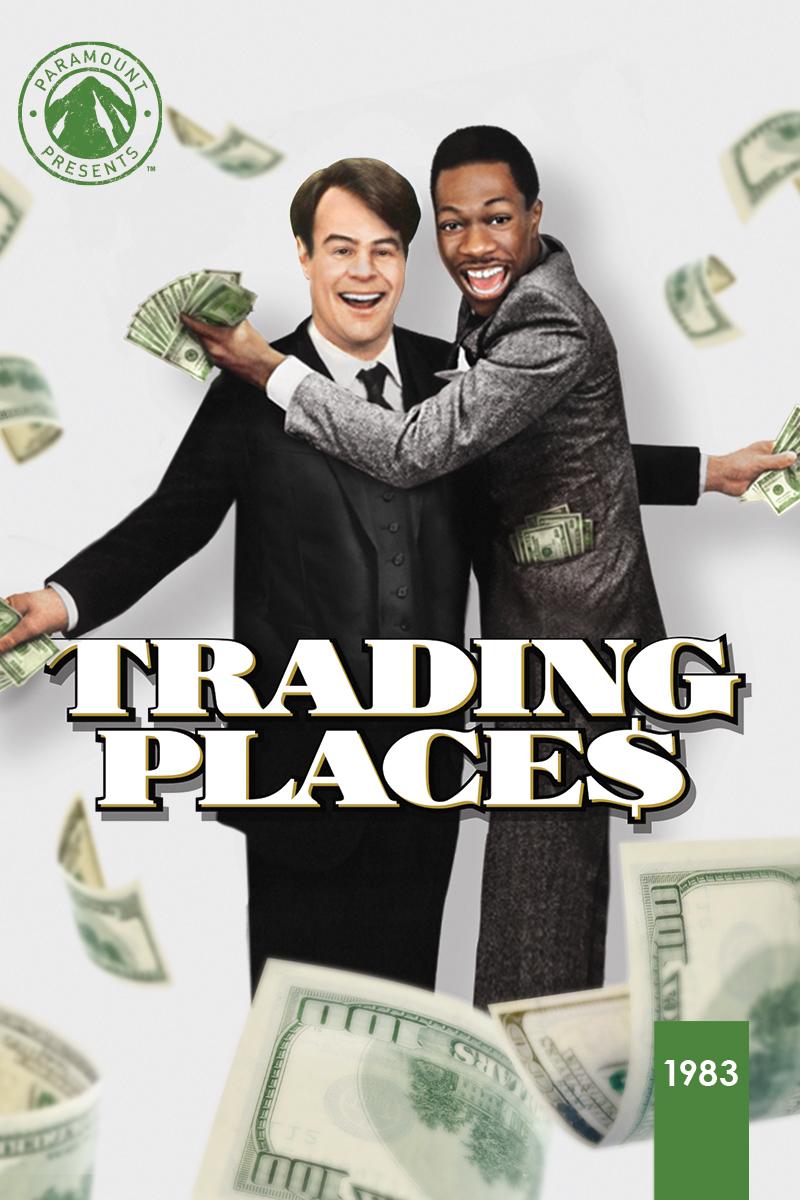
Trading Places poster

Trading Places

116 minutes

Cast

Selected cast credits · Film reference

Dan Aykroyd Louis Winthorpe III
Eddie Murphy Billy Ray Valentine
Ralph Bellamy Randolph Duke
Don Ameche Mortimer Duke
Denholm Elliott Coleman
Paul Gleason Clarence Beeks
Frank Oz Corrupt Cop
Jim Belushi Harvey
Kristin Holby Penelope Witherspoon
Alfred Drake President of Exchange
Bo Diddley Pawnbroker
Al Franken Baggage Handler #1
Tom Davis Baggage Handler #2
Maurice Woods Duke & Duke Employee
Richard D. Fisher, Jr. Duke & Duke Employee
Anthony DiSabatino Duke & Duke Employee
Bonnie Behrend Duke & Duke Employee
Sunnie Merrill Duke & Duke Employee
James Newell Duke & Duke Employee
Mary St. John Duke & Duke Employee
Bonnie Tremena Duke & Duke Employee
David Schwartz Duke & Duke Employee
Tom Degidon Duke Domestic
William Magerman Duke Domestic
Alan Dellay Duke Domestic
Florence Anglin Duke Domestic
Ray D'Amore Duke Domestic
Bobra Suiter Duke Domestic
Herb Peterson Duke Domestic
Sue Dugan Duke Domestic
Walt Gorney Duke Domestic
B. Constance Barry Duke Domestic
P. Jay Sidney Heritage Club Doorman
Avon Long Ezra
Tom Mardirosian Officer Pantuzzi
Charles Brown Officer Reynolds
Tony Sherer Philip
Robert Earl Jones Attendant
Robert E. Lee Cop #1
Peter Hock Cop #2
Clint Smith Doo Rag Lenny
Ron Taylor Big Black Guy
James D. Turner Even Bigger Black Guy
Giancarlo Esposito Cellmate #2
Steve Hofvendahl Cellmate #3
Gwyllum Evans President of Heritage Club
Eddie Jones Cop #3
John McCurry Cop #4
Michelle Mais Hooker #1
Barra Khan Hooker #2
Bill Cobbs Bartender
Joshua Daniel Party Goer
Jacques Sandulescu Creepy Man
W.B. Brydon Bank Manager
Margaret H. Flynn Duke & Duke Receptionist
Kelly Curtis Muffy
Tracey K. Shaffer Constance
Lucianne Buchanan President's Mistress
Jed Gillin Jr. Executive #2
Jimmy Raitt Ophelia's Client
Kate Taylor Duke's Secretary
Philip Bosco Doctor
Bill Boggs Newscaster
Deborah Reagan Harvey's Girlfriend
Don McLeod Gorilla
Stephen Stucker Stationmaster
Richard Hunt Wilson
Paul Austin Trader #1
Jack Davidson Trader #3
Bernie McInerney Trader #4
Maurice Copeland Secretary of Agriculture
Ralph Clanton Official #1
Bryan Clark Official #2
Gary Klar Longshoreman
Afemo Omilami Longshoreman
Donna Palmer Gladys
Barry Dennen Demitri
Murray Bandel Man at Police Station (uncredited)
Benjean Stray Dog (uncredited)
John Black Man Sitting on Couch at Party (uncredited)
John Landis Man with Briefcase (uncredited)
Shirley Levine Bag Lady (uncredited)
Charles Pendelton Cop (uncredited)
Yvonna Russell Girl in Park (uncredited)
Jan Saint Man in Police Station (uncredited)
Arleen Sorkin Woman at Party (uncredited)
Ronald Sylvers Rolls Royce Driver (uncredited)
Marlene Willoughby Woman Passed Out on Couch (uncredited)
Jim Gallagher Duke & Duke Employee

Trading Places | The Rewatchables

Explore episodeClose episode

Half-Assed Internet Research

Box office and contract; screenplay origins; credits; cameos; sailboat; dialogue; song; mugshot; traders; career counts; trading rule; money clip; profanity; restaurant; Italian broadcast

In the discussion (20)
Approx. transcript time · 00:05:48Read transcript
  • The film reportedly stayed in the box-office top ten for 17 weeks.
  • Paramount reportedly rewarded Murphy with a $25 million five-film contract and financing for a production studio.
  • Writer Timothy Harris’s experience with two wealthy, cheap tennis partners reportedly inspired the Duke brothers.
  • Commodity research included the Hunt brothers and Silver Thursday; familiar orange juice and pork bellies helped make the trading story accessible.
  • The Prince and the Pauper is noted as a possible influence rather than a firmly documented adaptation.
  • The budget is corrected from $50 million to $15 million, with $120.6 million gross and fourth place for 1983 reported.
  • The performer playing Penelope is described as a model with only this film and Manhunter credited, later marrying a biology professor and related to Ansel Elgort; these are reported biographical claims.
  • Harris reportedly received competing claims that Russo or Katzenberg originated the idea once the film became successful.
  • Esposito is identified in the jail scene and Falco as the disgusted salmon witness.
  • The ending’s 56-foot sailboat is reported still in the Caribbean, with the Virgin Islands identified.
  • Murphy reportedly changed stereotyped dialogue; Murphy and Landis opposed the studio’s attempt to remove the Kools-on-the-rug line.
  • The quartet song is described as an American Civil War song; its title is rendered “Orelia” in the transcript.
  • Louis’s mugshot number matches Jake Blues’s number in The Blues Brothers.
  • Actual traders were used in the exchange scenes.
  • The veteran actors’99th and 100th film claims prompted Murphy’s joke that the three collectively made 201 films.
  • A 2010 commodities restriction is reported as the Eddie Murphy rule.
  • The money-clip fumble reportedly happened unintentionally.
  • Ameche reportedly agreed to say the final profanity only once because of religious convictions.
  • A Philadelphia Westin restaurant was named Winthorpe and Valentine.
  • The film is reported as an annual highly watched Italian Christmas Eve broadcast.

Roger Ebert's review

In the discussion (1)
Approx. transcript time · 00:25:39Read transcript
  • Ebert gave 3.5 stars, praising character-based comedy beyond simple racial-prejudice lessons.

Mount Rushmore for Butlers

Coleman; Alfred; Clue’s butler; Hobson; Jeffrey added; Annie, Alice and Belvedere considered

In the discussion (8)
Approx. transcript time · 00:40:02Read transcript
  • Coleman is included in the proposed butler Mount Rushmore.
  • Alfred is included.
  • Tim Curry’s Clue butler is included.
  • Hobson from Arthur is included.
  • Annie’s unnamed possible butler is floated uncertainly.
  • Jeffrey from The Fresh Prince of Bel-Air is endorsed.
  • Alice from The Brady Bunch raises an eligibility question about maids versus butlers.
  • Mr. Belvedere is added with uncertainty about his caretaker role.

Probably Unanswerable Questions

Investment size; Murphy jail scenes; sympathetic sex-worker characters; smoothies; Beeks’s fate; Ophelia and Coleman

In the discussion (9)
Approx. transcript time · 00:48:35Read transcript
  • How much the heroes invested and whether their island stay represents retirement or vacation remain unresolved; savings may have restored their finances without enormous wealth.
  • This film’s jail scene is preferred to 48 Hrs., though the latter is considered a more iconic character introduction.
  • Curtis’s Ophelia is proposed as the best sympathetic sex-worker character, while Roberts is preferred in response; physical rescue and emotional rescue are compared.
  • Coleman’s drink prompts the joking question of whether he invented smoothies and a proposed expensive namesake drink.
  • The length of Beeks’s voyage to Africa is questioned.
  • Why the gorilla is at the Philadelphia station and what treatment Beeks experiences remain unresolved.
  • The costume going unnoticed and Beeks surviving for a year are questioned.
  • Poor animal care and the trip’s unsanitary conditions are offered as dark explanations for Beeks’s predicament.
  • A suggested Ophelia-Coleman sexual encounter is rejected because she is understood to love Louis.

Casting What-Ifs

Pryor and Wilder; Aykroyd pay cut; Curtis casting resistance; Milland to Ameche; Liddy as Beeks; Moranis and Thomas

In the discussion (9)
Approx. transcript time · 01:09:51Read transcript
  • The project was originally developed for Pryor and Wilder.
  • Pryor’s burn injury reportedly prevented his participation, and Paramount backed Murphy.
  • Murphy reportedly resisted working with Wilder because of the established Pryor-Wilder association.
  • The Vietnam-veteran hustle is attributed to the original plan to cast Pryor.
  • Aykroyd reportedly took a major pay cut after studio doubts about his solo appeal.
  • Landis insisted on Curtis despite Paramount’s resistance.
  • Ray Milland reportedly failed a physical, leading to Ameche’s return from a long acting gap.
  • G.Gordon Liddy reportedly declined Beeks because of the gorilla ending.
  • Moranis and Thomas were intended as the baggage handlers before Franken and Davis.

Picking Nits

Louis’s benefits; Dukes’ shared home; salmon; Coleman’s loyalty; crop-report news and forgery; dark handoff; infection risk

In the discussion (10)
Approx. transcript time · 01:22:01Read transcript
  • Louis’s apparent wealth despite his salary is explained by employer-provided house, butler and other benefits that can be withdrawn.
  • The wealthy Dukes sharing a home without visible spouses or families seems odd; thrift, companionship, widower or lifelong-bachelor possibilities are offered.
  • A joking suggestion that the Dukes are lovers draws objections that they are clearly brothers; the billionaire description is also corrected.
  • Separate wings in a family compound and economical storytelling are defenses of the shared residence.
  • Louis’s hunger and intoxication are revisited as the explanation for the salmon.
  • Coleman switching sides is explained by being treated as a person and included in the team.
  • Local television covering delivery of a crop report seems implausible.
  • The method of fabricating the crop report is not shown and must be accepted.
  • The Dukes should verify Beeks’s identity before exchanging money in a dark garage.
  • Ophelia getting into bed with a coughing Louis raises an infection concern, countered by memories of routinely sharing winter illnesses.

Producer review

Strong film with a message; newer comedies may be funnier

In the discussion (2)
Approx. transcript time · 01:36:30Read transcript
  • The film is liked but may be less funny than Step Brothers while being a better movie because it has a subject and message. — Craig Horlbeck
  • Older comedies such as The Breakfast Club and Parenthood are contrasted with the bit-driven laughs of Anchorman, leaving the quality-versus-funniness distinction unresolved. — Craig Horlbeck