
‹ All movies

Jack's house attacking the family: Keaton versus the washing machine, dryer and self-starting vacuum

One host's candidates begin with Jack getting fired, where everybody is trying to strangle each other and Jeffrey Tambor and Christopher Lloyd share the scene, which feels very 80s and would not be written that way today; the clip is played.

Martin Mull, as Terry Garr's creepy boss, makes his first visit to the house and Keaton comes to the door holding a chainsaw, overalls and a backwards Lions trucker hat, the two men sizing each other up over the 220, 221 wiring line; the clip is played, and the other host decides this is where Michael Keaton and Mr. Mom invented the hipster dad seen in Brooklyn and Silver Lake.

The film

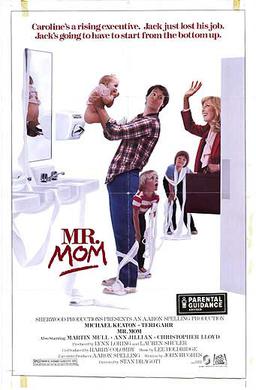
Mr. Mom (1983)

Directed by Stan Dragoti · Drama

91 minutes

Cast

Selected cast credits · Film reference

Cast credits have not been imported yet.

Everything from the episode

In the order the hosts got to it. Open a row for the discussion.

15:15

Roger Ebert's review

In the discussion (1)
Approx. transcript time · 00:15:15Read transcript
  • Ebert gave two of four stars and called the film a lost opportunity for resorting to cliches rather than finding humor in a promising and talented cast; a host thinks it deserves at least two and a half, since against the raunchy Porky's and Caddyshack comedies of the era, where nudity was required, this was a traditional comedy you could take your kids to.
39:36

Casting What-Ifs

Chevy Chase, Michael Douglas, Steve Martin and John Travolta were considered for Jack; Karen Allen, Jane Curtin, Farr...

Chevy Chase, Michael Douglas, Steve Martin and John Travolta were considered for Jack; Karen Allen, Jane Curtin, Farrah Fawcett and Sally Field for Carolyn; Ron Howard turned down directing to make Splash

In the discussion (2)
Approx. transcript time · 00:39:36Read transcript
41:05

Recasting Couch

Michelle Pfeiffer as Carolyn, with Richard Gere replacing Martin Mull's boss to match; Meryl Streep as Carolyn

Michelle Pfeiffer as Carolyn, with Richard Gere replacing Martin Mull's boss to match; Meryl Streep as Carolyn

In the discussion (9)
Approx. transcript time · 00:41:05Read transcript
  • Terry Garr is called not good, not really a good actress, in a part that is interesting in the right hands and which she is not interested in exploring; the defense offered is that the script gives her little material.
  • She could have played it sexier or more mom-ish, but the character is hard to describe: not really a mom, throwing the kids away for an hour, showing up frazzled, never asking about them or her husband until he gains weight and she throws darts, leaving the question of what is supposed to be likable about her.
  • A millennial brain trained that women should be ambitious says she should get on the plane after convincing a guy to spend $12 million, yet the film sets up a recession and a layoff and then treats it as no big deal; if she is ambitious, it is never clear in the first hour, so the character is undercooked in both script and performance, and she has no chemistry with Keaton, who has more with Angelian (as transcribed).
  • It is hard to believe she becomes successful at work since she seems like a clueless dipshit, going from two years of advertising experience and years at home to a high-powered executive, which is not how the workplace treats women after kids.
  • Michelle Pfeiffer is the replacement: it changes the whole dynamic and makes it interesting, but then the creep must be recast too, since Martin Mull is no threat to her, so Richard Gere; there are five more interesting versions of this film, and the Pfeiffer version ends with the mom leaving the family or having an affair while the husband watches soap operas.
  • Jack should have been much madder when Martin Mo (as transcribed) answers Carolyn's hotel phone in front of his friend and the kids, which is never resolved, and Carolyn finding Joan lying on her own bed is waved off too easily; Pfeiffer, queen of the 80s, 90s and 2000s, looks fantastic on the Maleficent 2 press tour.
  • There is a reason Terry Garr's career never exploded through the 80s, although she is good in Young Frankenstein and great in Tootsie; the frustration is that Tootsie Terry Garr is a character while this is only a sitcom mom, with Keaton given the fun things to do.
  • Meryl Streep is offered as one more idea, a fun part since she did weighty movies in the 80s, but she brings guilt and shame wherever she goes and would need a scene crying over missing Bobby's violin recital, which one host wanted and the other did not.
  • A parent who missed seven soccer games and a graduation during four weeks on the road at the NBA playoffs says the film never taps into that; the other host's mother, a successful lawyer who traveled, felt guilty, whereas this character does not care about her children at all, and Halloween, the best day for kids apart from birthdays, is the proof, though the $12 million pitch is conceded as a reason she has to be there.
49:19

Half-Assed Internet Research

Producer Laura Shuler Donner (as transcribed) met John Hughes after reading his National Lampoon article and his stor...

Producer Laura Shuler Donner (as transcribed) met John Hughes after reading his National Lampoon article and his story of a disastrous stretch looking after his two kids; Hughes brought in Aaron Spelling from his TV deal; Universal dumped Hughes for working in Chicago and had others rewrite the script; Spelling said he made it to have a film to take his kids to; Keaton turned down Splash for Mr. Mom

In the discussion (4)
Approx. transcript time · 00:49:19Read transcript
  • Producer Laura Shuler Donner (as transcribed), then at Motown Productions, read a National Lampoon article by John Hughes, kept in touch, and in a meeting he described a disastrous experience looking after his two children while his wife was away; she found it hilarious and they started working on the script.
  • Hughes had a TV deal with Aaron Spelling and brought him in as producer; Universal dumped Hughes because he worked in Chicago rather than LA and brought in other writers, and his script was apparently better, which the hosts believe.
  • Aaron Spelling's stated reason for making the movie was that he could not find a film suitable to take his kids to; a host doubts it, noting his kids were cut out of his estate.
  • Earlier, stepping on the category: Keaton turned down Splash to do Mr. Mom.
50:50

Picking Nits

Nobody cares less about her kids than Carolyn; Jack losing all three kids in the grocery store; the terrible Schooner...

Nobody cares less about her kids than Carolyn; Jack losing all three kids in the grocery store; the terrible Schooner Tuna ad; the filthy house; the kids' advanced understanding of their parents' employment

In the discussion (4)
Approx. transcript time · 00:50:50Read transcript
  • Does anyone care less about her kids than Terry Garr: she could come home to two kids instead of three and not notice for a day and a half; Keaton losing all his kids in the grocery store is defended as realistic by a host whose wife lost their son Ben in a London park for eleven minutes in 2012, since kids are like dogs and just run off.
  • Home Alone is raised as the most ridiculous version of leaving a kid behind, with the counter that people were not attached at the hip to their children then; the point is that she is a terrible parent, not a terrible mom, since getting a job does not stop you reading a bedtime story once.
  • The Schooner Tuna ad they end up with is really terrible and could have been made three percent better; the clip is played, and the hosts again conclude they ran out of time and film, though it gets the point across.
  • The house is disgustingly dirty, and Carolyn would at least notice that even if she missed a kid; the kids also seem to have an advanced understanding of their parents' employment status, which kids do not care about.
54:14

Probably Unanswerable Questions

How does Jack get his job back alongside Jeffrey Tambor's character, who was fudging numbers yet never gets fired?

How does Jack get his job back alongside Jeffrey Tambor's character, who was fudging numbers yet never gets fired?

In the discussion (2)
Approx. transcript time · 00:54:14Read transcript
  • Keaton gets his job back at the end with the other two guys after it turns out Jeffrey Tambor's character was fudging numbers, yet Tambor is not fired; the cause and effect of sales falling after Jack left makes no sense and the whole resolution is incoherent, when Jack should demand that Tambor be out.
  • Jeffrey Tambor was this exact character for seven straight years, on Three's Company and The Ropers and in five movies of the era, so it was amazing when he was hired as Hank on Larry Sanders; sitcoms then would bring an actor back as a lawyer and eight episodes later as a doctor.