‹ All movies
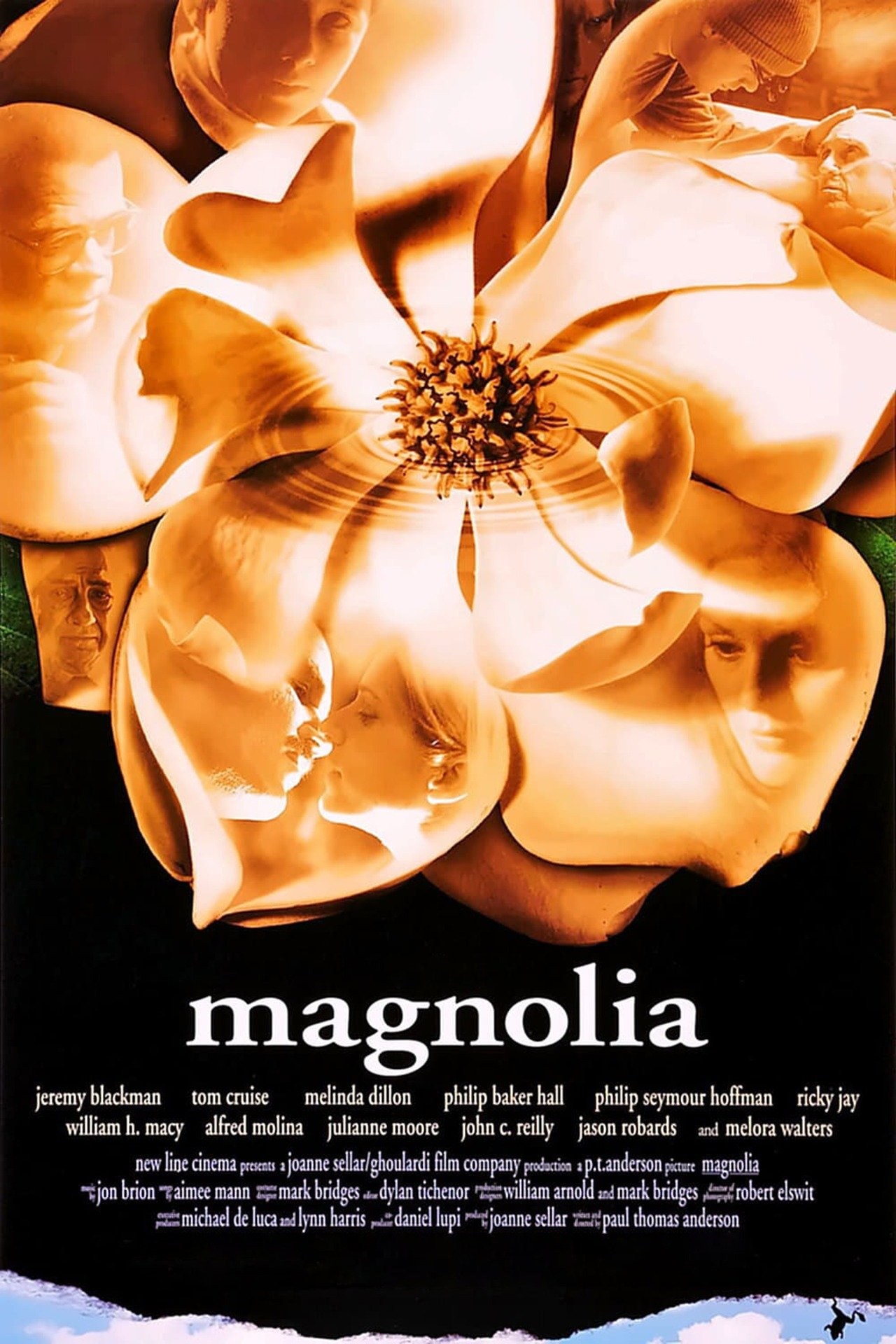
Magnolia poster

Magnolia

188 minutes

Cast

Selected cast credits · Film reference

Tom Cruise Frank T.J. Mackey
Jason Robards Earl Partridge
Julianne Moore Linda Partridge
Melora Walters Claudia Wilson Gator
Philip Baker Hall Jimmy Gator
Melinda Dillon Rose Gator
John C. Reilly Jim Kurring
William H. Macy Donnie Smith
Jeremy Blackman Stanley Spector
Michael Bowen Rick Spector
April Grace Gwenovier
Ricky Jay Burt Ramsey / narrator
Alfred Molina Solomon Solomon
Michael Murphy Alan Kligman
Henry Gibson Thurston Howell
Don McManus Dr. Landon
Danny Wells Dick Jennings
Thomas Jane Young Jimmy Gator
Cleo King Marcie
Clark Gregg WDKK employee
Robert Downey Sr. WDKK employee
Patton Oswalt Delmer Darion
Miriam Margolyes Faye Barringer
Pat Healy Sir Edmund William Godfrey / young pharmacist
Paul F. Tompkins Chad (voice)
Mary Lynn Rajskub Janet (voice)

Magnolia | The Rewatchables

Explore episodeClose episode
In the discussion (3)
Approx. transcript time · 00:03:03Read transcript
  • The introduction identifies this discussion as the origin of Linda Partridge joining the overacting award name.
  • Julianne Moore’s pharmacy scene prompts renaming the award for Linda Partridge; the intensity is considered overwhelming and unrealistic.
  • Linda Partridge formally replaces Rubinek in the award name; Cruise is considered but defended through the complete emotional arc, while Bowen remains a contender.

What’s Aged the Best?

Frank’s foresight; Oswalt; soundtrack; filmmaking craft; Hoffman; bar; ponytail; Jimmy Gator’s relevance

In the discussion (9)
Approx. transcript time · 00:22:29Read transcript
  • Frank anticipates masculine self-help, Tucker Max and the later pickup-artist movement associated with The Game and Neil Strauss.
  • Frank’s performance and foresight remain strengths; the early Patton Oswalt appearance is appreciated.
  • Aimee Mann’s soundtrack and its artist-centered structure are praised, compared with Nashville; a Counting Crows song-based movie is imagined.
  • The frantic style captures Anderson’s state and displays difficult choreography/editing, despite its exhausting length and derivative elements.
  • Hoffman’s unusually restrained, empathetic nurse showcases decency and growing versatility; 25th Hour is compared.
  • The two Supertramp songs and music generally are praised.
  • The bar and its flirtatious unattainable bartender feel specifically Los Angeles.
  • Frank’s top ponytail anticipates the man bun.
  • Jimmy Gator anticipates later exposure of abusive television figures; Anderson’s broadcast-family upbringing supplies context.

Most Rewatchable Scene

Frank confronting Earl at the deathbed

In the discussion (5)
Approx. transcript time · 00:25:02Read transcript
  • Rapid crosscutting repeatedly interrupts developing performances, especially Cruise’s bedside breakdown.
  • Opening coincidence vignettes are nominated as thematic entry points, though less compelling on repeat viewing; the scuba story is preferred over the drawn-out suicide story.
  • All Cruise scenes are favored in principle, especially Frank’s grand entrance.
  • Moore’s pharmacy meltdown, the frog downpour and Stanley needing to urinate during the quiz show are nominees.
  • Frank confronting Earl is the agreed winner, from his arrival through the breakdown; Hoffman crying in the background deepens it and the frogs awaken Earl.

What’s Aged the Worst?

Length; disputed subplots and performances; weather; singalong familiarity; threatening interview

In the discussion (9)
Approx. transcript time · 00:34:25Read transcript
  • Anderson’s 1999 prediction that Magnolia would be his best film is rejected; its personal ambition and flaws make it tempting to mentally repair.
  • Reilly’s subplot, Moore’s excessive intensity and overall length are criticized; removing Stanley and Donnie is proposed.
  • Unlike For Love of the Game’s obvious proposed cuts, this film invites disagreement over which stories are expendable; the quiz material is compelling but its necessity uncertain.
  • Walters is criticized as inadequate for a complicated role and its final scene, but defended as deliberately portraying an unpleasant, introverted cocaine addict rejecting kindness; later Adams or Stone is imagined as an alternative caliber.
  • Reilly’s simplicity is compared unfavorably with Forrest Gump and considered too prolonged, though defended as purposeful incompetence.
  • Moore’s subplot is proposed for removal; the pharmacy behavior seems implausibly intrusive and her lawyer-office confession excessively unhinged.
  • Rain and 99 percent humidity seem unlike Los Angeles, with the frog storm acknowledging the film’s unreality.
  • The Wise Up singalong loses novelty after years of musical television episodes.
  • Frank’s threatening intrusion into the interviewer’s space feels uncomfortable.

The most "year the movie came out" thing

Frank Mackey; singalong; television; telephone orders; Anderson and Fiona Apple

In the discussion (3)
Approx. transcript time · 00:42:57Read transcript
  • Frank’s self-help persona, the singalong, 1970s Hollywood nostalgia and television as a portal to tawdry distractions feel 1999.
  • Ordering porn magazines and deliveries by telephone feels pre-app 1999.
  • Anderson’s Fiona Apple relationship and bucket hat define the era; their intense creative interaction in That Moment and later friendship/video collaborations are admired.
In the discussion (3)
Approx. transcript time · 00:52:00Read transcript

Apex Mountain

Melora Walters; Aimee Mann’s solo career; a participant’s mother

In the discussion (3)
Approx. transcript time · 00:57:51Read transcript
  • Cruise and Anderson are rejected; Walters and Aimee Mann’s solo career are affirmed, with Mann especially favored; the Valley is floated.
  • Frogs are disputed against the Bible and prince-transformation stories; Stanley is merely mentioned.
  • One speaker jokingly picks his mom, who fiercely defended the movie and its frogs for twenty years.