
‹ All movies
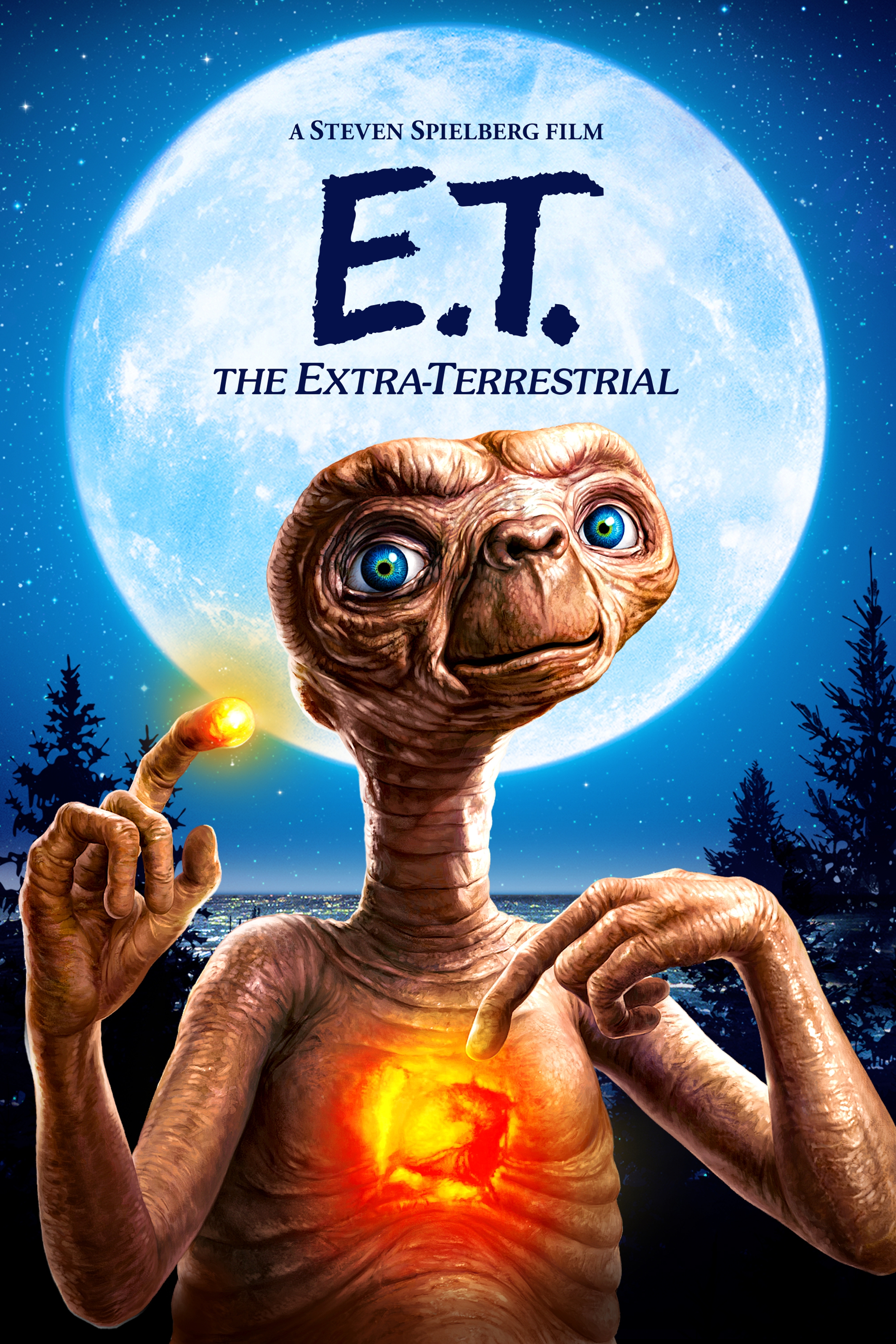
E.T. the Extra-Terrestrial poster

E.T. the Extra-Terrestrial

115 minutes

Cast

Selected cast credits · Film reference

Henry Thomas Elliott
Sean Frye Steve
Tom Howell Tyler
Erika Eleniak Pretty girl
David O'Dell Schoolboy
Richard Swingler Science teacher
Frank Toth Policeman
Robert Barton Ultra sound man
Michael Darrell Van man
Pat Welsh E.T.’s voice
Debra Winger E.T.’s voice

E.T. the Extra-Terrestrial | The Rewatchables

Explore episodeClose episode

Producer credits not yet identified.

Half-Assed Internet Research

Sequential filming for the children’s attachment

In the discussion (23)
Approx. transcript time · 00:11:10Read transcript
  • The production reportedly filmed sequentially to let the children become attached to E.T.
  • Spielberg reportedly imagined an alien companion after his parents’1960 divorce.
  • Loneliness while filming Raiders in Tunisia reportedly revived that childhood idea; Matheson developed the script, initially called E.T. and Me, following a Night Skies concept.
  • Columbia rejected the project as commercially doubtful and pursued Starman instead, though the simplified executive-blame story is qualified.
  • Universal reportedly bought the project for $1 million while Columbia retained 5 percent of net profits, making its rejection less disastrous financially.
  • Nine Oscar nominations produced four technical and music wins; Gandhi winning picture,director and actor over this film is strongly criticized.
  • Henry Thomas’s lack of a nomination prompts debate over whether a child lead would be entered as lead or supporting actor.
  • Wallace’s absence from the nominations is lamented as a missed great mother performance.
  • Attenborough reportedly said E.T. should have won and praised its invention and power.
  • A John Sayles Close Encounters sequel concept is recalled; Spielberg reportedly responded to reviews calling that film personal by making a genuinely personal alien story.
  • The film idealizes Spielberg’s Arizona childhood after divorce; The Fabelmans is anticipated as a more direct autobiography, while simultaneous Poltergeist work underscores his productivity.
  • The reported budget is $10.5 million against $793 million gross, an unusually large disparity for the show.
  • Reported records include surpassing Star Wars until Jurassic Park,16 weeks at number one,15 million VHS units,$250 million video revenue,50 million dolls and $1 billion merchandise; delaying home-video release frustrated viewers.
  • The 1990 Universal Studios Florida bike ride is recalled as still operating.
  • M&M’s rejection of product placement is called a major mistake that helped create a Reese’s Pieces competitor.
  • Rambaldi’s creature reportedly used four heads, animatronic facial controls and several costumed performers; Kennedy studied real and glass eyes, and the effects cost about $1.5 million.
  • Winger supplied temporary vocals, while Pat Welsh’s heavy smoking contributed to the final voice.
  • Welsh reportedly received $380 for nine-and-a-half recording hours; other sounds came from Spielberg, Winger, a sleeping sick wife, a professor’s burp, raccoons, otters and horses.
  • The shoot reportedly used A Boy’s Life as a secrecy title; locations listed are Culver City, Northridge, Tujunga, Crescent City and Porter Ranch for flying bicycles.
  • Barrymore’s dislike of E.T.’s feet was reportedly an ad-lib about visible wires that Spielberg retained.
  • Spielberg screened the movie for Ronald and Nancy Reagan; Michael Jackson reportedly owned a puppet, and a wet T-shirt filled with gelatin supplied walking sounds.
  • Spielberg reportedly described E.T. as a plant-like creature, neither male nor female.
  • Universal reportedly first saw the film at a Texas audience test, showing Spielberg’s unusual control, supported by his restrained budget.

Roger Ebert's review

In the discussion (1)
Approx. transcript time · 00:38:07Read transcript
  • Ebert gives four stars and praises the film’s ability to overcome caution and win hearts.

Casting What-Ifs

Macchio; Feldman; unconfirmed Shelley Long; cut Harrison Ford

In the discussion (3)
Approx. transcript time · 01:11:59Read transcript
  • Ralph Macchio reportedly nearly played another child, Tyler; Thomas rescued his audition by thinking about his dead dog and moving Spielberg to tears.
  • Feldman’s part reportedly disappeared in rewrites. Shelley Long being offered Mary is an unconfirmed internet report, with Night Shift and Cheers making the alternative outcome seem fine.
  • Ford’s cut principal appearance reportedly concealed his face, but a recognizable Star Wars actor could still distract in this world.

Picking Nits

Missing Han Solo figure; dog acceptance; Keys close-ups; medical and quarantine decisions; neighbors and police; hygiene; pizza; bicycle skill

In the discussion (13)
Approx. transcript time · 01:13:38Read transcript
  • Elliott owns Lando, Boba Fett and Greedo but no Han Solo figure; this absence complicates the joking objection to Ford appearing in a Star Wars-aware world.
  • Harvey’s quick acceptance of E.T. is questioned, countered by initial mutual alarm and E.T.’s ability to connect.
  • Repeated close-ups of Keys feel excessive, defended as a child’s memorable visual identifier.
  • Four-year-old Gertie should be kept away from the traumatic death scene.
  • Treating Elliott and E.T. together and then leaving the child alone with the unprecedented discovery strain medical and security logic.
  • The quarantine should draw more neighbor concern and news coverage than a small onlooking crowd.
  • Gertie’s arrival at the farewell prompts an initial question, answered provisionally as coming with her mother.
  • Mary, Gertie and Keys reaching the farewell alone without police following is implausibly convenient; federal charges for the children are jokingly imagined.
  • An online essay’s horror-film interpretation—E.T. disrupts a family, endangers it and leaves—earns respect for its contrarian commitment but strong rejection as a reading.
  • Keys eating discarded candy from the forest floor is inconsistent with later biohazard caution.
  • Everyone removing protective equipment immediately after E.T.’s death makes no quarantine sense while his body remains present.
  • One pizza for four teenage boys seems inadequate; leaving the fallen pizza and insecticide near food also bothers the hosts.
  • Elliott’s advanced bicycle riding seems improbable for his age, but visible cautious stopping and falling distinguish him from the older riders.

Recasting Couch

Leave intact; De Niro as Keys; Stone as Mary (joking)

In the discussion (1)
Approx. transcript time · 01:18:19Read transcript
  • The cast should remain intact; if forced,1982 De Niro as Keys is proposed. Stone as Mary draws a defense of Wallace, and Hopkins as Elliott makes the escalating premise plainly comic.

Probably Unanswerable Questions

Location and cornfield; E.T.’s biology and risks; keys; school; Sally; Mary’s romance; leaving Earth; Elliott’s future

In the discussion (11)
Approx. transcript time · 01:35:19Read transcript
  • The California setting remains imprecise: Elliott points near Tahoe, while the visual geography mixes the valley and redwoods.
  • The backyard cornfield appears from one angle but not others, making its existence puzzling despite its effectiveness.
  • The plant-like description prompts joking questions about E.T. as a Beyond Burger and whether he could be eaten.
  • Hypothetical disasters include a raccoon attack, bicycle crush, herpes, medical dissection, contacting invading aliens, alcohol poisoning and a DUI.
  • The many keys’ functions are unknown; house, storage, car and trunk are possibilities, and keeping them over a hazmat suit seems especially odd.
  • Whether the school continued having children chloroform live frogs after the escape remains unanswered.
  • Sally’s identity and relationship to the absent father are unknown; a performer transcribed as Dana Wheeler-Nickleson is proposed as a type, with the appearance of the imagined character disputed.
  • The father’s departure is reconsidered as a young couple falling out of love; the hosts connect it with Spielberg later learning a more complicated account of his own parents’ split.
  • E.T.’s Halloween reaction to Mary prompts a joking attraction question; Keys’s behavior raises a more plausible future date with her.
  • Elliott accepting the invitation to space divides the panel: some would go as children, others stay with family, with future sports and entertainment making departure less appealing.
  • Elliott’s next decade is imagined either as chasing an unrepeatable high through drugs or creating magical stories for others; Michael’s future is pessimistically imagined too.