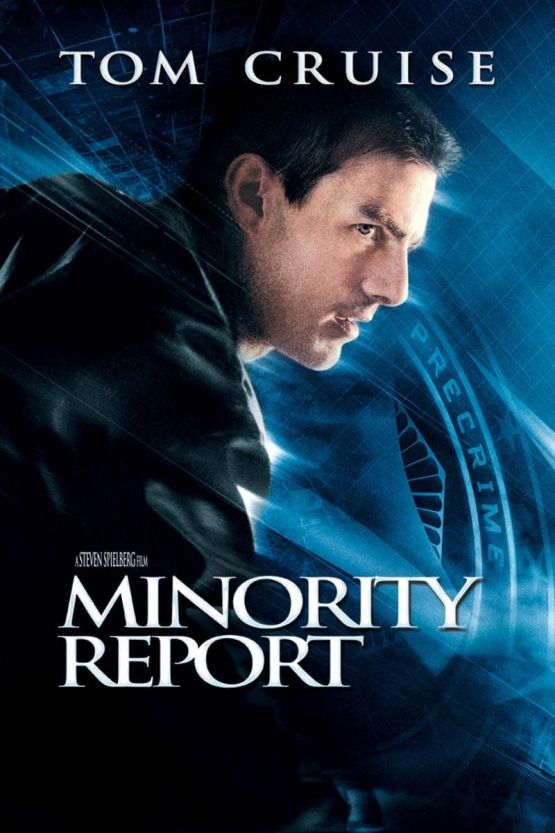
Scotty’s claim that marriage is obsolete is nominated; Mike’s admission of feelings is discussed as possible honesty in a close relationship rather than concealment.
Spielberg reportedly convened fifteen experts for three days and developed an eighty-page 2054 guide; his predictions of personalized advertising and privacy loss are considered prescient.
The first Cruise–Spielberg collaboration reportedly began development in 1997 but was delayed by Mission: Impossible 2 and AI; several production companies were involved.
Cruise and Spielberg reportedly took fifteen percent of gross to hold the budget below one hundred million dollars.
The reported budget is $102 million and worldwide gross $354 million.
Diaz, Crowe and Anderson reportedly make uncredited subway appearances; the literary Anderton is described as older, bald and out of shape.
The literary ending is tentatively recalled as exile to another planet; the original pre-cogs differ markedly, while Spielberg’s noir viewing and deliberate overlighting shaped the film.
The car-factory scene reportedly draws on an unfilmed North by Northwest sequence described to Truffaut.
Parallels with The Fugitive include a framed protagonist, subway recognition, trusted-colleague betrayal, appearance changes, risky escape jumps and a ceremonial public exposure.
Future technology is embedded in action without exposition; personalized ads establish the surveillance obstacle that leads naturally to the disturbing eye replacement.
Damaged noir characters, including the blind drug dealer, disgraced surgeon and wheelchair-using prison supervisor, preserve Philip K. Dick’s distinctive world.
Cruise manipulating pre-crime images with his hands holds up better than Disclosure; modern headset use and possible movement training are discussed.
Morton’s unsettling Agatha is praised despite being difficult company; her victimhood deliberately interrupts the action and humanizes the film.
The stated remaining time of 51 minutes 30 seconds reportedly matches the time left in the film.
Ordinary domestic routines interrupted by action and Cruise saying the film’s title are praised.
Sex, adultery, drugs and murder represent adult Spielberg, although his apparent discomfort with sex is joked about.
The Howard Marks intervention introduces pre-crime and red-ball urgency efficiently; the film is praised for sequences that flow across individual scenes.
The moving-hands analysis revealing a merry-go-round is a scene highlight.
Discovering himself in the Leo Crow murder prediction and hiding the ball showcases rapidly changing emotions conveyed through Cruise’s face.
The fifteen-minute escape from Wally’s warning through the completed car is praised as sustained action comparable to John Wick’s nightclub run.
The elevator encounter, apparent refuge with the older mentor and jumping across futuristic cars are escape-sequence highlights.
The jetpack chase, midair grab and intrusions into ordinary apartments are admired.
The crane fight and car assembly climax sustain the chase; autonomous machinery enclosing the fugitive reinforces the film’s technological threat, alongside Lexus placement.
The swimming-pool flashback to the missing child is praised for breath-holding foreshadowing.
The spider search and overhead view across apartments are admired; occupants briefly pause everyday activity for scans, and visual links to The Matrix and John Wick 4 are noted.
The futuristic pleasure club is a scene candidate, compared with Total Recall’s imaginative nightlife.
The confrontation where Cruise is told he still has a choice about killing Leo Crow is nominated.
Agatha’s intensity during the Leo Crow scene is criticized as unpleasant company, then defended as the consequence of her captivity; exploiting her gift for sports wagers is joked about.
Exposing Burgess during an honoring banquet is compared with The Fugitive and admired as an ideal public reveal.
The fifteen-minute escape sequence receives an explicit favorite-scene selection.
The greenhouse is nominated for its odd tonal shift and explanatory role; the kiss reportedly surprised Cruise during filming.
The disgraced eye surgeon and unsettling nurse are nominated as a creepy Philip K. Dick-style encounter.
The first Farrell–Cruise meeting is nominated for the ball-catching demonstration and clashing views on pre-crime.
The fifteen-minute escape receives another explicit favorite-scene selection.
The spider search is praised for suspense and for showing residents treating invasive scans as the price of a murder-free society.
An invited additional response agrees with the factory action sequence as the most entertaining portion.
The fire escape appears nine stories high, but the ensuing drop looks closer to fifty.
Rapid recovery from an eyeball transplant is considered implausible even with future technology.
Quickly encountering Ann Lively’s drowning is questioned, then explained as Agatha deliberately drawing attention to her mother.
Burgess’s revealing slip is revisited and his simple self-shooting finale is criticized as unimaginative after the film’s elaborate action.
Anderton’s retained retinal security access after becoming a fugitive is criticized; even his wife can use the old eyes to enter.
Police leaving the rescued woman alone by the lake enables Burgess to murder her; taking a statement or remaining with her would disrupt the plot.
Anderton learning about Crow through the prediction creates a causal paradox; the objection is defended as central to the premise and Agatha’s effort to solve her mother’s death.
Displaying discussions 2533 - 2544 of 6801 in total