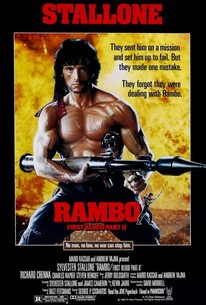
The hosts report Ebert gave a television thumbs-up, praised the pacing and lack of political bias, and enjoyed the movie despite logical flaws. No numerical star rating is stated.
The rock-breaking prison opening establishes the mission quickly, delivers an immediate explosion and ends with the question about getting to win this time; Rambo’s immaculate hair is enjoyed.
The airplane jump mishap is enjoyed for forcing Rambo to cut away his equipment and for the reaction shots, while the failure to deploy an elite soldier properly is mocked.
The meeting with Murdock and Erickson is added to the rewatchable-scene candidates.
The boat conversation with Co is enjoyed as awkward romantic comedy: becoming war, being expendable, the lucky knife and his interest in her necklace.
The boat ambush and escape are enjoyed, especially Co greeting Rambo and telling him he is not expendable; the hosts connect the wording jokingly to The Expendables.
The aborted helicopter rescue and ensuing Trautman–Murdock confrontation are praised. A proposal to strand an injured Trautman with Rambo is rejected because his return confrontation is needed.
The electrical torture and radio threat to Murdock are praised, including the perfectly timed lightning. The captors are faulted for leaving Rambo unrestrained and insufficiently guarded.
The kiss before Co’s death provokes jokes about Rambo’s hygiene after captivity; Schwarzenegger’s resistance to romance scenes in Predator and Commando is contrasted with Stallone’s embrace of them.
The revenge montage is praised first for the mud-wall reveal, then its peak is revised to the exploding-arrow kill. The soldier repeatedly missing is compared to Charles Smith failing to score against Chicago and to the UHF parody.
The slow-motion escape, emergence from beneath the helicopter, helicopter attack and gratuitous Stallone screams are celebrated. The hosts imitate the distinctive Stallone and Schwarzenegger vocalizations.
Rambo destroying Murdock’s office and firing into the air is singled out as the best five seconds; he ultimately places the knife beside Murdock instead of killing him.
The closing patriotic exchange with Trautman and Frank Stallone’s Peace in Our Life are mocked, with the song characterized as a weak Springsteen imitation.
A rewatch with a son produced similar objections to the melancholy closing songs of both First Blood films; Rambo walking off to nowhere is mocked.
The murder montage, particularly the mud-wall reveal, is the final Most Rewatchable Scene choice; it is compared to a slasher film and an intensified First Blood sequence.
Period-marker candidates include Martin Kove, Berkoff, the Frank Stallone ending and asking whether they can win this time. Kove is preferred from that list; the rescued prisoner asking the year is also offered. The transcript renders the year inconsistently.
A proposed comic beat would let the rescued prisoner ask what he missed, including Jaws and Red Sox and Celtics results.
The Floyd Gondolli enjoyment picks are knife sharpening and firing a belt-fed machine gun while holding the ammunition belt, with the discarded gun compared to a bat flip.
Another enjoyment pick is villains missing the hero at near-point-blank range and the camera geometry used to disguise the implausibility.
Aged Best selections include Trautman’s hell/home line and the instantly recognizable Russian villains, whose arrival escalates the stakes.
Trautman is an Aged Best selection, likened to a wrestling manager who promotes his fighter through polished one-liners and calls him Johnny.
A provocative joking reading casts Trautman as in love with Rambo; the hosts recount hostile reactions to their earlier Karate Kid II relationship jokes.
Cameron’s psychiatric-hospital opening is discussed as a precursor to Sarah Connor’s Terminator 2 setting. the Hot Shots sequel and especially UHF are praised for parodying the film.
The résumé-reading scene is the leading Aged Best pick: Murdock lists Rambo’s background, qualifications, kills and medals. A mock résumé for Kyle Brandt and a joke about the surprisingly low kill count extend the discussion.
The Russian villain gets two out of ten; a second low rating is unclear in the transcript. The accent and character development are criticized, as is his failure to use the heated knife on the prisoner.
Murdock receives seven or seven-and-a-half on the villain scale for stolen valor, deception and abandoning Rambo and the prisoners; a joke connects him to Napier’s later security-guard role.
The flex choice is the Inventing Cold Fusion award for Co: her model-like appearance is considered implausibly conspicuous for covert jungle work. A Romeo Doubs renaming of the Judd Nelson category is mentioned as an unused alternative.
Weak Link includes Rambo surviving situations where the enemies could simply kill him, his lack of bullet wounds and the awkward scheme to force a misleading radio message.
The ending is another Weak Link: Murdock receives too little punishment, Erickson needs a real fight with Rambo, and the helicopter fight with the large Russian should be stronger. Lethal Weapon and Road House are offered as fight models, followed by Karate Kid crossover jokes.
The removed death-scene screams; the licensed video game; overlap with Missing in Action; Vietnamese stereotypes and POW exploitation; ineffective mortars
Aged Worst includes the reportedly removed triple scream after Co’s death, cut because test audiences laughed; the hosts wish it had survived.
The licensed Rambo video game is criticized, while a game transcribed as Akari Warriors is recalled as a better Rambo-like game; rushed tie-in scheduling is suggested as an explanation.
Missing in Action is said to have used essentially the same rescue plot earlier, while Cameron’s earlier script work prevents a firm plagiarism claim.
Other criticisms include Vietnamese stereotypes, POW exploitation and ineffective mortar attacks on moving people.