Chapel's pitch count is an unanswered question; an estimate of 120–122 is offered from the strikeouts, batters and long counts.
His career totals remain uncertain, with 300 wins inferred as necessary for the film's Hall of Fame framing rather than explicitly supplied.
The owner's complaint about modern baseball provokes disagreement about progress, localized fandom and MVP criteria; his paternal relationship with Chapel prompts a Succession joke.
The number of Chapel's sexual partners is an unanswered question, with thousands proposed from his long traveling career and a counterpoint that repeat arrangements could reduce the total.
Costner and Scully are considered for winner; Costner receives the final choice for his performance and physical commitment, with Scully an honorable mention.
The Game Boy Color is proposed as the most 1999 detail; the unidentified game might be Pokémon according to a consulted enthusiast, while Mario and Kirby are personal alternatives.
The Game Boy choice is questioned as specifically 1999, while Chapel's white briefs are contrasted with expected modern athletic boxer briefs.
The lack of internet and magazine rather than blog writing are 1999 candidates.
The tow-truck call indicates that some technology is present.
Baseball's cultural prominence and Chapel being recognizable beyond the sport are the final most 1999 observation, contrasted with a joke about Mike Trout going unnoticed.
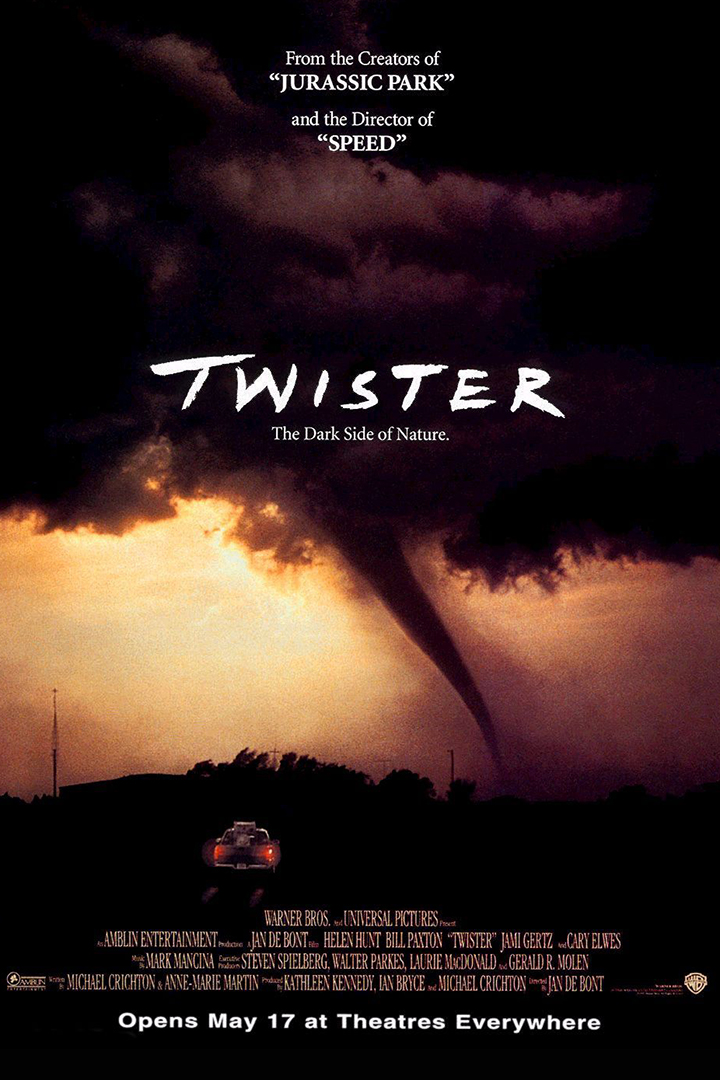
An Industrial Light and Magic proof-of-concept sequence with a truck, tornado and flying tractor tire reportedly initiated the project before the story took shape.
Paxton reportedly lost A Time to Kill to McConaughey.
The film reportedly received sound and visual-effects Oscar nominations.
De Bont’s difficult production reportedly involved crew walkouts, a knocked-over camera assistant, replacement cinematographers and Jack Green injured by a collapsing house before de Bont finished photography.
Schedule overruns reportedly delayed Mad About You; Crichton, Zaillian and Whedon worked on the script, including during filming, yet the visual result appears seamless.
Unexpectedly sunny conditions reportedly prompted intense lighting that temporarily impaired Hunt’s and Paxton’s eyesight.
Hunt reportedly suspected a concussion after a door struck her in the cornfield.
Paxton’s account contrasts being pelted by ice-chip hail with de Bont wearing a helmet nearby.
A 90 million budget and 495 million gross are reported, ranking second among 1996 movies; the transcript mistakenly renders the gross as billion.
De Bont reportedly blamed Hunt’s clumsiness for her concussion.
A missed oil-tanker explosion reportedly required a500,000 reshoot.
A reported accidental Hoffman exposure was edited from later home-video editions; the anecdote was not personally frame-checked.
Meteorology enrollment reportedly rose10percent nationally and doubled at Oklahoma after the film.
Production reportedly bought and demolished older Wakita houses; the low total purchase cost is recalled approximately.
The ditch reportedly required hepatitis shots because of bacteria, adding to the leads’ other injuries.
A tornado reportedly destroyed an Ontario drive-in screen scheduled to show Twister onMay24,1996; Ontario is clarified as Canada.
Paxton reportedly witnessed Kennedy’s final Fort Worth speech at age eight; the transcript incorrectly appends Jr to the president’s name.
Vegetarian de Bont reportedly disliked Meg’s meat-heavy scene.
De Bont reportedly personally recruited Tori Amos for the soundtrack.
Reported state daily tornado records complicate the five-storm objection: Texas66, Oklahoma58, Kansas70 after an Iowa correction, and Iowa34; definitions remain uncertain.
The score is rendered ambiguously as two and F stars; the quoted review praises skillful escapism while calling it dumb, prompting objections that tornado entertainment needs little plot.
The opening childhood-trauma scene is nominated, especially the father holding the shelter door.
Bill seeking divorce signatures and meeting the crew efficiently establishes Dorothy and distinct personalities; Dusty’s immediate familiarity with Melissa defines his energy.
The first chase culminates in sheltering under a bridge and the truck’s sudden fall.
The second tornado’s flying cows impress despite trailer exposure; Melissa watches Bill embrace his ex-wife.
Aunt Meg’s kitchen-table meal is a favorite: food, Jonas mockery, Bill’s past and affection for Meg advance several threads together.
The meal’s F5 explanation ends with the preacher’s finger-of-God line; an overqualified Brian Cox cameo is imagined.
The hailstorm argument turns into Bill’s declaration of lingering love, overheard by Melissa through the walkie-talkie.
The drive-in storm is strongly favored for the lightning reveal behind The Shining screen, sustained destruction and quiet pre-storm atmosphere.
Melissa’s calm breakup is praised as clean, well acted and sensible once she recognizes Bill’s storm obsession.
Dorothy’s launch includes Jonas’s death, driving through a house and fleeing into the cornfield.
The final tornado’s interior view and house-driving spectacle are admired despite disbelief that the leads survive.
The drive-in receives the final choice; the Me Jo love confession is a close second.
The father’s weak lock and decision to hold the doomed door instead of retreating are criticized; dismissing Jo’s grief is challenged because she witnessed his death.
Strapping themselves to a pipe would not plausibly protect the leads from wind and debris; the implement-filled barn also invites questions about its owners.
Dorothy is criticized for spilling easily, lacking remote release and existing in only four copies.
The rapid improvised sensor wings prompt skepticism.
The leads rarely suffer flying-debris injuries across repeated tornado encounters, unlike the scraped-up preacher.
The divorce lacks a satisfying explanation; incompatible paths, storm obsession, drinking or a missing infidelity scene are conjectured.
Five tornadoes in one day seem nationally notable enough to close the drive-in and local businesses.
Prepositioning many Dorothys is proposed; limited money and a need to prove results are offered as an explanation.
Stopping for steak and eggs, showers, blow-dried hair and homemade lemonade seems implausible while storms are so active; another tornado catches the group flat-footed.
Melissa’s home base is guessed as Dallas, Atlanta or Charleston; her tornado ignorance undermines Dallas, while a wealthy country-club family is jokingly imagined.
Dusty is imagined as Melissa’s revenge hookup; Jonas is suggested and rejected.
Bill’s unexpected arrival raises the question of Jo’s displaced regular driver, with Field suggested and Dusty ruled out.
Jo is thought likely to die that day without Bill repeatedly rescuing and redirecting her.
Jonas’s profit motive is questioned; selling warning technology to government is a possible explanation, and an explicit recruitment scene is imagined.
Killing an inner-circle member is rejected as damaging the hangout tone; Preacher is considered the least disruptive option but still unnecessary.
A tsunami is one scariest-disaster choice, while earthquakes are feared for rolling ground and Los Angeles geography.
Tornadoes are feared for unpredictability, but a driving-escape idea is challenged; another earthquake choice emphasizes helplessness.
A returning most-year category offers no internet, the Dodge Ram, Dusty without social-media influence, no Thunder references, the Shining drive-in, actor Todd Field and Hunt’s hair.
No Thunder references is selected; absent Sooners sports chatter prompts season and minicamp jokes.
Hunt’s hair and the Dodge Ram receive separate selections.
Displaying discussions 3949 - 3960 of 7108 in total