
‹ All movies
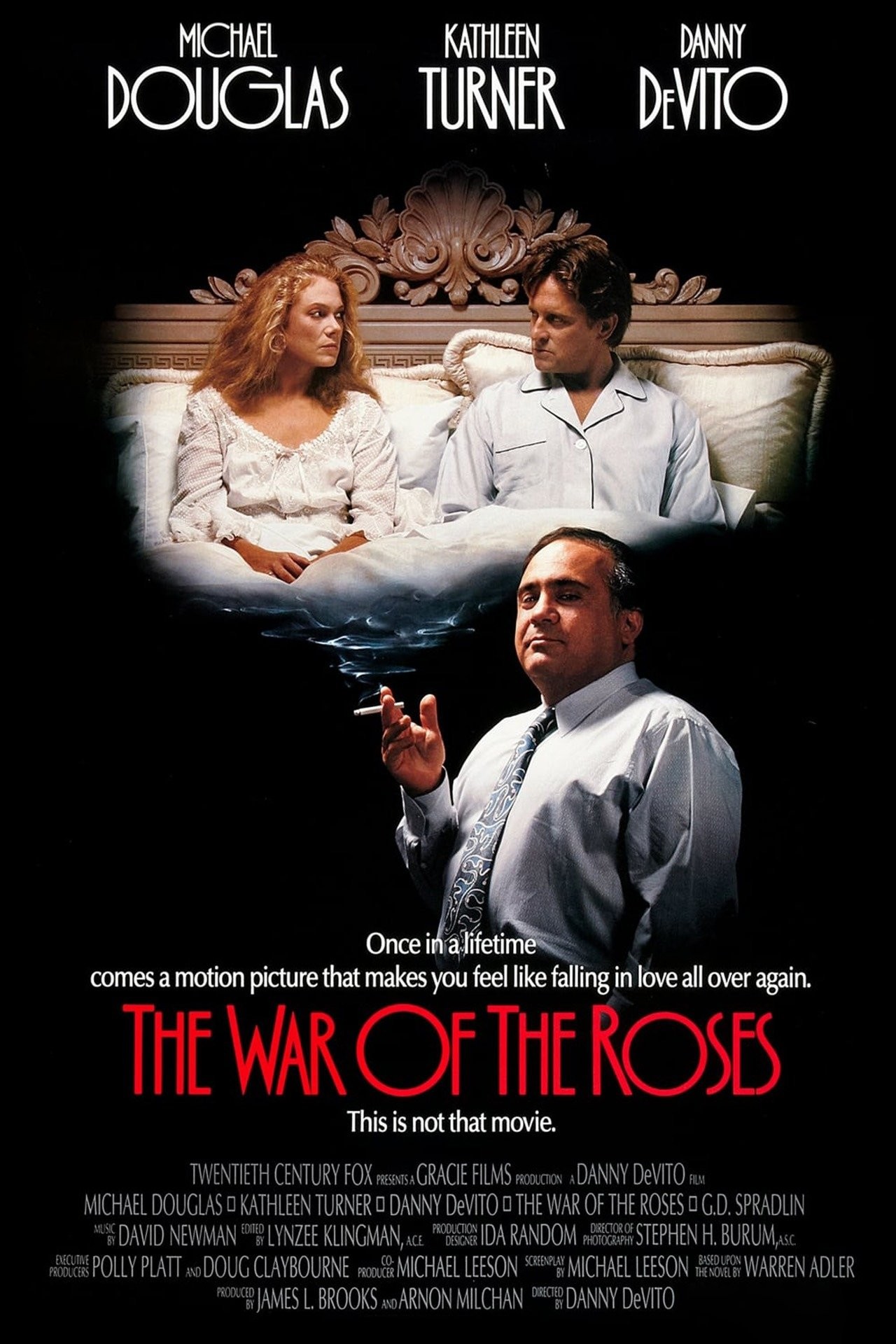
The War of the Roses poster

The War of the Roses

116 minutes

Cast

Selected cast credits · Film reference

Michael Douglas Oliver Rose
Kathleen Turner Barbara Rose
Danny DeVito Gavin D’Amato
Sean Astin Josh at17
Peter Donat Larrabee
Heather Fairfield Carolyn at17
G. D. Spradlin Harry Thurmont
Dan Castellaneta Man in chair
Gloria Cromwell Mrs. Marshall
Harlan Arnold Mr. Dell
Mary Fogarty Mrs. Dell
Peter Brocco Elderly mourner
Philip Perlman Bidder at auction
Susan Isaacs Auctioneer’s assistant
Trenton Teigen Josh at10
Bethany McKinney Carolyn at10
Shirley Mitchell Mrs. DeWitt
Michael Adler Dr. Hillerman
Lisa Howard Nurse2
Jeff Thomas Orderly
Jacqueline Cassell Gavin’s secretary
Vickilyn Reynolds Nancy/Oliver’s secretary
Eunice Suarez Latin woman
Julia Elliott Latin assistant
Tony Crane Teenage boy
Ryan Wickers Josh at3
Shaun Wickers Josh at3
Catherine Donohue Carolyn at3
Mary Donohue Carolyn at3
Sue Palka Anchorwoman
Morris Jones Anchorman
Roy Brocksmith Mr. Fisk
Peter Hansen Mr. Marshall
Prince Hughes Bleeding man
Danitra Vance Manicurist trainee
David Wohl Dr. Gordon

The War of the Roses | The Rewatchables

Explore episodeClose episode

Sequel, Prequel, Limited Series, or All-Black Remake

Technology-era remake; disputed children’s sequel

In the discussion (2)
Approx. transcript time · 00:13:30Read transcript
  • The announced Colman–Cumberbatch remake prompts doubt about believable sexual attraction and chemistry despite admiration for their acting; the original’s ferocious domestic violence may be difficult to reproduce.
  • A contemplated sequel about the children is disputed: the film intentionally excludes their perspective, but their future is intriguing; updated technology and social codes make the remake interesting.

Most Rewatchable Scene

Hospital-letter/divorce sequence; client-dinner destruction

In the discussion (15)
Approx. transcript time · 00:21:40Read transcript
  • The Nantucket courtship is amusingly ridiculous despite false geography and visibly middle-aged college characters; comparisons with de-aging and The Natural emphasize the problem.
  • The first sexual encounter and multi-orgasmic exchange are praised.
  • The first dinner and bedroom debrief expose condescension, embarrassing storytelling and personal attacks; DeVito’s self-directed foot-fetish material is questioned.
  • Barbara discovering the dream house during a funeral and leaving notes on houses are favorites.
  • The nanny hiring interview and insincere liberation speech showcase Turner’s comic sophistication.
  • The snoring/nose attack is a turning point; the earlier gymnastics-related sexual injury is recalled as a medically implausible callback.
  • Oliver’s dramatic hospital-letter reading meets Barbara’s devastating indifference, divorce demand and desire to smash his face; her unambiguous hatred distinguishes the film.
  • Divorce mediation weaponizes the letter and escalates through Oliver’s elaborate insults.
  • Sexual reassurance is refused while the children overhear the argument.
  • The accidental cat death is one personal favorite but provokes horror over the cleanup and grieving dog; intent and indifference are debated.
  • Barbara’s attempted seduction of Gavin and the footstuff reply are praised.
  • The sabotaged client dinner is a favorite, escalating from fake illness and tissue in soup to urinated-on fish and vehicular destruction.
  • The supposed dog pâté, violent escalation and chandelier collapse culminate in Barbara rejecting Oliver’s hand with her last breath.
  • Calculating a housekeeper-equivalent salary is recalled; Oliver reading fire-extinguisher instructions while the tree burns is another favorite.
  • Final choices split between the hospital-letter/divorce sequence and the client dinner escalating into car and figurine destruction.

What’s Aged the Best?

House; Douglas–Turner chemistry; marital irritation; pâté; visual storytelling; revenge; German popularity; disputed framing

In the discussion (12)
Approx. transcript time · 00:37:18Read transcript
  • The house’s attic, balcony, stairs, kitchen and sauna form an effective action-thriller setting.
  • Douglas and Turner’s chemistry and comic rhythm are admired; repeat romantic partnerships are harder to sustain outside the studio era.
  • Every small habit becoming intolerable captures long-term marital irritation.
  • Barbara’s catering career centers specifically on liver pâté; the house turns from dream to nightmare and becomes the single contested object representing everything.
  • Opposite ends of the long dinner table instantly signal mutual hatred.
  • Appliance noise, sauna imprisonment, sawn heels and color-coded house territories show creative revenge, though noisy appliances pose risks to pets.
  • Rapidly chubby children efficiently show neglect; former gymnastics ability becomes a weapon.
  • Gavin’s cynical divorce aphorisms and sinus-sensitive smoking are memorable.
  • The film’s reported German popularity made Rosenkrieg a term for bitter public divorce.
  • The romantic-day/slut line and escalating mutual insults are appreciated; Castellaneta’s silent client role feels odd in hindsight.
  • Sean Astin’s appearance evokes his later Rudy and Samwise roles.
  • Gavin’s framing story is defended as giving the violence a hideous-fable quality.

The Butch’s Girlfriend Award for the Weakest Link in the Film

DeVito framing; pacing; terrazzo floor; silent client

In the discussion (4)
Approx. transcript time · 00:50:13Read transcript
  • DeVito’s framing scenes are considered self-indulgent, overlong and pacing interruptions; another view defends the fable-like distance that softens the cruelty.
  • Preferences split between the unraveling first half and the more violent final act, with the hospital scene the pivotal turn.
  • The foyer’s terrazzo floor is disliked, opening a broader objection to gaudy 1980 sdecor.
  • The unresponsive client is a runner-up.

What’s Aged the Worst?

Young-Douglas wig; pre-cellphone plot; animal cruelty; joint Christmas; foot encounter

In the discussion (6)
Approx. transcript time · 00:56:17Read transcript
  • Young Douglas’s implausible, lighter wig looks cheaply improvised despite the film’s budget.
  • Cellphones would radically change misunderstandings, including the hospital call, and may reshape the remake.
  • Modern home cameras would alter the concealment and household intrusions.
  • Cruelty to the cat and dog is painful even as deliberate evidence that both spouses are monstrous; escape for the pets is wished for.
  • Joint Christmas after separation is considered torturous for children and often unwanted by one parent; Oliver also uses it tactically to regain residence.
  • The foot encounter is considered lame and overlong despite its later payoff; whether it was completed is questioned.

The Stephen A. Smith Hottest Take Award

Gavin’s conspiracy; overrated house; dog should really die

In the discussion (9)
Approx. transcript time · 01:01:42Read transcript
  • Gavin is theorized to engineer the conflict for career advantage; losing the client at the end and his actual advice challenge the conspiracy.
  • The Roses house is said not to rank among twenty desirable movie homes; seventeen initial alternatives and numerous additions are discussed, explicitly unranked despite initial numbering.
  • The dog should truly have become pâté to fulfill the darkness is argued against needing equal culpability and preserving fear over reality; a test-audience insert reportedly established survival, perhaps to protect the fatal ending.
  • Desirable movie-home alternatives: Father of the Bride; Home Alone; The Royal Tenenbaums; Something’s Gotta Give beach house; Parasite
  • Desirable movie-home alternatives: The Thomas Crown Affair 1999 vacation house and brownstone; The Game; The Holiday cottage. Numbering explicitly does not mean ranking; the California Holiday house is criticized.
  • Desirable movie-home alternatives: Call Me by Your Name villa; Phantom Thread townhouse; Cameron’s Ferris Bueller house; Mr. & Mrs. Smith before destruction; Boogie Nights; restored Notebook house; Godfather Part II Lake Tahoe house; Singin’ in the Rain villa
  • Desirable movie-home alternatives: Ex Machina; Saltburn; Downton Abbey; Ordinary People; Amityville Horror. The count is called twenty despite side suggestions.
  • Desirable movie-home alternatives: It’s Complicated; American Gigolo beach house; Wall Street Hamptons house; Tony Stark’s Iron Man mansion; Anatomy of a Fall house; To Gillian on Her 37th Birthday Nantucket house
  • Desirable movie-home alternatives: Fatal Attraction; The Big Chill; Sleeping with the Enemy beach house and later hiding-place house; Unfaithful house and admired apartment; Forrest Gump

The Dion Waiters Award for Best Heat Check Performance

Stabbed patient; Susan; daughter’s boyfriend

In the discussion (2)
Approx. transcript time · 01:11:03Read transcript
  • The stabbed hospital patient is a favorite brief performance.
  • Susan is another choice despite limited material; the daughter’s boyfriend delivering the house-on-fire reply is a separate pick.

Apex Mountain

Danny DeVito; Title 16-904, section C; urinating on fish

In the discussion (7)
Approx. transcript time · 01:16:42Read transcript
  • Douglas is rejected for 1987 and Turner for her mid-1980s peak.
  • The 1960 Morgan Plus 4 is nominated, with uncertain claims that only four of that version existed and one was destroyed.
  • DeVito is affirmed around this film and Twins.
  • Movie/revenge pâté is nominated, but cooking an important person into food is assigned elsewhere through a pie comparison.
  • Divorce movies are rejected in favor of Kramer vs. Kramer; Marriage Story remains a personal favorite.
  • The lawyers-at-the-bottom-of-the-ocean joke is disputed with Philadelphia; marriage-ruining houses lose to The Money Pit.
  • Title 16-904 section C and urinating on fish are affirmed; Sean Astin is rejected.
In the discussion (3)
Approx. transcript time · 01:19:50Read transcript
  • Cruise is initially outvoted 2–1 by Hanks supporters; the debate weighs unlikeability against comedy and the interest of casting Hanks against type.
  • Craig chooses Cruise, citing Hanks’s underlying lovability; Collateral and early Jerry Maguire illustrate the alternative.
  • A recent Jerry Maguire rewatch prompts a Hanks voter to switch to Cruise, making the final result 3–1.
In the discussion (1)
Approx. transcript time · 01:34:20Read transcript
  • Turner narrowly beats Douglas; her absence from the 1989 actress nominees and Pfeiffer’s loss to Tandy are criticized.

The Coach Finstock Award for Best Life Lesson

Heed free advice from an expensive lawyer; avoid drugs and infections; avoid divorce

In the discussion (1)
Approx. transcript time · 01:38:21Read transcript
  • House/car/wife/shoes as measures of a man is qualified; avoid divorce, heed free advice from an expensive lawyer, avoid drugs and sexual infections are alternatives.

Who Won the Movie?

Douglas and Turner together; Turner if forced to choose

In the discussion (1)
Approx. transcript time · 01:38:49Read transcript
  • Douglas and Turner together are favored because their partnership makes the film; forced to pick one, Turner is preferred and agreed with because her part offers more range.
Podcast choices
Speaker not identified
Michael Douglas and Kathleen Turner