
‹ All movies
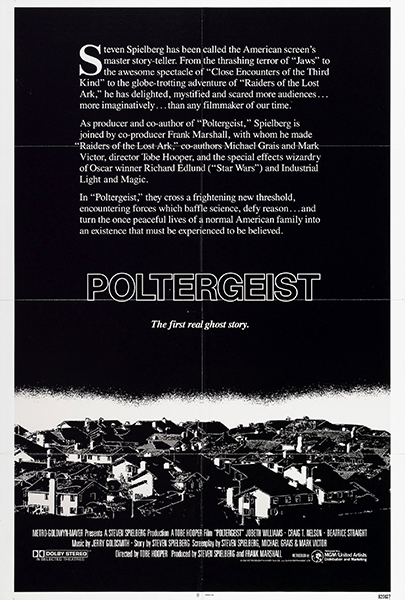
Poltergeist poster

Poltergeist

Cast

Selected cast credits · Film reference

Poltergeist | The Rewatchables

Explore episodeClose episode

Producer credits not yet identified.

Picking Nits

Remove clown; close curtains; stay with family; leave immediately; fear moving chairs

In the discussion (6)
Approx. transcript time · 00:07:19Read transcript
  • Remove the frightening clown from the child’s bedroom.
  • Closing the curtains would hide the frightening tree.
  • The father should remain with his family until he knows the danger has passed.
  • The family should leave immediately instead of spending days packing and sleeping in the house again.
  • Waiting several days after the house is declared clean is again criticized.
  • The family should be alarmed by moving chairs instead of treating the phenomenon as entertainment.


Probably Unanswerable Questions

Clowns; goo; stepmother; Carol Anne; viral footage; trauma; neighborhood; Williams’s career

In the discussion (8)
Approx. transcript time · 00:08:14Read transcript
  • When did clowns become frightening rather than friendly entertainment? John Wayne Gacy is suggested as a turning point.
  • Why is the other side covered in goo, as in Ghostbusters?
  • Is the mother the oldest daughter’s stepmother? Ages and dialogue suggest the possibility without settling it.
  • Was Carol Anne targeted because she was the first baby born in the house?
  • How many online views would real footage of the spirits descending the stairs receive?
  • Are all the kids damaged for life after these events?
  • Would the entire neighborhood leave after the house collapses, and would the developer’s company close?
  • Should Williams have become a bigger star? Her strong work is weighed against a crowded field of contemporary actresses.

Half-Assed Internet Research

Production debate; casting careers; curse lore; budget; football footage

In the discussion (22)
Approx. transcript time · 00:14:59Read transcript
  • The discussion places Poltergeist alongside Raiders of the Lost Ark and E.T. in Spielberg’s early-1980s dominance.
  • The project is described as growing from Night Skies, with Spielberg’s E.T. commitments preventing him from directing.
  • Spielberg’s visual fingerprints feed the disputed account that he effectively took over directing.
  • The discussion recounts Directors Guild involvement, a fine and Spielberg’s public letter praising Hooper.
  • Frank Marshall is quoted crediting Spielberg’s storyboards and near-daily presence while identifying Hooper as the on-set director.
  • Zelda Rubinstein is reported to have said Spielberg directed all six days she worked.
  • The film is said to have lost its effects, sound-effects and score Oscar nominations to E.T.
  • JoBeth Williams’s career is traced through Kramer vs. Kramer, Stir Crazy, The Big Chill and major television films; she is praised as this film’s driving force.
  • Craig T. Nelson’s long career is surveyed from film roles through Coach, Parenthood and The Incredibles.
  • The curse discussion recounts Dominique Dunne’s murder by her boyfriend and its connection to her father’s later reporting.
  • Heather O’Rourke’s death at twelve during the third film’s production is discussed as part of the curse lore.
  • Lou Perriman’s murder and other deaths are cited in the curse discussion, with a documentary series suggested for further context.
  • Williams is reported to have found pictures repeatedly crooked at home during production.
  • Rubinstein’s reported vision of her dog before learning of its death is presented as another strange anecdote.
  • The clown apparatus is reported to have malfunctioned and actually choked the child actor before the crew intervened.
  • The film’s roughly $10.7 million budget and strong 1982 box office are cited; the transcript garbles the gross.
  • Richard Lawson’s family connections and earlier acting work are discussed.
  • Spielberg’s childhood fear of clowns and a tree outside his window is said to have inspired the movie.
  • The house is said to remain in Simi Valley, California.
  • The televised Rams–Saints game is identified as a 1980 Monday Night Football game, with the Saints losing and Archie Manning struggling.
  • A late-nineteenth-century Denver cemetery incident is cited as an inspiration, correcting an initial garbled date.
  • The collapsing house is said to have been a roughly four-foot model.

Roger Ebert's review

In the discussion (1)
Approx. transcript time · 00:35:12Read transcript
  • Ebert gave three stars and praised the focus on the family’s experience rather than effects alone.

Most Rewatchable Scene

Final escalation and escape

In the discussion (11)
Approx. transcript time · 00:36:12Read transcript
  • The opening follows the dog through the family’s rooms before Carol Anne watches television.
  • Carol Anne’s second television encounter builds to the smoky hand and “They’re here.”
  • The stacked kitchen chairs retain a sense of innocent wonder before the haunting becomes threatening.
  • The tree attacks Robbie while Carol Anne disappears; earlier bedroom details prepare the later threats.
  • Dr. Lesh explains why some spirits resist entering the light.
  • The haunting escalates against the paranormal crew through the steak, maggots, face-ripping vision and headphone-wearing observer.
  • Tangina explains Carol Anne’s role and the Beast; the speech is important without being the speaker’s top scene.
  • The instructions about the light lead into the mother entering the portal and rescuing Carol Anne.
  • The final renewed attack includes the clown, the mother on the wall, the skeleton-filled pool and the family’s escape.
  • The mother climbing the wall anchors the exhilarating final escalation with the father and other protection absent.
  • Both agree on the final escalation as the most rewatchable sequence.

What’s Aged the Worst?

Catcalling; TV snow; effects; haunting terminology; family naïveté; sequels; remote; edit; remake; pan-and-scan

In the discussion (10)
Approx. transcript time · 00:37:04Read transcript
  • Television snow and stations going off air are less familiar in the cable era.
  • Construction workers catcalling the teenage daughter, and her mother laughing, have aged badly.
  • The face-melting effects look dated, although that is expected from an older film.
  • The distinction between a poltergeist and a haunting is challenged because multiple dead people appear to be haunting the development.
  • The family lacks later haunted-house movies as a reference for recognizing the danger.
  • The second and third films are disliked or barely remembered.
  • Using a remote to change a neighbor’s television no longer feels possible.
  • An abrupt edit after the chair-sliding scene is attributed to removing a Pizza Hut joke after the company objected.
  • The 2015 remake is rejected as unnecessary.
  • Pan-and-scan cable presentations harmed the film’s composition and rewatchability compared with widescreen.
In the discussion (6)
Approx. transcript time · 00:51:30Read transcript
  • Television snow is nominated as a period detail.
  • Calvin Klein jeans are another period detail.
  • Large Sony televisions with side dials are nominated.
  • The child’s Clue board game is nominated.
  • Gene Shalit appearing on television is nominated.
  • The Atari 2600 atop the television is the stated winner.

What’s Aged the Best?

Window fear; evil developer; family ghost films; title; family setup; marijuana; Spielberg’s reassurance; DirecTV parody

In the discussion (8)
Approx. transcript time · 00:52:39Read transcript
  • Fear of something outside the bedroom window remains timeless.
  • The callous developer fits a memorable era of evil businessman characters.
  • Family ghost films returned and expanded into a major genre.
  • The word poltergeist is praised as an effective name for a noisy ghost.
  • The opening establishes an ordinary three-child family before the supernatural events begin.
  • Smoking weed in bed while the parents hang out has aged well.
  • Spielberg is reported to have joined Williams in the skeleton pool to reassure her.
  • A 2008 DirecTV parody with Nelson and Carol Anne prompts nostalgia.

The most GIFable moment

Carol Anne at the TV; face-ripping vision

In the discussion (2)
Approx. transcript time · 00:58:19Read transcript
  • Carol Anne at the television and her “They’re here” turn are nominated.
  • The grotesque face-ripping image is another GIF candidate.

The Great Shot Gordo Award for Most Cinematic Shot

Skeletons in the pool; graves reveal

In the discussion (2)
Approx. transcript time · 00:58:36Read transcript
  • Skeletons rising in the pool are the main cinematic-shot choice.
  • The reveal of graves beneath the planned development is also praised for explaining the haunting.

The Stephen A. Smith Hottest Take Award

Rubinstein’s acting questioned; stronger-actress alternatives; ghost-world racial dynamics

In the discussion (8)
Approx. transcript time · 01:06:08Read transcript
  • Rubinstein may look perfectly cast as a medium while giving an unconvincing acting performance.
  • The response defends the importance of looking like someone who could contact another world.
  • Sally Field with unusual makeup is proposed as an alternative medium.
  • Shirley MacLaine is proposed as a potentially stronger medium.
  • Viola Davis is imagined commanding the room as the medium.
  • Meryl Streep is another imagined medium, with an objection that the role may be too small.
  • A comic theory imagines reversed racial power dynamics in the ghost world to explain why these ghosts target white families.
  • A counterargument attributes the shortage of Black ghost stories to limited opportunities and investment for Black filmmakers.

Casting What-Ifs

King; Spano; unverified MacLaine rumor; Barrymore

In the discussion (4)
Approx. transcript time · 01:10:11Read transcript
  • Spielberg is reported to have asked Stephen King to co-write the screenplay, but King declined.
  • Joe Spano is said to have been wanted for the father but unable to leave his television contract.
  • An online claim that Shirley MacLaine declined a role is explicitly unverified.
  • Drew Barrymore was considered for Carol Anne before being placed in E.T., which is judged the better career outcome.

Van Lathan Award for Did This Movie Need More Black People?

Lawson appreciated; developer and doctor alternatives debated

In the discussion (3)
Approx. transcript time · 01:11:10Read transcript
  • Richard Lawson’s presence is appreciated, with surprise that his character remains in the haunted house.
  • The evil businessman knocking down headstones could have been Black; the reply jokes that this would not happen.
  • The doctor is suggested as another role that could have been played by a Black actor; the response ultimately expresses satisfaction with Lawson.

Recasting Couch

Gosselaar; Schroder; Lawrence as the brother

In the discussion (3)
Approx. transcript time · 01:13:06Read transcript
  • Mark-Paul Gosselaar is proposed to replace the little brother.
  • Ricky Schroder is proposed and enthusiastically supported.
  • Joey Lawrence is another proposed replacement for the brother.

Apex Mountain

Spielberg; Williams; bedroom clowns; closet portals; family ghost films; cursed productions; haunted-house escape

In the discussion (10)
Approx. transcript time · 01:17:30Read transcript
  • Spielberg is proposed on the strength of Raiders, E.T. and Poltergeist.
  • Spielberg had the juice to do whatever he wanted after this week.
  • Craig T. Nelson is considered and rejected.
  • JoBeth Williams is affirmed.
  • Creepy bedroom clowns are affirmed.
  • Closet portals are affirmed.
  • Family ghost movies are affirmed.
  • Supposedly cursed real-life productions are affirmed.
  • Hooper is rejected in favor of The Texas Chain Saw Massacre.
  • Frantic haunted-house escapes are compared with The Amityville Horror, before this film’s escape is favored.

Cruise or Hanks?

Hanks, after initial Cruise preference

In the discussion (1)
Approx. transcript time · 01:19:15Read transcript
  • Cruise is initially chosen to explore him in horror, but the discussion settles on Hanks as the everyday father; another Hanks response follows.

Sequel, Prequel, Limited Series, or All-Black Remake

All-Black cast; limited series across haunted houses

In the discussion (2)
Approx. transcript time · 01:21:32Read transcript
  • An all-Black cast is suggested as the natural remake approach, while the actual remake is still rejected.
  • A five- or six-episode prestige series might work, potentially following different houses over the graves.

Just One Oscar

Visual effects; screenplay

In the discussion (1)
Approx. transcript time · 01:22:43Read transcript
  • Visual effects and screenplay are the two stated Oscar choices.

Who Won the Movie?

JoBeth Williams; Spielberg also considered

In the discussion (2)
Approx. transcript time · 01:27:24Read transcript
  • Ghost movies are initially credited, followed by JoBeth Williams as the individual choice.
  • Spielberg or Williams are considered; the discussion emphasizes Williams carrying the film while Spielberg received most of the credit.
Podcast choices
Speaker not identified
JoBeth Williams

More from the conversation

Van Lathan joins for Scary Month; the opening also discusses Agatha All Along and The Penguin.
Approx. transcript time · 00:01:59Read transcript
Poltergeist was selected for its large cultural footprint, including the lore surrounding its production.
Approx. transcript time · 00:02:55Read transcript
Late-1970s and early-1980s horror repeatedly makes familiar people, homes and enclosed spaces frightening.
Approx. transcript time · 00:03:38Read transcript
Poltergeist and A Nightmare on Elm Street made unavoidable everyday experiences—home and sleep—feel dangerous.
Approx. transcript time · 00:04:34Read transcript
The family initially treats moving chairs as exciting because it lacks later haunted-house movies as a warning system.
Approx. transcript time · 00:05:34Read transcript
Darth Vader imagery adds threatening details to a supposedly safe bedroom.
Approx. transcript time · 00:07:38Read transcript
The decade’s religious atmosphere is connected to horror about invisible forces and the afterlife.
Approx. transcript time · 00:08:46Read transcript
The era’s films trap people in homes, isolated places or situations they cannot control.
Approx. transcript time · 00:09:47Read transcript
The Entity’s repeated sexual assaults by a spirit are considered exceptionally disturbing and difficult to remake.
Approx. transcript time · 00:10:28Read transcript
A Nightmare on Elm Street is described as a shift toward mainstream pop-culture horror while retaining moral ambiguity.
Approx. transcript time · 00:11:08Read transcript
The ghosts can be read as victims whose resting place has been disturbed.
Approx. transcript time · 00:11:38Read transcript
The discussion catalogs fears of hidden threats, altered loved ones and becoming something inhuman oneself.
Approx. transcript time · 00:12:11Read transcript
The Fright Night remake is defended as underrated for its threatening-neighbor premise.
Approx. transcript time · 00:13:21Read transcript
An American Werewolf in London is added to the era’s important horror films.
Approx. transcript time · 00:13:38Read transcript
A haunted home undermines hope and roots; the father’s work selling the development strengthens his initial faith in it.
Approx. transcript time · 00:13:51Read transcript
The family, suburban setting, supernatural children and persistent hope make the film feel Spielberg-like.
Approx. transcript time · 00:18:05Read transcript
A reported conversation with a spouse concludes she would enter the portal while he held the rope; household responsibilities become the joke.
Approx. transcript time · 00:18:58Read transcript
A claim that Nelson should have played more villains is revised after several villain roles are recalled.
Approx. transcript time · 00:21:31Read transcript
The internet is said to have weakened urban legends while amplifying conspiracy theories; the supposed curse sits between these ideas.
Approx. transcript time · 00:24:59Read transcript
The discussion questions whether curse stories became marketing, while noting some events happened after release.
Approx. transcript time · 00:26:12Read transcript
A future Super Bowl poster and the timing of O’Rourke’s death are noted as a coincidence in the curse lore.
Approx. transcript time · 00:26:53Read transcript
The television’s channel number and O’Rourke’s age at death are linked as another eerie coincidence; the curse became television-documentary material.
Approx. transcript time · 00:27:36Read transcript
Room 237 illustrates how viewers impose competing conspiracy interpretations on a film; the same tendency is applied to Poltergeist.
Approx. transcript time · 00:28:27Read transcript
An explicitly speculative conspiracy tangent alleges a music executive benefited from a rapper’s death; this is an unsupported personal theory, not an established account.
Approx. transcript time · 00:29:19Read transcript
The tangent debates competing JFK-assassination conspiracy beliefs without resolving them.
Approx. transcript time · 00:30:54Read transcript
Sasquatch and Loch Ness creatures are entertained as possible undiscovered animals, contrasted with documented deep-sea life.
Approx. transcript time · 00:31:30Read transcript
A disputed theory treats Michael Jordan’s baseball hiatus as a secret suspension; the opposing view questions why a commissioner would conceal the punishment.
Approx. transcript time · 00:32:32Read transcript
The conversation returns to the movie after recommending Room 237.
Approx. transcript time · 00:34:43Read transcript
The mother’s upbeat response makes her seem like an appealing partner even amid the strange events.
Approx. transcript time · 00:39:26Read transcript
Childhood memories compare the frightening tree with Amityville’s recurring time and Nightmare’s unnoticed slips into sleep.
Approx. transcript time · 00:40:30Read transcript
A reported childhood trip to The Shining with a parent is jokingly described as inappropriate.
Approx. transcript time · 00:41:59Read transcript
The speech prompts belief in lingering spirits and an observation that people who report ghost experiences take them seriously.
Approx. transcript time · 00:43:17Read transcript
Tangina’s mistaken clean-house declaration prompts a basketball comparison between a capable medium and an elite one.
Approx. transcript time · 00:47:04Read transcript
An Eddie Murphy haunted-house routine is invoked to support leaving immediately.
Approx. transcript time · 00:49:28Read transcript
The Atari sighting prompts memories of Intellivision and its sports games.
Approx. transcript time · 00:52:16Read transcript
A question about a Black family equivalent prompts discussion of Death by Temptation.
Approx. transcript time · 00:53:29Read transcript
Def by Temptation is recommended for its succubus story and frightening television sequence; it is said to appear on an upcoming Black horror top-ten list, whose full rankings are not supplied.
Approx. transcript time · 00:54:15Read transcript
The deleted joke prompts nostalgia for Pizza Hut restaurants and regional pizza chains.
Approx. transcript time · 01:02:55Read transcript
A horror-remake discussion defends When a Stranger Calls as better than its original and rejects the Rob Zombie Halloween films.
Approx. transcript time · 01:03:54Read transcript
The expansion of Black science fiction and horror is welcomed; The Blackening is praised, with a less enthusiastic airplane viewing response.
Approx. transcript time · 01:09:37Read transcript
Ghost-hunting interest among Black people is contrasted with the 1980s, with Ernie Hudson cited alongside Lawson.
Approx. transcript time · 01:12:04Read transcript
A reported visit to the Menendez house prompts discussion of streaming documentaries reviving old true-crime stories.
Approx. transcript time · 01:15:11Read transcript
Looking up the Saints’ season leads to watching their narrow win over the Jets and celebration at avoiding a winless year.
Approx. transcript time · 01:16:30Read transcript
Archie Manning’s difficult career is jokingly imagined as a bargain for his descendants’ football success.
Approx. transcript time · 01:16:55Read transcript
Putting the television outside at the end provides a final reassuring laugh.
Approx. transcript time · 01:19:00Read transcript
A comic imagined conversation gives the ghosts escalating frustration at the family’s lack of fear.
Approx. transcript time · 01:20:42Read transcript
A first-time viewer finds the family warmth and dated effects make the horror approachable, like a theme-park ride.
Approx. transcript time · 01:28:41Read transcript
A question about whether the effects were impressive in 1982 receives a clear affirmative response.
Approx. transcript time · 01:28:54Read transcript
The closing discussion again reads Spielberg’s influence in the camera movement and prominent production credit.
Approx. transcript time · 01:29:40Read transcript
The maternal connection and family dynamics make the mother entering the portal feel right.
Approx. transcript time · 01:30:21Read transcript
The ghosts are treated sympathetically as having a grievance, while the developer is the real villain; a sequel is said to complicate that reading.
Approx. transcript time · 01:31:01Read transcript
The closing explicitly continues Scary Month, with three more October films planned.
Approx. transcript time · 01:31:33Read transcript
The longer running time is defended for patient family setup and quiet suspense, despite a general preference for short movies.
Approx. transcript time · 01:31:46Read transcript
Night Shift is remembered as an especially brisk earlier selection; Van Lathan and Craig are thanked.
Approx. transcript time · 01:32:17Read transcript