
‹ All movies
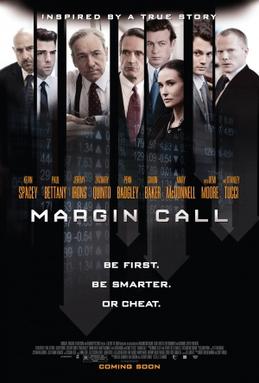
Margin Call poster

Margin Call

105 minutes

Cast

Selected cast credits · Film reference

Kevin Spacey Sam Rogers
Paul Bettany Will Emerson
Jeremy Irons John Tuld
Zachary Quinto Peter Sullivan
Penn Badgley Seth Bregman
Simon Baker Jared Cohen
Mary McDonnell Mary Rogers
Demi Moore Sarah Robertson
Stanley Tucci Eric Dale
Aasif Mandvi Ramesh Shah
Ashley Williams Heather Burke
Susan Blackwell Lauren Bratberg
Maria Dizzia Executive Assistant
Jimmy Palumbo Security Guard
Al Sapienza Louis Carmello
Peter Y. Kim Timothy Singh

Margin Call | The Rewatchables

Explore episodeClose episode

What’s Aged the Best?

Ensemble; cyclical crises; fast dialogue; moral complexity; overnight setting; custodian; Moore; Quinto; cigarette acting

In the discussion (20)
Approx. transcript time · 00:04:23Read transcript
  • The film makes smart, attractive people’s conscious moral abandonment legible while remaining funny; its psychological portrait is preferred to The Big Short’s film version.
  • Bettany’s Will is charismatic, funny and unusually honest about the game he is playing; the performance is called career-best.
  • The ensemble has no weak performance, including Moore’s understated, experienced corporate operator; replacing an actor seems difficult.
  • John’s list of recurring crises captures finance’s cyclical nature, compared with new NBA owners making predictable splashy trades.
  • The script refuses to talk down to viewers, allowing its speed and unexplained detail to require a second viewing; that confidence is described as inspiring for Billions.
  • The film plays as a crime thriller without a prosecutable crime or visible assault, murder or drug use, distinguishing its moral criminality from its legal conduct.
  • Quinto makes intelligence, conflict and loyalty visible; repeatedly crediting Dale’s work complicates his role as the person whose discovery triggers the destruction.
  • Shutting off Dale’s phone is a small, realistic mechanism that lets him disappear without a contrived plot device.
  • Moore’s effective supporting work is welcomed as a former major star delivering a restrained late-career appearance.
  • John’s child-or-golden-retriever request remains a sharp illustration of powerful people pretending they lack brains.
  • The sad financial-district strip-club atmosphere feels accurate to the disappointment of such places.
  • The crisis produced an impressive body of books, films, articles and documentaries, even though the event itself was disastrous.
  • The overnight setting makes enormous decisions while everyone else sleeps into a metaphor for an unaware public about to be harmed.
  • The custodian trapped between Baker and Moore in the elevator makes class separation visible through his effort to remain unnoticed.
  • Moore’s character gains nuance through her prior warning to John and the humane final exchange with Dale; she tried to intervene but would be crushed too.
  • Goldman’s share-price recovery is offered as an ironic aged-best choice, with the bank’s legal defenses and the discussion’s own limited expertise acknowledged.
  • Badgley’s later success in You makes his presence notable, though its creepy role can be difficult to separate from the actor.
  • Quinto gains credibility beyond Heroes and Spock through an intelligent performance that makes him an appealing potential collaborator.
  • Irons’s accent, physical manner and distinctive presence confer authority, compared with the deference given English television judges.
  • Spacey’s character-specific cigarette handling is admired, contrasting Sam’s ritual with Verbal Kint’s unusual grip.

Most Rewatchable Scene

Bettany on the balcony; John’s conference-room entrance; trading-day selloff

In the discussion (22)
Approx. transcript time · 00:06:40Read transcript
  • Questions about whether Tucci’s house is paid off and Will’s final nice-house remark expose the financial leverage that makes everyone capitulate.
  • Baker shaving while Seth learns he is being fired is chilling: once the decision is made, sympathy becomes wasted effort and the dismissed employee no longer exists to him.
  • Irons’s entrance and simple-explanation request are a favorite: the film delays exposition until its most powerful figure can demand clarity, having already decided to sell.
  • Irons’s claim not to be the smartest is interpreted as a deliberate power move, reinforced by his helicopter arrival and immaculate appearance.
  • Quinto praising Sam’s son as nice exposes Sam’s damaged values: he responds as though niceness were a defect and has barely considered his son across town.
  • Sam instantly switching from despair about the reduced staff to clapping out an encouraging entrance is praised as a revealing acting choice: principles yield immediately to making money.
  • John dining alone above the city after the bell, already feeling better about the destruction, makes the finale darkly comic; his steak becomes a carnivore’s reward after a mission.
  • Dale’s layoff, the warning accompanying the drive and Bettany’s ambiguous shoulder slap form a strong opening sequence; the slap seems both friendly and hostile.
  • Bettany explaining the model to Sam lets Spacey register the disaster gradually, from questioning the figure to demanding Dale and the young analyst back.
  • The balcony scene is proposed as Bettany’s career-best, with the distinction between fearing a fall and fearing that one might jump.
  • Will’s spending breakdown makes enormous income vanish through taxes, mortgage, parental support, car, restaurants, clothes, savings and $76,520 on hookers, booze and dancers.
  • Will’s spending speech inspires the younger men instead of producing the resentment such boasting generated in the radio-work anecdote.
  • The strip-club conversation converts even the dancer into an income question, showing how completely the men frame experience financially.
  • The later Tucci–Bettany exchange is independently nominated among the rewatchable scenes.
  • John’s first meeting combines the odorous-excrement warning with the music-stopping speech, explaining that he is paid to anticipate the silence.
  • The first John–Sam confrontation balances resistance against the risk of insulting a superior, letting two major actors face off without easy defiance.
  • Their second confrontation turns on John’s claim that being first out the door is not panicking; the proposition is challenged rather than universally accepted.
  • Sam trying to quit leads to John’s long defense of the system that enables houses, cars and unaffordable lifestyles.
  • The stoop conversation gives Dale a glimpse of his alternative life and Tucci room to express a poetic humanity; Will’s house remark completes a carefully planted financial trap.
  • The layoff scene’s HR hand gestures, security guard and sailboat retirement-guide cover turn apparent warmth into institutional coldness; the details are praised even by someone not calling it a rewatchable favorite.
  • The balcony and first Irons conference-room scene emerge as final favorites, with the conference-room choice emphasizing shifting group dynamics.
  • Will selling positions across a trading day is another favorite: the camera follows the room, calls and prices, ending with approval of a $131 million loss at sixty-five cents.

What’s Aged the Worst?

Spacey’s offscreen baggage; The Big Short overshadowing the film

In the discussion (3)
Approx. transcript time · 01:01:36Read transcript
  • Spacey’s offscreen baggage makes the first stretch uncomfortable, even though the performance eventually absorbs attention and includes an unusual softness.
  • The Big Short’s success may have taken attention away from this film and limited its broader cable-rewatching profile.
  • The Big Short’s larger-budget montage more forcefully conveys the public’s ignorance of looming disaster than the nighttime drive here, though the comparison is acknowledged as unfair.

Is There a Better Title for This Movie?

Sell, Sell, Sell; Pigs; Biggest Bag of Odorous Excrement

In the discussion (4)
Approx. transcript time · 01:04:56Read transcript
  • Pigs is proposed as a more aggressively anti-bank title that might attract curiosity.
  • Biggest Bag of Odorous Excrement is another joking title alternative.
  • Margin Call is criticized as obscure and not central enough, though a finance writer finds it acceptable.
  • Sell, Sell, Sell is proposed and praised as a more immediate account of the characters and story.

The Stephen A. Smith Hottest Take Award

Better than The Big Short; top ten of fifteen years; Moore as leader in a 2022 version (disputed)

In the discussion (3)
Approx. transcript time · 01:07:03Read transcript
  • Margin Call is preferred to The Big Short as more satisfying and rewatchable, with explicit agreement.
  • The film is called one of the ten best movies of the preceding fifteen years, without a ranked list of other films.
  • A 2022 version might make Moore the leader instead of the lone female scapegoat; that prediction is challenged on period accuracy and changing contemporary expectations.
In the discussion (6)
Approx. transcript time · 01:16:16Read transcript
  • Quinto is an affirmative candidate because producing and starring with this ensemble appeared to move him to another level, with Spock offered as an alternative career marker.
  • Bettany is proposed for charismatic leading-man impact, then challenged by A Beautiful Mind and the broader reach of the Avengers franchise.
  • Wall Street movies are rejected as an Apex here, without a settled replacement.
  • Irons’s earlier Oscar and television work weigh against an Apex here.
  • Baker is also rejected as an Apex choice.
  • Chandor receives the strongest affirmative choice: the short writing and shooting process made him an A-list director whose next project could be greenlit.

Sequel, Prequel, Limited Series, or All-Black Remake

Thirteen-hour series; one-year-later recovery; mortgage-securitization prequel

In the discussion (3)
Approx. transcript time · 01:21:28Read transcript
  • A thirteen-episode, thirteen-hour version modeled on 24 is considered intriguing, possibly for Apple, though the initial preference is to leave the film untouched.
  • A sequel series one year later could follow John rebuilding relationships and the bank’s recovery despite its betrayal.
  • A mortgage-approval prequel sounds dull, but the counterproposal follows the people who discover how bundling bad mortgages changes their ratings and marketability.
In the discussion (2)
Approx. transcript time · 01:29:44Read transcript
  • Chandor receives a final winner choice and separate agreement for executing a sleek film with little money or time; Irons is offered as runner-up.
  • The third final choice also favors Chandor over a possible Irons case, praising the difficult, nonformulaic structure and unhappy version of success.
Podcast choices
Speaker not identified
J.C. Chandor
Speaker not identified
J.C. Chandor
Speaker not identified
J.C. Chandor