

‹ All movies
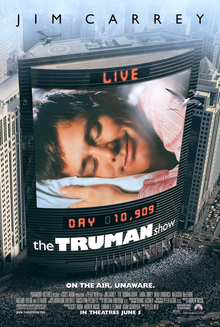
The Truman Show poster

The Truman Show

103 minutes

Cast

Selected cast credits · Film reference

Jim Carrey Truman Burbank
Blair Slater young Truman
Ed Harris Christof
Laura Linney Hannah Gill
Noah Emmerich Louis Coltrane
Natascha McElhone Lauren/Sylvia; Sylvia met Truman while playing Lauren, Truman's college schoolmate
Holland Taylor Truman's mother, as portrayed by an in-universe actress
Brian Delate Truman's father, as portrayed by an in-universe actor
Paul Giamatti Simeon
Una Damon Chloe, Christof's control room assistant
Philip Baker Hall network executive
John Pleshette network executive
Peter Krause Truman's boss, as portrayed by an in-universe actor
Heidi Schanz Vivien
Harry Shearer Mike Michaelson

The Truman Show | The Rewatchables

Explore episodeClose episode

Most Rewatchable Scene

Opening interview; Lauren flashback; Truman discovers the set; escape attempts; reunion; sailboat; final exit.

In the discussion (12)
Approx. transcript time · 00:38:03Read transcript
  • Christof’s opening interview and its claim that the constructed show is real are nominated.
  • Truman’s high-school memory of Lauren is nominated for her affectionate look and lasting presence.
  • The car radio frequency, hospital, Fiji ticket, makeup bib, and broken bus are nominated.
  • Truman finally driving across the water during the escape attempt is nominated.
  • Meryl’s product pitch and Truman confronting her are nominated.
  • Marlon’s heart-to-heart is praised, alongside the reveal that Christof supplies his lines.
  • Truman crying when he sees his father is read either as reunion emotion or realizing his whole life is false.
  • The basement escape and sailboat confrontation are nominated.
  • The score during the sailboat confrontation is singled out for praise.
  • The boat reaching the wall and Truman’s final goodbye are nominated as an iconic ending.
  • Truman progressively recognizing the set is selected as the most rewatchable sequence.
  • The discovery sequence uses triumphant music rather than paranoid tension, encouraging the audience to root for Truman.

What’s Aged the Best?

Adult actors in school flashbacks; product placement satire; poster; ending; screenplay rhythm; media prophecy.

In the discussion (7)
Approx. transcript time · 00:44:02Read transcript
  • The adult cast convincingly playing their younger selves is praised.
  • The product-placement economy and branded recap culture are praised as predictive, while the placements are also called too obvious.
  • The absence of cats in Seahaven is jokingly selected, with a control-room cat noted as a correction.
  • Rob Silverman’s mosaic poster is praised.
  • The ending creates a laugh-cry response: sadness that the show ends and happiness for Truman.
  • The screenplay is praised for a major discovery at roughly ten-minute intervals.
  • The altered T. Rex song is praised as world-building for Truman’s controlled culture.

The Neil McCauley “A Book about Metals” Award for Best Line from the Movie

The line that no camera was ever inside Truman’s head is selected; the control-room exchange about never showing intimacy is another favorite.

Flex pick · Chris Ryan

In the discussion (2)
Approx. transcript time · 00:54:23Read transcript
  • The line that no camera was ever inside Truman’s head is selected for placing a limit on surveillance. Chris Ryan
  • The control-room exchange explaining that the show never depicts the couple’s intimacy is another favorite.

Did This Movie Need a Random Sports Scene?

The panel imagines a fake baseball or lacrosse world and the production staff required to sustain its sports news.

In the discussion (2)
Approx. transcript time · 00:55:32Read transcript
  • A Double-A baseball scene is proposed, prompting questions about whether Truman receives fake scores and sports pages.
  • Lacrosse is suggested because helmets would conceal the invented players.

The Butch’s Girlfriend Award for the Weakest Link in the Film

The father storyline; Marlon’s thin characterization; limited outside-world development.

In the discussion (4)
Approx. transcript time · 00:57:05Read transcript
  • The father plot is criticized as underdeveloped and potentially better with a wider casting search.
  • Another participant says the film has no clear weak link but agrees the father material is least convincing.
  • The friend is called one-dimensional, though deleted scenes may have shown him trying to help Truman.
  • The limited depiction of the commercial and social world outside Seahaven is raised as a missed opportunity.

What’s Aged the Worst?

Matt Gaetz’s childhood home as Truman’s house; surveillance ethics left largely unexamined.

In the discussion (2)
Approx. transcript time · 01:01:48Read transcript
  • The Florida residence used for Truman’s house is reported as Matt Gates’s childhood home.
  • The premise’s coercive surveillance and the audience’s complicity are criticized.

Casting What-Ifs

Jim Carrey took a discount; Samuel L. Jackson was discussed; alternate directors and leads considered.

In the discussion (3)
Approx. transcript time · 01:12:01Read transcript
  • Jim Carrey’s quick acceptance and reduced fee are discussed.
  • Samuel L. Jackson is mentioned as someone considered, but the panel doubts the fit.
  • The film’s development through other directors and possible stars is discussed as casting history.

Picking Nits

Production logistics; Christof’s plan; Truman’s calm reaction; private bodily life; no visible second shift.

In the discussion (6)
Approx. transcript time · 01:22:21Read transcript
  • The panel questions 1981 camera quality, permanent jobs for the actors, and the enormous cost of sustaining the show.
  • The plan if Truman simply agrees to stay is questioned because the show remains enormously expensive.
  • Whether Christof meant to kill Truman or only traumatize him into returning is debated.
  • Truman’s calm reaction after his boat strikes a wall is criticized; the speaker says they would lose their mind.
  • The panel questions how the show handles sex, masturbation, and bathroom use when Truman does not know he is filmed.
  • The control room never showing an overnight shift is criticized.

Sequel, Prequel, Limited Series, or All-Black Remake

Mostly untouchable; alternatively prestige television or a sequel about Truman rescuing his child.

In the discussion (2)
Approx. transcript time · 01:27:34Read transcript
  • A prequel is rejected and prestige television is considered possible.
  • A sequel in which Truman must re-enter the dome to rescue a child born there is proposed and endorsed.

Is This Movie Better With…?

Jon Bernthal as the policeman; a sports-talk ecosystem around Truman.

In the discussion (2)
Approx. transcript time · 01:28:21Read transcript
  • Jon Bernthal is proposed in the police role, prompting an imagined Wayne Jenkins speech.
  • The panel proposes sports-style debate shows analyzing Truman’s life to deepen the outside world.

Just One Oscar

Peter Weir; alternatively Andrew Niccol.

In the discussion (2)
Approx. transcript time · 01:31:21Read transcript
  • Weir is selected because the movie is well crafted, filmed ahead of its time, and feels years newer than 1998.
  • Andrew Nicol is proposed for the original screenplay and the many rewrites that transformed it.

Probably Unanswerable Questions

Was Christof evil?

In the discussion (3)
Approx. transcript time · 01:32:03Read transcript
  • Christof is judged likely evil but possibly deluded rather than self-aware.
  • His fatherly self-image and claimed protection of Truman are offered as his internal justification.
  • His insistence on personal privacy is noted as especially hypocritical.

What Piece of Memorabilia Would You Want From This Movie?

Christof’s beret; Meryl’s kitchen tool; Truman’s ring; the original poster prototype.

In the discussion (2)
Approx. transcript time · 01:34:01Read transcript
  • Christof’s beret, the kitchen utensil, Truman’s ring, and the original poster are offered.
  • The artist’s original poster prototype is selected as another option.

The Coach Finstock Award for Best Life Lesson

Paranoia can be justified; audiences move on quickly.

In the discussion (2)
Approx. transcript time · 01:34:30Read transcript
  • The audience changing channels immediately after 35 years is framed as a lesson about attention.
  • The maxim that paranoia does not mean nobody is pursuing you is offered.

More from the conversation

Awards history, box office, reviews, and the film’s warnings about technology.
Approx. transcript time · 00:33:38Read transcript
The movie’s relationship to livestreaming, parasocial audiences, and social media is discussed.
Approx. transcript time · 01:35:41Read transcript