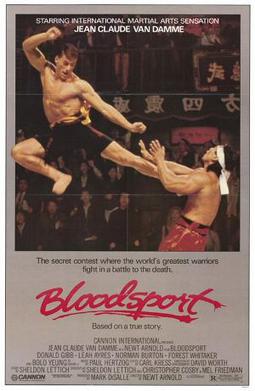
Frank Dux's claimed 329-0 Kumite record was disproved by the Los Angeles Times; Sheldon Lettich says Dux's tall tales inspired the script and a corroborating witness later recanted; Dux was fight coordinator and trained Van Damme for three months; Kowloon Walled City was later demolished; Van Damme does six splits; the knocked-out tooth was real; Paco was Muay Thai champion Paulo Tocha and Swan Paredes actor Michel Qissi became Tong Po; the arcade game is Karate Champ; Mortal Kombat drew on the film
Frank Dukes' (as transcribed) résumé, shown at the end of the film, claimed 329 Kumite matches from 1975 to 1980, undefeated, with 36 consecutive knockouts; the internet is full of doubt, a Los Angeles Times story a few months after release disproved everything, and a trophy he said was awarded to him turned out to have been made down the block from his house.
He also said he was in the CIA and his father in the Mossad; co-writer Sheldon Ledich (as transcribed), one of the two writers, is quoted saying he knew Dukes for months, that most of his tales turned out to be bullshit, but the Kumite stories sounded like a great movie.
Dukes' real mistake was claiming it happened to him instead of pitching it as a movie idea, since he could have written 25 martial arts films; one story has him saying the film toned it down and the real fights happened on a temple roof with tiles cracking underfoot; that kind of fabrication only worked pre-internet, or if you are running for president.
Lettich (transcribed 'Letitch') is also quoted about Richard Bender, who swore he attended the Kumite and years later confessed Dukes coached his story; photos of Dukes do not look like a fifteenth-degree ninjutsu expert who killed for the CIA, and he is clearly what Steven Seagal later became; he was the film's fight coordinator and put Van Damme through a three-month training program.
The film was shot inside Kowloon Walled City, which was later knocked down entirely, possibly for an airport; cursory research says it was a constant fire hazard associated with crime where fugitives could hide; the hosts joke Janice's Atlantic story on the Kumite got it torn down.
How many splits Van Damme does: four are named, the drawn-and-quartered device, the temple roof, the chairs and the Pumala fight, a trailing fifth is counted without being named, and being dragged by Pumala makes six; the jump over Chong Li in the air is proposed as a seventh but ruled not to count, so the answer is six.
The fighter elbowed in the mouth really was knocked unconscious and lost teeth, and it was kept in the film; Bolo was in Enter the Dragon; Paco was played by Paolo Tocha (as transcribed), a Muay Thai champion; Michael Kissy (as transcribed), who played Swan Paredes, the broken-leg guy, went on to play Tong Po in Kickboxer, because in Thailand they could not find a local for the part and put makeup on him.
The arcade game played is Karate Champ from 1984, and the idea that martial-arts skill translates to the game is enjoyed; Mortal Kombat took huge inspiration from the film, with Johnny Cage the obvious character, and game creator John Tobias is quoted as wanting to make a gritty game based on it.
The opening credits are loved: the music sets it up, Bolo Young (as transcribed) as Chong Li gets the last-billed credit shine while kicking giant ice blocks (how long does an ice block take to prepare and hang?), there is a terrible cut to the tree-chopping coconuts, a monkey-style fighter does MMA in front of torch-holding island natives, Ogre as Ray Jackson hears you can get killed in the Kumite, and a giant smiling bear-hug guy breaks a man's back over his knee; it is called powerful storytelling that introduces every piece before the arena is readied.
Young JVD training blindfolded and the rope device, written down as a 'rope Jesus cross', are rewatchable; the real Frank Deuce (as transcribed) said the drawn-and-quartered device was real and used on him; the hosts wonder what it would do to a normal person, note the film implies children were forced into splits, and that Kickboxer does the same thing lying down; the mentor is borrowed from seven other movies including Enter the Dragon.
The small scene where JVD honors his invitation by breaking the bottom brick of a five-brick stack is a favorite 'show how cool this guy is' moment; Ray Jackson reacts like he unwrapped a plasma TV, Chong Li is not impressed, the low-angle shot of Van Damme's gigantic eyes convinces one host he really did it, and 'brick not hit back' is recalled; nobody can explain the physics beyond a transfer of energy.
Asked to compare Van Damme breaking the brick to Eleven from Stranger Things moving things, the answer is that Van Damme is far more impressive because the power is embodied in him, with no cutting-edge science experiments or interdimensional forces. — Jason Concepcion
Eleven is said to have had multi-billion-dollar weapons-program help while Van Damme is all him; the hosts skip past the fact that he hit the top brick yet only the bottom one broke, do a Stranger Things impression, and wonder why Eleven cannot telekinetically hold her nosebleed in or carry a handkerchief.
The first-round fight montage is almost unfair to call rewatchable: a council of officials whose link to the Black Dragon Fighting Society is unclear, the ring that bends down, six minutes of fights, and Ray Jackson winning his first bout then taunting Chong Li, which one host calls a tactical error (finish the job) and another defends as setting the tone since Chong Li talked trash first after the brick; it presages the Mountain and the Viper from Game of Thrones.
Whether Ray Jackson should have been named Ray Jackson is debated: he seems to be from a mountain state like Wyoming, 'Sully' is rejected as not strong enough, and he does no MMA moves, just brute strength; JVD's 12-second knockout gets Ray's 'first round of Kumite, broke the world record' line; the song 'Fight to Survive' is rated behind 'You're the Best' by Joe Esposito.
The later-round montage: Chong Li crushes Swan Paredes, Jao Gomez (as transcribed) does a slow-motion throat slit and is beaten in about five seconds and kicked off the mat; the hosts ask how anyone keeps time with no clock or stopwatch, and how 12.2 reaches the scoreboard faster than Fenway Park posts runs.
The smiling bear-hug guy beats the crawling fighter, who makes the mistake of closing the distance, and JVD's revenge is called probably the second-best fight in the film: the slow-motion stomach punch, the shake-off, then the finish; the hosts joke there was no CGI, he really hit him, and imagine the one-take set conversation; the giant's name is Pumala.
Chong Li versus Ray Jackson is tough to watch, like Goose dying in Top Gun; celebrating was a terrible idea when one shove would have pushed Chong Li off the edge, and the shouted 'he's dead' is enjoyed; Van Damme's 'No, no!' while held back by a 5'7" man after punching through five bricks is called the Oscar reel; Ray looks murdered Apollo Creed style, and the earlier brick-with-the-head scene foreshadows his hard skull.
Semifinal gambling lines: Chong Li about a minus-600 favorite, both finalists massive favorites with the top three fastest knockouts in Kumite history; Dukes versus Paco is a wonderful fight, with Paco's Muay Thai leg-revving compared to Vince Carter starting a motorcycle and a dancing vibe in the shoulders; one host says Paco is the guy he pretended to be with his sisters.
Chong Li killing a guy: the silent ref's disgust is praised, there appear to be no rules beyond quitting and falling off the stage, the crowd and council turn their backs; Chong Li ratchets it up every fight with Dukes the final target, is a Darth Vader figure on screen about seven minutes who casts a shadow over the film, like how WWE uses Brock Lesnar; 'you are next' may be dubbed, as every line of his might be.
In the final, the blinding powder is guessed to be a salt pill and whether he went fully blind is debated; the slow-motion freak-out is the moment Van Damme might figure out acting, a pure emotional beat of a man cheated like Tim Duncan in Game 6 of 2013; nobody official saw the cheat; the slow-motion is good for an era that had not figured it out, probably the most expensive day with one special Hong Kong camera.
The comeback is one of the better sports-movie comebacks; the hospital scene with Ray's comical bloody bandage, the Harley-Davidson bandana returned, 'anytime, anyplace, anywhere,' the lady friend near tears and 'I love you, my friend' is a genuine moment in one of the worst-acted movies of the eighties, more emotional than anything Steven Seagal did; the hosts wonder what the set was like when they suddenly turned into De Niro and Pacino in Heat.
The three picks: one host's favorite scene is the hospital but his most rewatchable is Chong Li killing a guy; another goes with any of the fight montages, effectively a five-way tie, and settles on the final fight as iconic; the movie knows what people want, quick backstory, the different fighting styles, Van Damme in a Speedo.
Going a different way from both others, the pick is the introduction of Chong Li for his first fight: his name on the cards, the bad-guy sound, him rising from his seat while Victor Lin downloads his stats to Van Damme, never defeated, fastest kill, a man kicked in the throat who died on the platform; the scene sticks the landing on every part, and a good character introduction is loved more than anything else in this kind of movie. — Shea Serrano