
‹ All movies
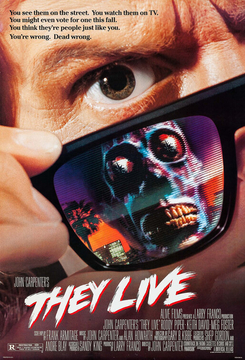
They Live poster

They Live

94

Cast

Selected cast credits · Film reference

Keith David Frank
Meg Foster Holly
Peter Jason Gilbert
Raymond St. Jacques Street preacher
Jason Robards III Family man
John Lawrence Bearded man
Susan Barnes Brown haired woman
Sy Richardson Black revolutionary
Wendy Brainard Family man's daughter
Lucille Meredith Female interviewer
Susan Blanchard Ingenue
Norman Alden Foreman
Dana Bratton Black junkie
John F. Goff Well dressed customer
Norm Wilson Vendor
Thelma Lee Rich lady
Stratton Leopold Depressed human
Rezza Shan Arab clerk
Norman Howell Blonde haired cop
Larry Franco Neighbor
Tom Searle Biker
Robert Grasmere Scruffy blonde man
Vince Inneo Passageway guard
Bob Hudson Passageway guard #2
Jon Paul Jones Manager
Dennis Michael Male news anchor
Nancy Gee Female news anchor
Claudia Stanlee Young female executive
Christine Anne Baur Woman on phone
Eileen Wesson Pregnant secretary
Gregory J. Barnett Security guard #1
Jim Nickerson Security guard #2
Kerry Rossall 2nd unit guard
Cibby Danyla Naked lady
Jeff Imada Male ghoul
Michelle Costello Female ghoul

They Live | The Rewatchables

Explore episodeClose episode
In the discussion (1)
Approx. transcript time · 00:20:37Read transcript
  • The performance is called Piper’s acting Apex; later films are criticized and Piper credited Carpenter with making him a good actor.

Most Rewatchable Scene

The alley fight; the first sunglasses revelation

In the discussion (7)
Approx. transcript time · 00:30:24Read transcript
  • The glasses reveal advertising commands and alien faces, leading into the bank confrontation and bubblegum line.
  • Holly sending Piper’s character through the window is nominated as an abrupt, effective stunt.
  • The five-and-a-half-minute fight is broken down into punches, groin shots, slams and suplexes; the close imaginary score favors Piper.
  • The hotel-room philosophical conversation is another favorite.
  • The collaborators’ dinner party and tuxedoed sellout receive praise.
  • The final shootout and Holly’s turn are discussed.
  • The panel calls the fight the signature scene while another preference favors the glasses; the audience is also split.

What’s Aged the Best?

The score; Piper’s hair; drifters with a past; cultural influence; the bubblegum line; social critique

In the discussion (7)
Approx. transcript time · 00:39:45Read transcript
  • The simple score is praised and identified as the last collaboration with Alan Howarth.
  • Piper’s feathered hair recalls wrestlers, rock musicians and other 1980s figures.
  • A capable drifter arriving with a knapsack remains an appealing setup.
  • The anticipated roaring 1990s and the film’s 2025 takeover date are revisited.
  • The film’s Obey imagery is linked to Shepard Fairey’s street art.
  • The bubblegum line and the television-interview exchange about meeting the A team endure.
  • Economic inequality, homelessness and manipulative government/media remain resonant.

The Great Shot Gordo Award for Most Cinematic Shot

The transformed billboard skyline; the opening train and arrival

In the discussion (2)
Approx. transcript time · 00:43:28Read transcript
  • The wide-screen skyline reveals the transformed advertising landscape.
  • The opening credits, train and arrival are praised; a costly train retake is reported.

What’s Aged the Worst?

Neo-Nazi and Alex Jones appropriation; cheap-looking production; missed television satire

In the discussion (4)
Approx. transcript time · 00:45:31Read transcript
  • Neo-Nazi interpretations reportedly prompted Carpenter’s rejection; Alex Jones’s enthusiasm is also criticized.
  • The ending’s nudity is debated as dated gratuity versus a deliberate satire of cultural distraction.
  • The low-budget handmade appearance is compared unfavorably with Prince of Darkness, though the monochrome alien effects work.
  • The television-station setting could have included more direct parodies; Stay Tuned and UHF are comparisons.

The Stephen A. Smith Hottest Take Award

Selling out looks appealing; Carpenter’s most memorable 1980s film; Keith David in Samuel L. Jackson roles

In the discussion (3)
Approx. transcript time · 00:49:40Read transcript
  • Alien collaboration appears to offer a comfortable life with cars, housing and television work.
  • The film is proposed as Carpenter’s most memorable 1980s work; Escape from New York and The Thing are counterchoices.
  • A counterfactual proposes Keith David could have had much of Sam Jackson’s career, including Jules and a Die Hard 3 role.

Apex Mountain

Roddy Piper; 1980s downtown Los Angeles movies; street fights

In the discussion (6)
Approx. transcript time · 01:00:01Read transcript
  • Piper is affirmed because of his wrestling fame and the film’s number-one opening.
  • Piper’s persona and move into acting are compared with Dwayne Johnson’s later career.
  • Carpenter is rejected in favor of Halloween, with Starman also discussed; Reagan critiques receive only a qualified suggestion.
  • Downtown L.A. films receive a yes with Prince of Darkness as a comparison; Foster’s possible peaks include Masters of the Universe and Leviathan.
  • Keith David’s peak is placed at Platoon, with There’s Something About Mary also recalled.
  • Street fights receive an affirmative suggestion, challenged with The Warriors and Mission: Impossible comparisons.

Sequel, Prequel, Limited Series, or All-Black Remake

All-Black cast; contemporary television; alien-arrival prequel

In the discussion (4)
Approx. transcript time · 01:07:43Read transcript
  • An all-Black version jokingly retains Piper in Keith David’s role.
  • A contemporary series could explore the internet or a Newsroom-like alien television station.
  • A prequel could explain the arrival and infiltration; the father’s changed behavior is debated as literal evidence or social metaphor.
  • A prestige series could expand construction and Denver backstory, with quality depending on the streamer.
In the discussion (3)
Approx. transcript time · 01:20:59Read transcript
  • The film’s number-one opening and rapid disappearance frame a Carpenter preference; it is called his last truly great movie.
  • Carpenter is selected again; Piper receives a distinct alternative vote for his singular performance, while Peter Jason is considered and rejected.
  • The film is placed at the end of Carpenter’s peak run, with later influence emphasized.
Podcast choices
Speaker not identified
John Carpenter
Speaker not identified
John Carpenter
Speaker not identified
Roddy Piper