‹ All movies
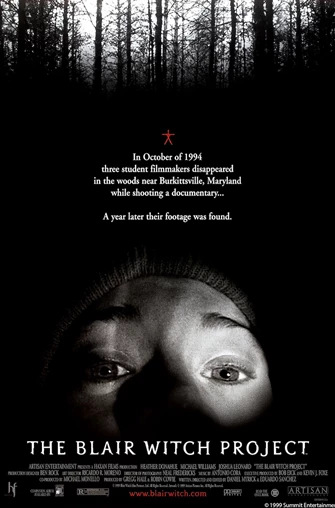
The Blair Witch Project poster

The Blair Witch Project

Cast

Selected cast credits · Film reference

The Blair Witch Project | The Rewatchables

Explore episodeClose episode

Half-Assed Internet Research

Viral campaign; production process; budget; cast experiences; house; camera sale; online theories

In the discussion (23)
Approx. transcript time · 00:06:18Read transcript
  • A website and the Curse of the Blair Witch television documentary helped build buzz between Sundance and the summer theatrical release.
  • The actors were initially withheld from promotion to preserve the premise that the filmmakers had disappeared.
  • Joshua Leonard is reported to have faced objections to another acting appearance because it could undermine the disappearance premise.
  • Myrick is quoted saying public interviews made the fiction clear, while the movie allowed willing audiences to believe.
  • Earlier found-footage precedents include The Last Broadcast and an unnamed cannibal film; this movie did not invent every element.
  • The filmmakers sought a horror film for themselves, studying documentary-style movies and building a short outline.
  • In Search Of influenced an early plan mixing footage with analysis; editing revealed that the woods footage should become the entire film.
  • The companion documentary reflects that earlier concept; the actors worked from an outline and shot much of the material themselves.
  • The camcorder became an additional storytelling presence alongside the 16mm footage.
  • The production reportedly used limited food, tiredness, GPS directions and unexpected nighttime harassment to elicit reactions.
  • An art director reportedly ran through the woods in white to frighten the cast.
  • Michael C. Williams was told to be close to himself, but the super-scared one.
  • Website development and extra Sundance screenings are described as part of the growing buzz.
  • Varying low-budget estimates are contrasted with nearly $250 million in receipts; the claimed record return is discussed rather than independently verified.
  • Paying for the Gilligan’s Island theme song and paying the actors are cited as budget expenses.
  • The plan reportedly changed from removing Mike to removing Josh because of the Heather–Josh dynamic; Josh was quietly taken away for a meal while the others woke to his absence.
  • The actors reportedly signed permission for psychological manipulation and did not know exactly what the nighttime attacks would involve.
  • Donahue’s mother reportedly received sympathy cards from people who believed her daughter had died.
  • The shoot is said to have lasted eight days; the discussion claims the actors did not know the witch was fake.
  • Fans reportedly visited Maryland seeking the legend and took pieces from the house, leading to demolition.
  • An online theory identifies Mary as the witch and interprets a Genesis rock-boundary passage as explaining why disturbing the rocks provokes her.
  • The house is identified as the Griggs House in Patapsco Valley State Park, long abandoned before filming and later demolished.
  • Josh’s CP-16 camera reportedly sold on eBay for $10,000, correcting a $30,000 guess.

Producer review

Milder in a morning viewing; regrets missing the original phenomenon

In the discussion (2)
Approx. transcript time · 00:16:43Read transcript
  • A first-time morning viewing felt surprisingly mild; the response argues that daylight and later found-footage films change the effect.
  • The final response regrets missing the original cultural phenomenon and doubts a similar experience could happen again.

Roger Ebert's review

In the discussion (1)
Approx. transcript time · 00:34:26Read transcript
  • An expectation that Ebert disliked it is corrected: he gave four stars and praised unseen threats as frightening.

Most Rewatchable Scene

Final fifteen minutes in the house

In the discussion (10)
Approx. transcript time · 00:36:16Read transcript
  • The hotel drinking scene is nominated.
  • The first frightening nighttime awakening and the later discovery of three rock piles are nominated.
  • The missing map leads to Mike admitting he threw it away.
  • Discovering the elaborate objects in the forest produces the joke that no redneck is this creative.
  • The nighttime screaming after Josh disappears is nominated.
  • Heather finds body parts wrapped in Josh’s shirt.
  • Heather’s confessional and the house ending are the major candidates.
  • Returning to the same log after hours of walking creates an especially frightening sense of being trapped.
  • The last fifteen minutes in the house are the final choice; the confessional is distinguished as the most memorable and parodied scene.
  • Mike facing the corner pays off the earlier story and ends abruptly without a reassuring epilogue.

Picking Nits

More house time; leave burial ground; battery life; cigarettes; discard equipment; delayed concern

In the discussion (7)
Approx. transcript time · 00:44:23Read transcript
  • The house is so effective that more time there might have helped, although practical filming limits are acknowledged.
  • The group should leave when an Indigenous burial ground becomes part of the situation.
  • The camera batteries seem to last far too long for days of constant filming.
  • The smokers should have brought far more cigarettes for a multi-day trip.
  • Mike should have searched the bottom of his cigarette pack much sooner.
  • Abandoning heavy camera equipment would make escape easier once survival is at stake.
  • Why would Josh’s girlfriend not worry sooner? The delay feels like a 1990s thing.

The most "year the movie came out" thing

Circuit City camera purchase and return

In the discussion (3)
Approx. transcript time · 00:47:00Read transcript
  • Heather’s appearance is suggested as a 1999 marker.
  • Josh’s inexpensive car, cigarettes and manner of talking fit the era.
  • Buying a camera at Circuit City and returning it after filming is the strongest period detail.

What’s Aged the Best?

Invited danger; companion documentary; corner; circular walk; group dynamics; silence; marketing; cameras; cigarettes

In the discussion (9)
Approx. transcript time · 00:49:00Read transcript
  • Horror characters who invite danger by entering forbidden woods remain effective.
  • The companion Curse of the Blair Witch documentary is valued.
  • Making one victim face the corner while another is murdered is praised as a uniquely creepy device.
  • Walking all day and returning to the same spot remains a powerful fear.
  • The shifting three-person dynamic distributes panic, anger and peacemaking convincingly.
  • The lack of music in the woods is praised, apart from songs earlier in the car.
  • The trailer and missing-person-style poster are praised as effective marketing.
  • The film captures recognizable people and the growth of handheld video in social life.
  • Cigarettes as a major source of plot tension are missed; modern equivalents might be nicotine products or a dead phone.

Probably Unanswerable Questions

Navigation; tree-climbing; rescue fire; map; recovered footage; Heather’s knowledge

In the discussion (6)
Approx. transcript time · 00:49:14Read transcript
  • Heather’s navigation inspires immediate distrust; the discussion questions whether she is really using the map.
  • Could climbing a tree reveal an escape route? The response notes the view might only show more trees.
  • Starting a forest fire to attract rescue is floated and immediately questioned for the destruction it would cause.
  • Did the witch make Mike discard the map, or was he simply tired and hungry?
  • Who found the equipment and when? Search parties in the documentary suggest authorities eventually found it.
  • How much danger did Heather knowingly lead them into? Her journals suggest more awareness, without establishing that she was evil.

What’s Aged the Worst?

Cast treatment and compensation; equipment; close-up; limited bonding; sequels; missed witch shot

In the discussion (12)
Approx. transcript time · 00:52:15Read transcript
  • Sudden fame and audiences confusing actor with character reportedly invaded the cast’s privacy; Donahue wished the film had been a smaller hit.
  • The actors had to preserve the fiction of being dead, then faced backlash when audiences learned they were alive.
  • Bulky handheld cameras and DAT machines are dated.
  • Higher-definition televisions make the confessional’s nostril close-up less flattering.
  • The opening could use another fun bonding scene or more hotel drinking, with an objection that extra pop-culture banter could date it.
  • A joke laments that Josh and Mike missed Maryland’s Juan Dixon and Steve Blake tournament run.
  • The actors got no points or threshold bonuses despite shooting and creating the characters; the discussion says they were not paid fairly.
  • Jason Blum passing on the original is called a missed opportunity before his later success with Paranormal Activity.
  • The sequel is disliked; the reboot is also criticized but its climactic sequence receives strong praise.
  • A planned glimpse of a figure in white reportedly went uncaptured by the camera.
  • The sequel’s fixed release date left no time to create it; the filmmakers said they were out.
  • Donahue’s departure from acting and name change are presented as signs of the difficult aftermath and regret over using her real name.

The most GIFable moment

Heather’s confessional

In the discussion (1)
Approx. transcript time · 00:54:29Read transcript
  • Heather’s close-up confessional wins; Mike facing the wall is the brief alternative.

The Butch’s Girlfriend Award for the Weakest Link in the Film

Motion discomfort; unexplained disorientation; repetitive interviews

In the discussion (3)
Approx. transcript time · 00:55:23Read transcript
  • Motion discomfort is mentioned but judged less severe after years of similar footage.
  • Getting so lost is hard to accept without supernatural manipulation, which the discussion wishes were clearer.
  • The town interviews feel repetitive; ten minutes could be shifted into the woods, though the mother with the baby is liked.

The Stephen A. Smith Hottest Take Award

Companion documentary may be better; squandered franchise potential

In the discussion (2)
Approx. transcript time · 01:04:15Read transcript
  • Curse of the Blair Witch may be better; combining it with the movie into two and a half hours is proposed.
  • The franchise squandered potential for many sequels and historical prequels by rushing and mishandling follow-ups.

Casting What-Ifs

No alternate casting; improv audition account

In the discussion (1)
Approx. transcript time · 01:05:50Read transcript
  • No alternate casting is supplied; improvisational auditions are described, including Donahue’s reported refusal to argue for parole in an exercise, whose accuracy is questioned.

Recasting Couch

Recognizable young stars considered, then challenged

In the discussion (2)
Approx. transcript time · 01:07:00Read transcript
  • Affleck, Damon and Paltrow are floated as an example of using recognizable actors.
  • Michelle Williams, Heath Ledger and Jake Gyllenhaal are proposed, then the premise is challenged because recognizable actors would undermine it.

Apex Mountain

Cast and directors; viral marketing; Cal Ripken film references; corner-facing murder; Artisan; you-had-to-be-there moments

In the discussion (9)
Approx. transcript time · 01:12:24Read transcript
  • The cast and directors are affirmed collectively.
  • Sundance is considered but compared with the earlier impact of Sex, Lies, and Videotape.
  • Viral marketing is affirmed.
  • Found footage is disputed against Paranormal Activity’s larger franchise.
  • Witches are rejected in favor of The Wizard of Oz.
  • Cal Ripken references in films are affirmed.
  • Facing a corner before a murder is affirmed.
  • Artisan Entertainment is affirmed for its extraordinary investment return.
  • You-had-to-be-there moments are proposed and explicitly welcomed in the closing discussion.

Cruise or Hanks?

Young Hanks as Mike

In the discussion (1)
Approx. transcript time · 01:13:37Read transcript
  • Both are imagined together, then young Hanks as Mike becomes the recorded choice; the stars as fishermen is another joke.

Is This Movie Better With…?

Byron Mayo; Private Hudson alternative

In the discussion (2)
Approx. transcript time · 01:17:54Read transcript
  • Private Hudson from Aliens is proposed as a new candidate for the better-with category.
  • Byron Mayo is chosen for an imagined sexually suggestive tent encounter.

Just One Oscar

Hypothetical marketing award; no standard category

In the discussion (1)
Approx. transcript time · 01:18:57Read transcript
  • No standard Oscar choice is offered; the marketing campaign would deserve a hypothetical award.
In the discussion (3)
Approx. transcript time · 01:22:31Read transcript
  • The camera is the obvious choice, with its reported $10,000 sale cited.
  • A slimed sleeping bag is mentioned as a less appealing alternative.
  • Heather’s journal and Mike’s last cigarette or empty pack are additional choices.

Who Won the Movie?

Artisan Entertainment; filmmakers including cast

In the discussion (2)
Approx. transcript time · 01:23:36Read transcript
  • Artisan Entertainment is the first choice, with the filmmakers offered as an alternative and the actors initially excluded from the financial win.
  • The filmmakers, expressly including the actors’ creative contribution, are the second choice for popularizing found footage.
Podcast choices
Speaker not identified
Artisan Entertainment
Speaker not identified
The filmmakers, including the actors

More from the conversation

Chris Ryan and Bill Simmons are introduced amid discussion of The Watch, Industry and other Ringer shows.
Approx. transcript time · 00:01:53Read transcript
A non-ranked list of influential movie templates includes Superman, 48 Hrs., Die Hard, Fatal Attraction, Halloween, When Harry Met Sally, Animal House and The Blair Witch Project.
Approx. transcript time · 00:02:55Read transcript
The film’s influence is attributed to cheap found footage, early internet participation and a moment when established horror franchises felt exhausted.
Approx. transcript time · 00:04:01Read transcript
The producer is brought in early to discuss whether 1999 audiences could really believe the footage was authentic.
Approx. transcript time · 00:05:33Read transcript
Two opening-weekend Kendall Square memories describe unusually frightened audiences; one recollection admits skepticism while still being emotionally convinced.
Approx. transcript time · 00:07:01Read transcript
Dial-up internet, limited verification and familiar local legends made the fictional backstory easier to believe.
Approx. transcript time · 00:09:11Read transcript
The conversation compares movie secrets with The Crying Game, The Usual Suspects and The Sixth Sense, then television spoilers and readers preserving Game of Thrones surprises.
Approx. transcript time · 00:10:47Read transcript
The marketing is praised for leaving opening audiences uncertain even after the screening.
Approx. transcript time · 00:12:15Read transcript
MrBeast stunt videos are offered as a modern approximation of the uncertainty.
Approx. transcript time · 00:13:20Read transcript
The theatrical screening is remembered as exceptionally frightening, alongside separate unsettling viewings of The Texas Chain Saw Massacre.
Approx. transcript time · 00:13:41Read transcript
A reported late-night Oregon viewing still frightened younger viewers enough to search whether the film was real.
Approx. transcript time · 00:15:43Read transcript
The characters’ cars, cigarettes, food and personalities feel recognizably like people from the viewers’ own college years.
Approx. transcript time · 00:18:12Read transcript
Rewatchability is debated: one view improves with time, while another describes fatigue followed by renewed interest through children.
Approx. transcript time · 00:19:05Read transcript
The expanded website, journals and background lore are compared with the optional deep engagement of Lost.
Approx. transcript time · 00:21:10Read transcript
DVD extras, online deleted scenes and extended hotel footage helped sustain the fictional world.
Approx. transcript time · 00:21:45Read transcript
Believable internet deception, ubiquitous camcorders and the particular personalities make the film feel distinctly 1990s.
Approx. transcript time · 00:22:22Read transcript
The aspiring documentarian, casually involved cameraman and bulletin-board recruit embody a recognizable local filmmaking scene.
Approx. transcript time · 00:22:45Read transcript
The documentary boom and bulky cameras fit the era; modern phones, mapping and constant online posting would alter the setup.
Approx. transcript time · 00:23:49Read transcript
People then visibly performed for a camcorder, unlike today’s more routine phone recording.
Approx. transcript time · 00:25:10Read transcript
The opening legends plant the corner-facing murders and witch backstory, though the basic idea of evil woods works without mastering all the lore.
Approx. transcript time · 00:29:42Read transcript
A hiking aversion becomes a joke about enjoying outdoor recreation without aimless walking.
Approx. transcript time · 00:31:28Read transcript
The missing-character imagery becomes a joke about a household ghost leaving only a shirt and body parts.
Approx. transcript time · 00:35:19Read transcript
An online theory reads Heather’s confessional and supplemental journals as evidence of culpability or possession; the discussion reports it without endorsing that interpretation.
Approx. transcript time · 00:41:04Read transcript
Chernobyl Diaries and a frightening theatrical viewing of Paranormal Activity extend the found-footage discussion.
Approx. transcript time · 00:44:42Read transcript
Low-budget success stories prompt a joke about the unsuccessful filmmakers left with credit-card debt.
Approx. transcript time · 00:48:22Read transcript
Mike’s cigarette brand cannot be identified; several brands are guessed rather than established.
Approx. transcript time · 01:22:46Read transcript
Learning about the fear of getting deeply lost becomes a closing joke about a retreat and trust exercises.
Approx. transcript time · 01:23:59Read transcript