
‹ All movies
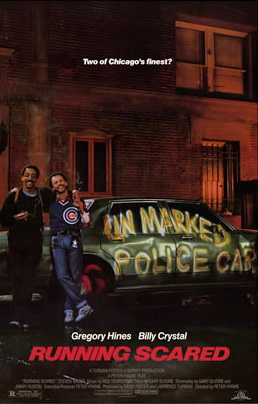
Running Scared poster

Running Scared

107 minutes

Cast

Selected cast credits · Film reference

Gregory Hines Ray Hughes
Billy Crystal Danny Costanzo
Steven Bauer Frank
Darlanne Fluegel Anna Costanzo
Dan Hedaya Captain Logan
Jimmy Smits Julio Gonzales
Tracy Reed Maryann Thomas

Running Scared | The Rewatchables

Explore episodeClose episode
In the discussion (5)
Approx. transcript time · 00:12:52Read transcript
  • The script was allegedly imagined for older New York cops with Hackman and Newman in mind, though it was never brought to them.
  • Tom Selleck and John Travolta were reportedly considered; Selleck had Magnum and Travolta’s agent advised against it.
  • Peter Hyams reportedly liked Darlane Flugel in To Live and Die in L.A.
  • Hyams’s earlier Busting and later 2010, Capricorn One, and Sudden Death establish his action craftsmanship.
  • Gregory Hines is described as having replaced Richard Pryor in History of the World Part I and as having dropped out of 48 hours for The Cotton Club.

In the discussion (4)
Approx. transcript time · 00:18:47Read transcript
  • Key West is named during the rapid sweep of categories for the sequence.
  • The sunset, scooters, boat, roller skating, women, and potential bar make the location feel like a complete second movie.
  • The scene’s power makes the return to Chicago feel like leaving the life the characters should choose.
  • The State of Illinois Building is offered as the location-category alternative before the exchange agrees with Key West.

Roger Ebert's review

In the discussion (4)
Approx. transcript time · 00:32:25Read transcript
  • The episode states “Roger Ebert, three stars” and says he liked the film.
  • The quoted review calls the premise another street-smart buddy-cop story and initially complains the genre is overpopulated.
  • Ebert nevertheless says Running Scared transcends its dreary roots and becomes fun because of Hines and Crystal.
  • The Times critic transcribed as Vincent Camby is described as making a similar point more negatively and steering audiences toward television police shows.

Most Rewatchable Scene

Opening basketball and Snake chase; lineup; Key West; apartment shootout; stairway and airport chases; train tracks and lifted cab; double-elevator ending

In the discussion (7)
Approx. transcript time · 00:34:13Read transcript
  • The opening combines outdoor basketball, punches, and a chase before establishing the partners’ comic rhythm.
  • Snake’s pursuit is praised for the detectives announcing his cash to the neighborhood instead of simply arresting him.
  • Snake’s police lineup is nominated, then his violent death is described as the moment the film’s R rating becomes apparent.
  • The Key West section sweeps several categories and compresses an aspirational new life into a few minutes.
  • The apartment-building shootout supplies several escalating mock-Miranda lines.
  • The stairway, airport, train-track, lifted-cab, and double-elevator chases keep the second half moving through set pieces.
  • The double-elevator ending receives immediate praise, followed by the statement that the scene round needs no further negotiation; the undiarized transition does not identify Key West alone as the winner.

Apex Mountain

Chicago — tentative

In the discussion (1)
Approx. transcript time · 00:36:08Read transcript
  • The panel calls the period a possible Chicago apex because movies were filming across the city as Michael Jordan was about to become a rocket ship and the leads promoted the White Sox and Cubs.

The most GIFable moment

Matching novelty T-shirts

In the discussion (3)
Approx. transcript time · 00:37:25Read transcript
  • The matching shirts are nominated directly for the “most Giffable moment.”
  • Quick cuts change the women riding behind the detectives on scooters.
  • The sequence also includes roller skates, a bank exit, and the bar decision.
In the discussion (4)
Approx. transcript time · 00:41:41Read transcript
  • Jimmy Smits as the villain and Sweet Freedom shoehorned into the movie open the 1986 list.
  • Walter Payton gear, the 1985 Bears, Michael Jordan, and a 1983 White Sox cap make Chicago sports central to the answer.
  • Darlane Flugel, Joey Pants with hair, and roller skating are further period markers.
  • The Honda Elite scooters win because of their era-specific ad campaign and disappearance.

What’s Aged the Best?

Cop names; angry lieutenants; rival buddy cops; Steven Bauer’s look; uncontainable villains; unannounced visits; dead-body escalator; friendship; poster; company cars; croissant mockery; Chicago bars

In the discussion (10)
Approx. transcript time · 00:43:48Read transcript
  • Ray Hughes and Danny Costanzo are praised as archetypal cop names.
  • Dan Hadea preserves the angry-lieutenant tradition and prompts a long Inspector Todd riff.
  • A buddy-cop movie with rival buddy cops is admired even though the “young” rivals are the same age as Hines.
  • Stephen Bauer’s layered clothes, beard, and unwashed energy are described as peak mid-1980s texture.
  • A villain committing murder and immediately returning to the street is defended as an essential action-movie staple.
  • Unannounced visits are remembered as common before cellphones; a recent personal doorstep visit shows the habit has not entirely vanished.
  • A dead bad guy descending an escalator, “you are the detectives, go and detect,” and the poster are preserved as memorable images.
  • Company cars, including the detectives’ unmarked car, prompt nostalgia for shared workplace vehicles.
  • The period’s derision toward croissants is treated as a comic cultural marker.
  • Chicago bars look unusually good on film and function as the characters’ living rooms.

What’s Aged the Worst?

Reused title; uncontainable villains; Uzis; police abuse; scarf flourish; interrupted sex; repetitive final hour; soundtrack beyond Sweet Freedom; fake snow; underused R rating

In the discussion (10)
Approx. transcript time · 00:46:28Read transcript
  • The unrelated 2006 Running Scared creates title confusion on cable, streaming, search, and the episode title.
  • Uzis are described as a once-common film prop that seems to have fallen out of fashion; the speakers remain unsure whether they still appear in newer action films.
  • Constant police brutality and rule-breaking are identified as another dated genre convention.
  • Crystal’s repeated scarf flip feels more like a performer bit than Danny Costanzo behavior.
  • Walking into a friend’s bedroom during sex is described as something films rarely show now, while Hines’s character seems completely comfortable with the interruption.
  • The last hour repeats confrontations with Julio and could lose roughly seven minutes, especially from the airport chase.
  • Sweet Freedom carries an otherwise weak, loud, synth-heavy soundtrack.
  • Some artificial Chicago snow looks cheap.
  • The movie is rated R, but the hosts ask why it did not “earn the R” with the adult material it repeatedly approaches.
  • A murderer being released immediately after an obvious public killing is offered as Aged Worst before the same trope is defended separately as Aged Best.
In the discussion (2)
Approx. transcript time · 00:50:35Read transcript
  • Birthday cake and the bar’s draft pilsner are the first candidates.
  • Fresh seafood is imagined as an appealing Key West option; the women’s boat lunch with margaritas receives the explicit final food choice.

The Butch’s Girlfriend Award for the Weakest Link in the Film

Danny–Anna chemistry; Crystal’s Italian Chicago-cop identity

In the discussion (3)
Approx. transcript time · 00:52:10Read transcript
  • Anna’s willingness to leave her dentist fiancé for Danny feels unsupported because the breakup and lingering attraction are barely explained.
  • The film offers only the idea that Danny values police work more than their relationship before his Florida plan brings Anna back.
  • The competing answer questions casting Billy Crystal as Danny Costanzo without acknowledging a Jewish or mixed family identity.

Mallory Rubin Award: Did This Movie Need a Better Sex Scene?

Fuller Hines scene; apartment-raid or Key West nudity

In the discussion (3)
Approx. transcript time · 00:59:10Read transcript
  • The episode says it might have had Heinz step in for about 30 seconds.
  • The hosts ask for more sex happening in the apartments the detectives bust into.
  • The film repeatedly flirts with nudity in bedrooms and Key West but stops short.

The Stephen A. Smith Hottest Take Award

Lethal Weapon franchise potential; aspirational Key West location

In the discussion (4)
Approx. transcript time · 00:59:54Read transcript
  • A planned sequel called Still Running failed because Crystal and Hines rejected the scripts, which the hosts call an enormous missed business opportunity.
  • The main take argues this chemistry and premise could have become the Lethal Weapon franchise in a friendlier release window.
  • The hosts sketch sequels that finish one last Chicago job and then defend a Key West bar from a past enemy.
  • A separate take places Key West beside Cocktail’s Jamaica and Hardbodies’ Santa Monica and Malibu as childhood escape fantasies.

Is There a Better Title for This Movie?

Unresolved: Danny and Ray; One Last Job; Short Time; Chicago Heat; joking alternatives

In the discussion (3)
Approx. transcript time · 01:04:13Read transcript
  • The hosts ask who is running scared and find the title disconnected from the movie.
  • Danny and Ray, One Last Job, Short Time, and Chicago Heat are proposed.
  • The title discussion adds joking possibilities such as Bisexual Buddies and Homoerotic Chicago Cops without settling on a replacement.
In the discussion (4)
Approx. transcript time · 01:09:19Read transcript
  • Joey Pants wins automatically, with Dan Hadea as an obvious alternative.
  • Larry Hankin qualifies because one host did not know his name despite recognizing his work.
  • Don Calpha is recognized from Weekend at Bernice.
  • Jonathan Grease is identified through Napoleon Dynamite, White Lotus, and 90210.

Recasting Couch

Unresolved contemporary cast

In the discussion (7)
Approx. transcript time · 01:10:57Read transcript
  • The hosts struggle to find contemporary marketable actors around the characters’ stated age.
  • Driver and the actor transcribed as Shalamee are proposed, but age and box-office concerns complicate the pairing.
  • Donald Glover is considered because he has not made this kind of buddy-cop movie.
  • LeBron is proposed as stunt casting for the Hines role.
  • Marcelo Hernandez and Shane Gillis are comic possibilities, but no pairing is finalized.
  • Glen Powell is named as an obvious contemporary possibility, although no pairing is finalized.
  • Andrew Dismukes is floated as another contemporary casting possibility.

Half-Assed Internet Research

Crystal’s prop-pistol injury; his memory of Hines; State of Illinois Center finale

In the discussion (3)
Approx. transcript time · 01:14:11Read transcript
  • A 1986 book says its author accidentally hit his head with a pistol, split his nose, and needed plastic surgery.
  • A 2021 quote says the movie is sometimes watched as a way to visit the late Gregory Hines.
  • The finale was filmed inside the new State of Illinois Center, now reportedly sold to Google.

Apex Mountain

Gregory Hines; Key West disputed; Dan Hedaya; Michael McDonald music videos

In the discussion (9)
Approx. transcript time · 01:15:33Read transcript
  • Crystal is rejected because City Slickers and his Oscars period are later.
  • Hines receives a plausible apex here because “now he’s a real movie guy” and the role leads toward Tap.
  • Key West is debated between this movie, Hemingway, and a Real World season.
  • Jack Walsh is selected among Chicago movie cops because he had to leave the force after refusing a Serrano buyout.
  • Jimmy Smits is rejected here and tentatively placed nearer NYPD Blue.
  • Dan Hadea is placed around Blood Simple and his Cheers role.
  • Michael McDonald music videos receive an apex while Yacht Rock is said to end here.
  • Chicago movie bars are tested for Apex, especially the bar in About Last Night and the bar in Thief that the transcript says Conn blows up.
  • Joey Pants is rejected for Apex.
In the discussion (2)
Approx. transcript time · 01:19:22Read transcript
  • Hanks wins this episode and is considered a natural Danny. The separately mentioned 18–14 score is the series running tally, not an episode vote count.
  • Michael Keaton after Night Shift is proposed as a strong third path for Danny.

Picking Nits

Ray kissing Anna; Julio’s repeated release; rail-track driving; reckless gunfire; remaining cops; friendly fire; close-range finale

In the discussion (7)
Approx. transcript time · 01:20:16Read transcript
  • Ray kisses Anna fully enough to suggest unexplained sexual tension among the three leads.
  • Gonzalez is described as running amok with “just no laws” even though the police keep catching him.
  • Cars staying aligned on train tracks during a chase feels mechanically implausible.
  • Police firing aimlessly at escaping vehicles is questioned.
  • After both detectives are shot and Anna jumps between elevators, choosing to remain cops contradicts the Key West plan.
  • Danny is shot in the chest by another officer without meaningful accountability.
  • The finale has people firing past one another at implausibly close range.

Is This Movie Better With…?

Danny Trejo; Sam Jackson; Ramon Raymond; Longlegs

In the discussion (5)
Approx. transcript time · 01:23:08Read transcript
  • The category cycles through the recurring actor pool without a clear initial answer.
  • Ramon Raymond is proposed for one of Julio’s lieutenants or Bauer’s partner.
  • Sam Jackson could replace Joey Pants as Snake or fit elsewhere in the movie.
  • Danny Treo is the favored addition as Jimmy Smits's lead henchman.
  • Longlegs as Julio is a comic alternate version rather than the final answer.

Just One Oscar

Michael McDonald’s “Sweet Freedom” — Best Song

In the discussion (1)
Approx. transcript time · 01:24:11Read transcript
  • Michael McDonald receives the Oscar for Sweet Freedom as Best Song.

Probably Unanswerable Questions

Move to Key West; bar loan; Danny–Anna relationship

In the discussion (3)
Approx. transcript time · 01:24:41Read transcript
  • The absent sequel leaves it unknown whether the pair ever moved to Key West.
  • A reported 10.19 percent 1986 mortgage rate makes the unused bar lease financially dangerous.
  • Anna’s renewed interest appears tied to Danny leaving Chicago, so his reversal may send her back to the dentist.

What Piece of Memorabilia Would You Want From This Movie?

White Sox cap; novelty T-shirts; Honda Elite scooters

In the discussion (3)
Approx. transcript time · 01:26:38Read transcript
  • The White Sox cap is the immediate memorabilia choice.
  • The movie-worn matching shirts are considered but judged impractical outside a costume.
  • The Honda Elite scooters would be desirable movie-used objects despite the host’s prior crash.

The Coach Finstock Award for Best Life Lesson

Move to your Key West and stay; no cop-to-dentist marriage switch

In the discussion (2)
Approx. transcript time · 01:27:43Read transcript
  • The first lesson says a former cop is an impossible transition to a dentist spouse.
  • Another life lesson is to act on the desire to move to Key West and remain there instead of returning to Chicago.

Producer review

Liked the chemistry; a relaxed watch below the best buddy-cop films

In the discussion (3)
Approx. transcript time · 01:28:57Read transcript
  • The first-time viewer praises the Crystal–Hines chemistry but places the film below Lethal Weapon, Midnight Run and Beverly Hills Cop. Craig Horlbeck
  • The easy cable-watch quality is described as both flatter than its peers and central to its appeal.
  • Hines is praised as an underused movie talent whose broader cultural stature came through dance.

More from the conversation

The episode treats Sweet Freedom and the Key West montage as the moment Yacht Rock gives way to a different mid-1980s leisure style.
Approx. transcript time · 00:03:39Read transcript
Running Scared is framed as an unusually affectionate buddy-cop movie because the detectives begin as best friends instead of becoming friends through the case.
Approx. transcript time · 00:06:47Read transcript
The buddy-cop discussion proposes personal Mount Rushmore selections without assigning numbered ranks; category boundaries and the treatment of Midnight Run remain debated.
Approx. transcript time · 00:07:47Read transcript
Miami Vice is considered but challenged because the category is expected to include comedy; Midnight Run is substituted, with ex-cop eligibility debated.
Approx. transcript time · 00:08:21Read transcript
One personal quartet is 48 Hrs., Lethal Weapon 2, Running Scared and Bad Boys.
Approx. transcript time · 00:09:22Read transcript
Another proposed quartet is 48 Hrs., Lethal Weapon 2, Training Day and The Nice Guys.
Approx. transcript time · 00:09:41Read transcript
A later recap names 48 Hrs., Lethal Weapon 2, The Nice Guys, Running Scared and Midnight Run, then treats Midnight Run as an optional sixth-man addition; 48 Hrs. and Lethal Weapon 2 are considered essential.
Approx. transcript time · 00:10:11Read transcript
Gregory Hines and Billy Crystal are read as meeting at a rare career intersection where both can sell physical action and fast comedy.
Approx. transcript time · 00:11:34Read transcript
The screenplay was reportedly written for older New York cops before the production made the characters younger, leaving room for the leads’ lived-in improvisational chemistry.
Approx. transcript time · 00:16:40Read transcript
The bar dream asks why the partners keep risking their lives for police work when Key West offers a concrete exit.
Approx. transcript time · 00:18:47Read transcript
Chicago’s mid-1980s film boom and elevated trains, civic buildings, winter streets, and neighborhood bars make the city a playground for the action.
Approx. transcript time · 00:22:37Read transcript
Joey Pants, Darlanne Fluegel, and the Sweet Freedom music video anchor a discussion of the cast’s period careers and movie marketing.
Approx. transcript time · 00:25:28Read transcript
The film reportedly earned $38.5 million and ranked 26th for 1986 in a crowded theatrical weekend.
Approx. transcript time · 00:30:03Read transcript
The film’s final decision to stay in Chicago is treated as a thematic failure because it abandons the alternative life established in Key West.
Approx. transcript time · 01:22:13Read transcript