
‹ All movies
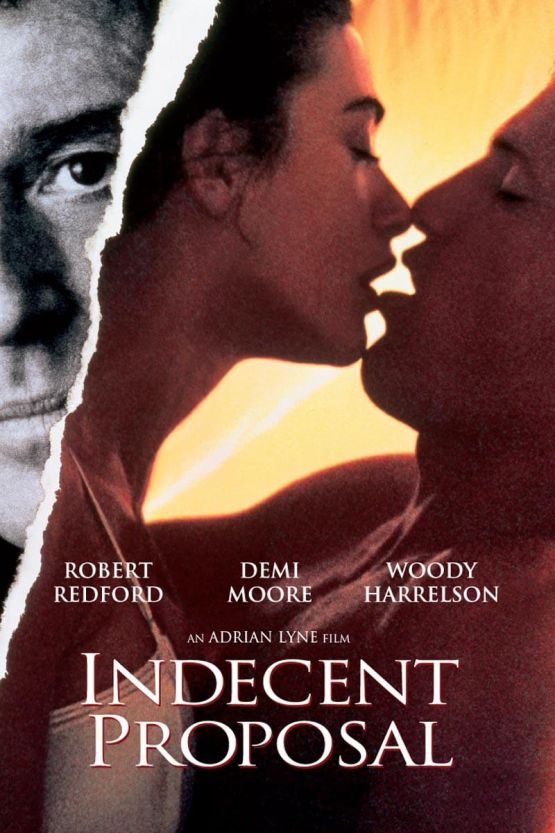
Indecent Proposal poster

Indecent Proposal

118 minutes

Cast

Selected cast credits · Film reference

Robert Redford John Gage
Demi Moore Diana Murphy
Woody Harrelson David Murphy
Oliver Platt Jeremy
Seymour Cassel Mr. Shackleford
Billy Bob Thornton Day Tripper
Rip Taylor Mr. Langford
Billy Connolly Auction emcee
Joel Brooks Realtor
Pierre Epstein Van Buren
Danny Zorn Screenwriter
Kevin West Screenwriter
Pamela Holt David’s girlfriend
Tommy Bush David’s father
Mariclare Costello David’s mother
Curt Odle David’s boss
Jedda Jones Craps woman
Myra J. Craps woman
Edwonda White Craps woman
Joseph Ruskin Pit boss
Maurice Sherbanee Citizenship student

Indecent Proposal | The Rewatchables

Explore episodeClose episode

Roger Ebert's review

In the discussion (2)
Approx. transcript time · 00:27:07Read transcript
  • Roger Ebert awarded three stars; no rating scale is spoken.
  • Ebert praised the premise’s ability to provoke discussion about fidelity despite calling its construction artificial and manipulative.

Recasting Couch

Sydney Sweeney; husband unresolved; Brad Pitt; gender-swapped Angela Bassett

In the discussion (7)
Approx. transcript time · 00:42:45Read transcript
  • Scarlett Johansson is raised as a contemporary Moore comparison before Sydney Sweeney is proposed for a remake.
  • For Sydney Sweeney’s husband, a younger Adam Driver is considered; Glen Powell is rejected as too attractive and Miles Teller is viewed as a better candidate.
  • Jacob Elordi and Paul Mescal are rejected as too attractive for the desired contrast; Elordi’s height is also noted.
  • A producer identified in the transcript as Linda Oakes describes Harrelson’s appeal to women as both adorable and adventurous; the name remains uncertain.
  • Rory Culkin is proposed before the Succession actor is corrected to Kieran; Jeremy Strong follows, but the age gap with Sweeney draws an objection.
  • Brad Pitt is favored over “Leo” (surname not spoken) for Gage because of his resemblance to and career association with Redford.
  • A gender-swapped Gage prompts an emphatic Angela Bassett choice; Halle Berry and Nicole Kidman are additional candidates, while Reese Witherspoon is a joking contrast.
In the discussion (4)
Approx. transcript time · 01:06:28Read transcript
  • The original reported star configuration was Tom Cruise and Nicole Kidman with Warren Beatty as the billionaire, enthusiastically compared with their later Eyes Wide Shut.
  • Julia Roberts reportedly declined Diana; her apparent youth and repeating a paid-sex premise after Pretty Woman draw objections, although the character’s age is estimated at twenty-six.
  • Harrelson reportedly left Benny and Joon and faced a lawsuit; Johnny Depp had been approached for this film before taking that role, while White Men Can’t Jump persuaded Lyne to cast Harrelson.
  • Harrelson is defended as inspired casting because David needs less overwhelming attractiveness than Cruise despite the marriage’s continuing sexual chemistry.

Half-Assed Internet Research

Reviews; parody; production; original ending; dress; casino filming

In the discussion (10)
Approx. transcript time · 01:12:44Read transcript
  • The film reportedly appears in John Wilson’s book of one hundred enjoyably bad movies and inspired a 2002 Simpsons parody.
  • Moore reportedly recalled Harrelson’s discomfort performing sex scenes with a friend’s wife.
  • Negative reviews from the Los Angeles Times, New York Times and Rolling Stone led Amy Holden Jones to publish a rebuttal; the Thelma and Louise screenwriter also criticized the film.
  • Redford’s missed-connection speech is described as substantially borrowed from Citizen Kane.
  • Moore reportedly received final approval over her sex scenes and participated in editing them.
  • The secretary reading Susan Faludi’s Backlash is identified as a deliberate thematic detail.
  • The original script let Diana leave independently; Beatty reportedly refused because his character would not get the woman.
  • Lyne and Moore reportedly argued over the character before he conceded that she was right.
  • The five-thousand-dollar Thierry Mugler dress became a widely copied sensation.
  • Vegas casino filming reportedly began at three in the morning for several weeks.

Picking Nits

Billionaire plausibility; casino procedures; Diana’s competence; bathroom hygiene

In the discussion (9)
Approx. transcript time · 01:18:27Read transcript
  • A billionaire as handsome as Redford is questioned; the defense argues that charm and confidence could facilitate his business success, while his lack of public notoriety remains implausible.
  • Gage is defended as a believable billionaire through his assured gambling, effortless requests for money and personal aide.
  • A billionaire gambling enormous sums should have a private casino area instead of mingling at public tables; the need to meet Diana does not excuse the staging.
  • A pit boss breaking his coffee cup over a million-dollar win is criticized as unlike professional casino behavior.
  • The million-dollar craps bet is challenged as exceeding a plausible table limit, even for Gage.
  • The two-person poker game and unusual chips are confusing.
  • Diana trying to pull back a losing chip pile should result in immediate expulsion.
  • Diana’s real-estate competence is questioned because she misses the mortgage deadline, fails to identify their house as an asset and has sold nothing in six months despite her boss’s praise.
  • The bathroom conversation is criticized for Diana’s robe draping over the toilet while David leans against her; closeness does not excuse the hygiene.

Probably Unanswerable Questions

Gere; Gage’s morality; TV format; contract boundaries; dogs; Shackleford; business card

In the discussion (10)
Approx. transcript time · 01:26:52Read transcript
  • Richard Gere as Gage is rejected because he has already played adjacent roles; Redford’s unexpected casting provides useful disorientation.
  • Gage’s morality remains disputed: one view calls the proposition unequivocally bad despite complexity and consent, while the other sees a flawed man whose willingness to let Diana leave mitigates the judgment.
  • The Million Dollar Club is proposed as an anthology or reality show, potentially an extreme evolution of The Bachelor.
  • The contract should specify permitted sexual conduct and boundaries, rather than only payment and death contingencies; freeze-framing reveals little beyond the capitalized term Act.
  • Specific unanswered contractual boundaries include positions, kissing and oral sex, with possible extended activity reinforcing the desire for flashbacks.
  • A counterargument says withholding the sex scene lets viewers imagine something more extreme than the film could show.
  • The fate of the two dogs Gage acquired to create a welcoming home is raised as a question.
  • Whether Gage keeps and cares for the dogs after Diana leaves remains unanswered; their disposal is dark speculation, not a plot fact.
  • Whether Shackleford has actually killed someone is debated, including possible indirect responsibility rather than a deliberate murder.
  • Diana is thought to have kept Gage’s business card willingly after enjoying the night, rather than Shackleford secretly planting it; the alternative remains the question’s premise.

Producer review

Entertaining; Gage is a loser

In the discussion (4)
Approx. transcript time · 01:34:47Read transcript
  • The invited producer review calls the film sufficiently good, entertaining and absorbing enough to delay going to bed.
  • The producer sees Gage as a pathetic pickup artist rather than merely a bad man, emphasizing stalking, his empty life and the manipulative two-headed coin.
  • The coin’s appeal and Gage’s lack of a known life draw further debate; a television adaptation could gradually reveal this unpleasant side, with a Don't Worry Darling comparison.
  • The concluding assessment agrees that Redford’s appeal initially obscures Gage’s strange, unappealing behavior.