
‹ All movies
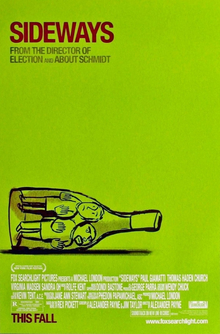
Sideways poster

Sideways

127 minutes

Cast

Selected cast credits · Film reference

Paul Giamatti Miles Raymond
Virginia Madsen Maya Randall
Sandra Oh Stephanie
Marylouise Burke Mrs. Raymond
Jessica Hecht Victoria Cortland
Lee Brooks Ken Cortland
Missy Doty Cammi
M.C. Gainey Cammi's husband
Alysia Reiner Christine Erganian
Shake Tukhmanyan Mrs. Erganian
Shaun Duke Mike Erganian
Stephanie Faracy Stephanie's mother
Patrick Gallagher Gary the Bartender
Joe Marinelli Frass Canyon Pourer

Sideways | The Rewatchables

Explore episodeClose episode

Most Rewatchable Scene

Miles and Maya’s porch conversation

In the discussion (18)
Approx. transcript time · 00:36:28Read transcript
  • The first Hitching Post visit is a scene candidate: Maya's interest meets Miles's negative assumption that she only wants tips, while Jack encourages him and her American Spirits entrance is admired.
  • The split-screen tasting leading to Stephanie is a scene candidate, especially her openly flirtatious spanking exchange with Jack and his immediate recognition of their chemistry.
  • The Los Olivos dinner is a scene candidate, beginning with Miles’s refusal to drink Merlot.
  • The dinner's phone-call sequence is admired as a cringe-inducing breakdown: ringing is heard before Miles calls his ex, like the inevitable disastrous calls in Swingers. Drinking is likened to pulling a grenade pin.
  • The kitchen/porch conversation is immediately called the scene to beat.
  • Richebourg,1988 Sassicaia, Andrew Murray and1961 Cheval Blanc are admired wine-name drops during the visit.
  • Miles’s incoherent description of his enormous novel is a comic highlight.
  • Miles's Pinot monologue is admired as an exceptional script passage, despite Payne reportedly downplaying its greatness.
  • Maya’s speech about wine’s evolving life and inevitable decline earns equal praise.
  • The performances keep the conspicuously written speeches natural; Miles visibly falls in love before ruining the opportunity.
  • The porch receives an explicit final scene choice.
  • The spit-bucket and beach sequence is another scene candidate.
  • Recovering the wallet is a comic scene candidate, admired for coexisting with the porch’s very different tone.
  • Gainey's uninhibited nude chase is admired as an outrageous comic performance; the couple's excitement at being caught adds to the joke.
  • The ambiguous ending and voicemail unlock Miles’s painful history.
  • Drinking prized wine with fast food gives Miles one good thing without a tidy self-improvement makeover.
  • The porch is confirmed as the scene winner.
  • The wedding encounter with the pregnant ex-wife is an additional admired scene, with Giamatti barely containing a breakdown and again deserving Oscar recognition.

What’s Aged the Best?

Church’s Jack; wine culture; regional setting; opening credits; dark comic details

In the discussion (11)
Approx. transcript time · 00:53:54Read transcript
  • Church's Jack is an aged-best portrait of a recognizably indiscriminate womanizer, compared with a reported Warren Beatty because-you-never-know anecdote; the conduct is also flagged for aged-worst discussion.
  • Jack suggesting a wine-store career to Miles is funny because the nearby clerk already works there; the film's dated genital euphemisms are also enjoyed.
  • Sex is presented as primal and unglamorous rather than erotic, both with Stephanie and with Cammy's husband.
  • The two printer boxes and underestimating Stephanie are comic details.
  • The fragmented opening credits chart Miles’s delayed departure.
  • Stealing money beside family photographs is an admired dark detail, despite reservations about the mother’s-house scene.
  • The family photograph reportedly shows Giamatti’s real father, Bart, the baseball commissioner.
  • Jack’s wide-open-place enthusiasm is another comic aged-best detail.
  • Walking the highway to dinner is a recognizable local detail.
  • Miles devouring farmers-market popcorn is funny but briefly makes Maya’s attraction harder to understand.
  • Wine culture and the Santa Ynez region are aged-best choices, including its accessibility from Los Angeles.
In the discussion (3)
Approx. transcript time · 01:00:30Read transcript
  • The fake car accident is the weak-link choice.
  • The concrete-block crash and still-drivable car are reiterated as the weak link, with no character considered weak.
  • Jack marrying into a wealthy Armenian family seems implausible to one voice, but his looks, acting identity and charm are a defense; a personal anecdote concerns an Armenian father recognizing a young suitor's immaturity.

What’s Aged the Worst?

2004 phones; Jack’s behavior; drunk driving

In the discussion (4)
Approx. transcript time · 01:02:42Read transcript
  • The 2004 cellphones are an aged-worst choice, recalling a time they were mainly for emergencies.
  • The golf scene's only failing is that it is too short; a fuller hot take is deferred.
  • Jack's behavior would be received less sympathetically now, but the film needs his flaws and womanizing to generate the story; greater modern caution about flawed characters is criticized.
  • Unacknowledged drunk driving is an aged-worst issue, contrasted with the region's later driver services; the plan to be nearer the hotel when drunk still involves driving.

The Stephen A. Smith Hottest Take Award

Golf movie with wine; great directors should work more often

In the discussion (5)
Approx. transcript time · 01:08:05Read transcript
  • Sideways is a golf movie with wine: Miles’s clothes, Jack’s clubs and golf on television support the argument. — Chris Ryan
  • Payne's best film is debated among Sideways, Election and The Descendants. Election's cruelty divides the speakers, while Payne's later emotional warmth is admired; Clooney's Up in the Air, Descendants and Michael Clayton period is praised.
  • Great directors should work more often, with Payne and Field singled out for long gaps.
  • A Knausgård adaptation with Mikkelsen reportedly collapsed just before production; a Dorian Gray project is another unrealized Payne film.
  • Comparing Payne with the Knicks failing to acquire stars is rejected because Payne already made Sideways and won two screenplay Oscars.

Apex Mountain

Santa Ynez; Virginia Madsen; Saab Turbo; car champagne; Payne/Oh marriage; Pinot Noir; Barely Legal

In the discussion (15)
Approx. transcript time · 01:24:32Read transcript
  • Giamatti's Apex is placed in the John Adams/Billions period rather than Sideways, with the mid-2010s suggested.
  • Church's Apex remains discussed rather than clearly resolved: Wings, the Oscar nomination, Spider-Man, steady later work and an Emmy for Broken Trail are considered; an older-character-actor career like Dern's is desired.
  • Santa Ynez, including Los Olivos and Solvang, receives an affirmative Apex choice because the film boosted the region.
  • Bachelor-party disasters lose Apex to The Hangover, with Bachelor Party and Very Bad Things alternatives.
  • Madsen is initially favored for Apex on the Oscar nomination and iconic scene, with her earlier Hot Spot and Candyman career considered.
  • The Saab Turbo receives an affirmative Apex choice despite being disliked.
  • Drinking champagne in a car receives an affirmative choice, apparently the only example remembered.
  • Oh is rejected for Apex here; Grey's Anatomy and Killing Eve's first season are competing peaks, while The Chair receives praise and Arliss is rejected.
  • The Payne/Oh marriage receives an affirmative Apex choice before its later breakup.
  • Pinot Noir receives an affirmative Apex choice because the film reinvigorated it.
  • Angry naked men are proposed but initially rejected without a settled alternative; Eyes Wide Shut is floated but its nudity may reflect passion rather than anger.
  • Golfer James Lepp receives a joking Apex mention.
  • Richebourg receives a qualified Apex mention for its name-drop.
  • Barely Legal magazine receives an affirmative choice for its most memorable movie moment.
  • Madsen receives a clear affirmative Apex choice after consideration of her earlier films.

Sequel, Prequel, Limited Series, or All-Black Remake

Vertical/Chile sequels; six-to-eight-episode series

In the discussion (2)
Approx. transcript time · 01:34:45Read transcript
  • Pickett's Vertical sequel follows the men and Miles's mother toward Oregon; another book goes to Chile. Payne's refusal to make sequels is noted, while new destinations become jokes.
  • A modern adaptation is imagined as a six-to-eight-episode HBO series, perhaps one episode per day, while the existing week-long structure is considered naturally episodic.

Is This Movie Better With…?

Wayne Jenkins in several roles

In the discussion (1)
Approx. transcript time · 01:35:42Read transcript
  • Wayne Jenkins is imagined as Gainey's character, Miles, Jack, the tasting-room server or a third companion reacting to the wine descriptions; the different role assumptions are part of the joke.

Just One Oscar

Payne and Taylor’s screenplay

In the discussion (1)
Approx. transcript time · 01:37:05Read transcript
  • The hypothetical Oscar goes to Payne/Taylor's screenplay by two choices against one for Giamatti.

What Piece of Memorabilia Would You Want From This Movie?

Dinner wine bottles; 1961 Cheval Blanc; Jack’s golf clubs

In the discussion (4)
Approx. transcript time · 01:41:33Read transcript
  • Sea Smoke or the preserved dinner wine bottles are memorabilia choices.
  • The1961 Cheval Blanc is another choice, though described as undrinkable now.
  • Jack’s new golf clubs are another choice.
  • The Saab is rejected as memorabilia.

The Coach Finstock Award for Best Life Lesson

Avoid alcoholism; avoid an 800-page first novel

In the discussion (2)
Approx. transcript time · 01:42:26Read transcript
  • Avoid alcoholism is a life lesson.
  • Avoid an800-page first novel is another lesson, followed by the suggestion not to write one at all.

Who Won the Movie?

Paul Giamatti (two choices); Alexander Payne (one choice)

In the discussion (4)
Approx. transcript time · 01:42:43Read transcript
  • Giamatti is selected because the film made him a viable movie star rather than a supporting actor.
  • A second explicit Giamatti choice emphasizes the leading career this film enabled.
  • A stray M.C. Gainey interjection interrupts the Giamatti discussion; it is not treated as an unambiguous final ballot.
  • Payne is the competing winner because Sideways made him a must-see director and gave his filmography an enduring commercial success; earlier acclaim did not guarantee that leap.
Podcast choices